Vajpeyee Atulabh, Chauhan Puneet Singh, Pandey Swapnil, Tiwari Shivam, Yadav Lokendra Bahadur, Shroti Akhilesh Kumar, Vajpeyee Manisha
Department of Neurology, Pacific Medical College & Hospital, Pacific Medical University, Udaipur, India.
CSIR National Botanical Research Institute, Lucknow, India.
Neurointervention. 2021 Mar;16(1):39-45. doi: 10.5469/neuroint.2020.00353. Epub 2021 Feb 3.
The purpose of this study was to assess the microbiota in middle cerebral artery thrombi retrieved in mechanical thrombectomy arising out of symptomatic carotid plaque within 6 hours of acute ischemic stroke. Thrombi were subjected to next-generation sequencing for a bacterial signature to determine their role in atherosclerosis.
We included 4 human middle cerebral artery thrombus samples (all patients were male). The median age for the patients was 51±13.6 years. Patients enrolled in the study from Pacific Medical University and Hospital underwent mechanical thrombectomy in the stroke window period. All patients underwent brain magnetic resonance angiography (MRA) and circle of Willis and neck vessel MRA along with the standard stroke workup to establish stroke etiology. Only patients with symptomatic carotid stenosis and tandem lesions with ipsilateral middle cerebral artery occlusion were included in the study. Thrombus samples were collected, stored at -80 degrees, and subjected to metagenomics analysis.
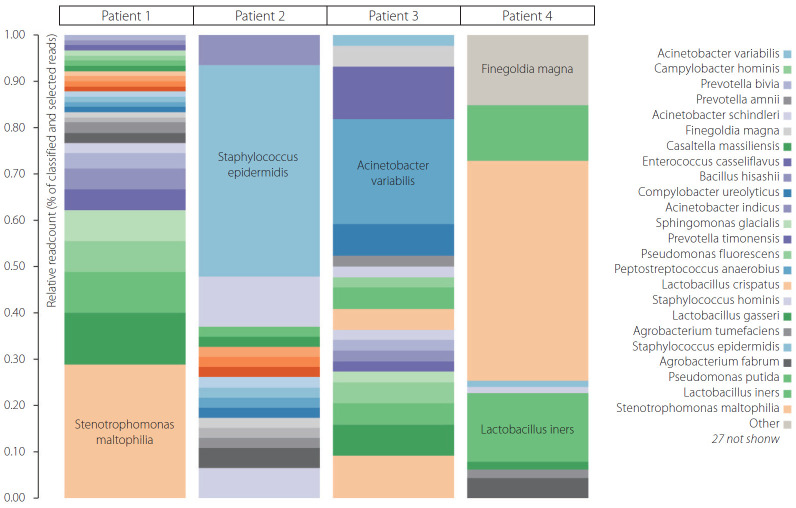
Of the 4 patients undergoing thrombectomy for diagnosis with ischemic stroke, all thrombi recovered for bacterial DNA in qPCR were positive. More than 27 bacteria were present in the 4 thrombus samples. The majority of bacteria were Lactobacillus, Stenotrophomonas, Pseudomonas, Staphylococcus, and Finegoldia.
Genesis of symptomatic atherosclerotic carotid plaque leading to thromboembolism could be either due to direct mechanisms like acidification and local inflammation of plaque milieu with lactobacillus, biofilm dispersion leading to inflammation like with pseudomonas fluorescence, or enterococci or indirect mechanisms like Toll 2 like signaling by gut microbiota.
本研究旨在评估急性缺血性卒中6小时内,因症状性颈动脉斑块导致的大脑中动脉血栓中微生物群。对血栓进行下一代测序以寻找细菌特征,从而确定它们在动脉粥样硬化中的作用。
我们纳入了4例人类大脑中动脉血栓样本(所有患者均为男性)。患者的中位年龄为51±13.6岁。从太平洋医科大学及医院招募的患者在卒中窗口期接受了机械取栓术。所有患者均接受了脑磁共振血管造影(MRA)、Willis环和颈部血管MRA以及标准的卒中检查,以确定卒中病因。本研究仅纳入有症状性颈动脉狭窄及同侧大脑中动脉闭塞串联病变的患者。收集血栓样本,保存在-80度,并进行宏基因组分析。
在4例因缺血性卒中接受取栓术的患者中,qPCR检测回收细菌DNA的所有血栓均为阳性。4个血栓样本中存在超过27种细菌。大多数细菌为乳酸杆菌、嗜麦芽窄食单胞菌、假单胞菌、葡萄球菌和菲氏菌属。
导致血栓栓塞的症状性动脉粥样硬化性颈动脉斑块的形成,可能是由于直接机制,如乳酸杆菌导致斑块环境酸化和局部炎症、铜绿假单胞菌生物膜分散导致炎症,或肠球菌;也可能是间接机制,如肠道微生物群的Toll样2信号传导。