Papadopoulos Panagiotis D, Tsigalou Christina, Valsamaki Pipitsa N, Konstantinidis Theocharis G, Voidarou Chrysoula, Bezirtzoglou Eugenia
Master Programme Food, Nutrition and Microbiome, Department of Medicine, Democritus University of Thrace, 68100 Alexandroupolis, Greece.
Laboratory of Microbiology, Department of Medicine, Democritus University of Thrace, 68100 Alexandroupolis, Greece.
Biomedicines. 2022 Apr 20;10(5):948. doi: 10.3390/biomedicines10050948.
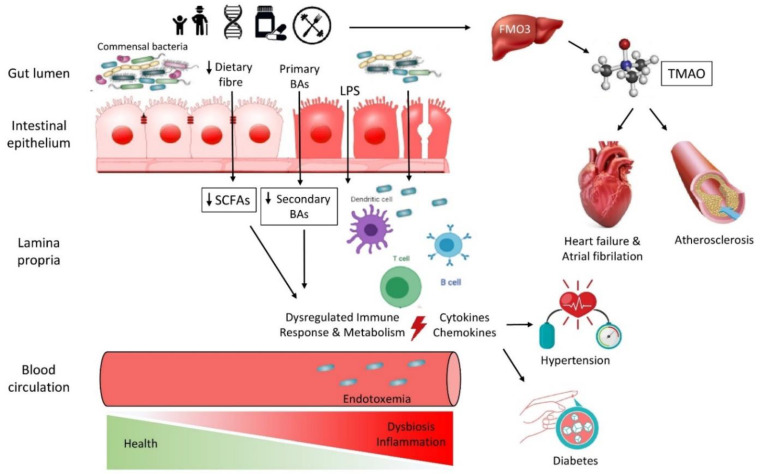
The collection of normally non-pathogenic microorganisms that mainly inhabit our gut lumen shapes our health in many ways. Structural and functional perturbations in the gut microbial pool, known as "dysbiosis", have been proven to play a vital role in the pathophysiology of several diseases, including cardiovascular disease (CVD). Although therapeutic regimes are available to treat this group of diseases, they have long been the main cause of mortality and morbidity worldwide. While age, sex, genetics, diet, tobacco use, and alcohol consumption are major contributors (World Health Organization, 2018), they cannot explain all of the consequences of CVD. In addition to the abovementioned traditional risk factors, the constant search for novel preventative and curative tools has shed light on the involvement of gut bacteria and their metabolites in the pathogenesis of CVD. In this narrative review, we will discuss the established interconnections between the gut microbiota and CVD, as well as the plausible therapeutic perspectives.
主要栖息于我们肠道腔的正常非致病微生物群落以多种方式塑造我们的健康。肠道微生物库中的结构和功能紊乱,即“生态失调”,已被证明在包括心血管疾病(CVD)在内的几种疾病的病理生理学中起着至关重要的作用。尽管有治疗方案可用于治疗这类疾病,但它们长期以来一直是全球死亡率和发病率的主要原因。虽然年龄、性别、遗传、饮食、吸烟和饮酒是主要因素(世界卫生组织,2018年),但它们并不能解释CVD的所有后果。除了上述传统风险因素外,对新型预防和治疗工具的不断探索揭示了肠道细菌及其代谢产物在CVD发病机制中的作用。在这篇叙述性综述中,我们将讨论肠道微生物群与CVD之间已确立的相互联系以及合理的治疗前景。