Department of Joint Surgery, Linyi People's Hospital, Linyi, 276000, People's Republic of China.
Department of Orthopaedics of Integrated traditional and Western Medicine, Linyi People's Hospital, Linyi, 276000, People's Republic of China.
Arthritis Res Ther. 2021 Feb 2;23(1):50. doi: 10.1186/s13075-020-02382-x.
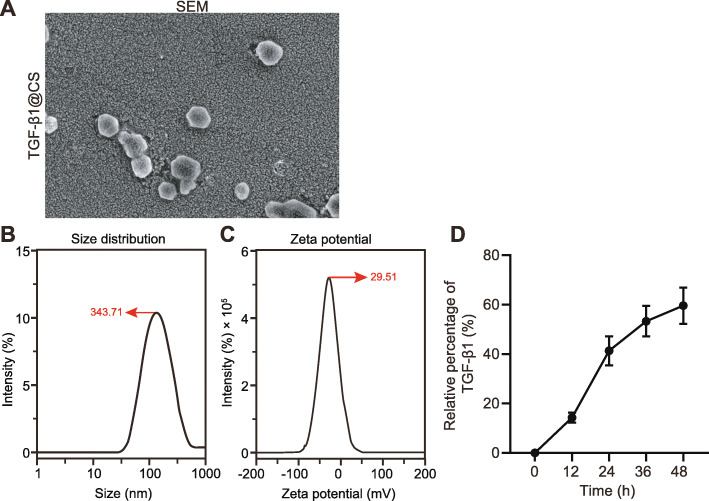
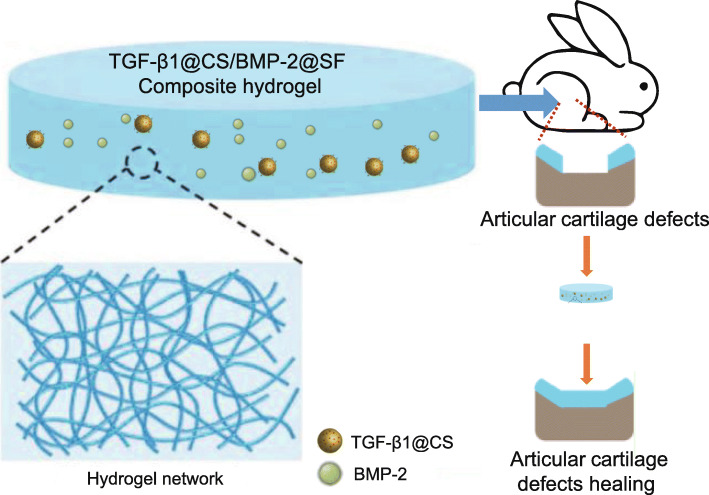
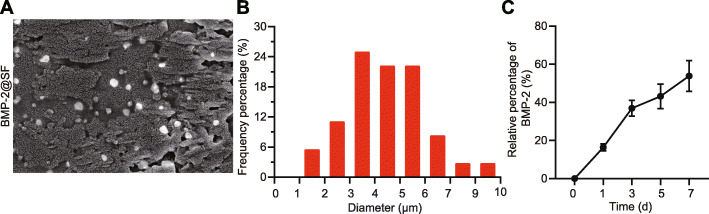
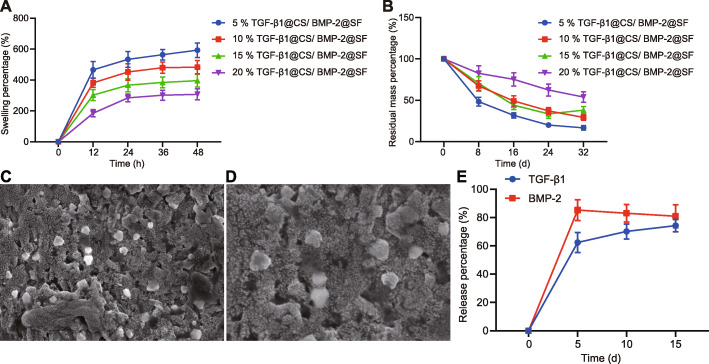
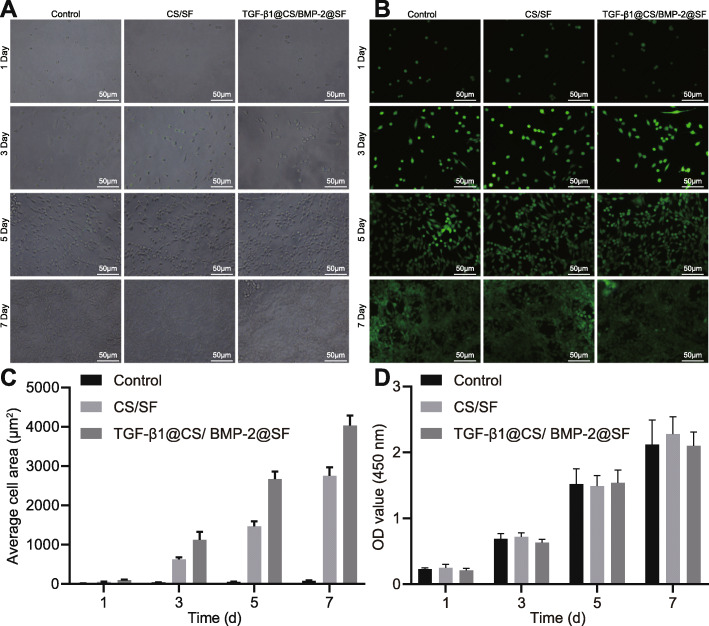
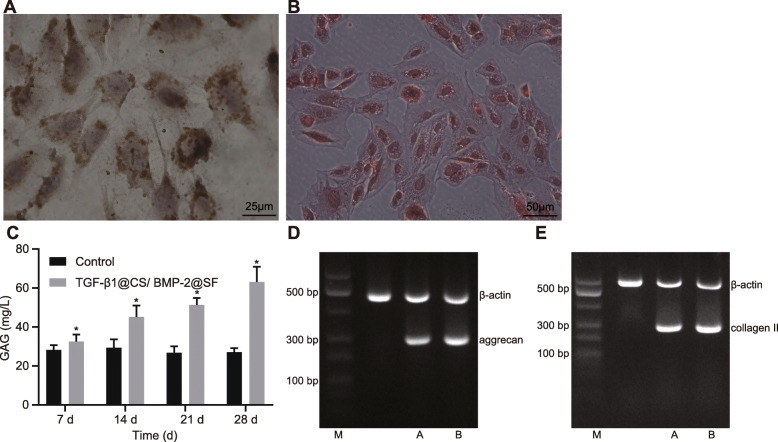
Cartilage defects frequently occur around the knee joint yet cartilage has limited self-repair abilities. Hydrogel scaffolds have excellent potential for use in tissue engineering. Therefore, the aim of the present study was to assess the ability of silk fibroin (SF) hydrogel scaffolds incorporated with chitosan (CS) nanoparticles (NPs) to repair knee joint cartilage defects. In the present study, composite systems of CS NPs incorporated with transforming growth factor-β1 (TGF-β1; TGF-β1@CS) and SF incorporated with bone morphogenetic protein-2 (BMP-2; TGF-β1@CS/BMP-2@SF) were developed and characterized with respect to their size distribution, zeta potential, morphology, and release of TGF-β1 and BMP-2. Bone marrow stromal cells (BMSCs) were co-cultured with TGF-β1@CS/BMP-2@SF extracts to assess chondrogenesis in vitro using a cell counting kit-8 assay, which was followed by in vivo evaluations in a rabbit model of knee joint cartilage defects. The constructed TGF-β1@CS/BMP-2@SF composite system was successfully characterized and showed favorable biocompatibility. In the presence of TGF-β1@CS/BMP-2@SF extracts, BMSCs exhibited normal cell morphology and enhanced chondrogenic ability both in vitro and in vivo, as evidenced by the promotion of cell viability and the alleviation of cartilage defects. Thus, the TGF-β1@CS/BMP-2@SF hydrogel developed in the present study promoted chondrogenic ability of BMSCs both in vivo and in vitro by releasing TGF-β1 and BMP-2, thereby offering a novel therapeutic strategy for repairing articular cartilage defects in knee joints.
软骨缺陷经常发生在膝关节周围,但软骨自我修复能力有限。水凝胶支架在组织工程中有很好的应用潜力。因此,本研究旨在评估丝素蛋白(SF)水凝胶支架与壳聚糖(CS)纳米颗粒(NPs)复合体系修复膝关节软骨缺损的能力。在本研究中,制备了壳聚糖纳米颗粒(CS NPs)与转化生长因子-β1(TGF-β1;TGF-β1@CS)复合的系统和丝素蛋白(SF)与骨形态发生蛋白-2(BMP-2;TGF-β1@CS/BMP-2@SF)复合的系统,并对其粒径分布、Zeta 电位、形态和 TGF-β1和 BMP-2的释放进行了表征。将骨髓基质细胞(BMSCs)与 TGF-β1@CS/BMP-2@SF 提取物共培养,通过细胞计数试剂盒-8 测定法评估体外软骨生成情况,然后在兔膝关节软骨缺损模型中进行体内评估。成功构建了 TGF-β1@CS/BMP-2@SF 复合系统,并表现出良好的生物相容性。在 TGF-β1@CS/BMP-2@SF 提取物存在的情况下,BMSCs 表现出正常的细胞形态,并在体外和体内均增强了软骨生成能力,这表现在促进细胞活力和减轻软骨缺损方面。因此,本研究中开发的 TGF-β1@CS/BMP-2@SF 水凝胶通过释放 TGF-β1 和 BMP-2,促进了 BMSCs 的软骨生成能力,为修复膝关节关节软骨缺损提供了一种新的治疗策略。