Department of Radiation Oncology, School of Medicine, Kyungpook National University Hospital, 130 Dongduk-Ro, Jung-Gu, Daegu, 41944, Republic of Korea.
Cardiovascular Research Institute, School of Medicine, Kyungpook National University, Daegu, Republic of Korea.
Cancer Imaging. 2021 Feb 2;21(1):19. doi: 10.1186/s40644-021-00388-5.
Radiomics is a promising field in oncology imaging. However, the implementation of radiomics clinically has been limited because its robustness remains unclear. Previous CT and PET studies suggested that radiomic features were sensitive to variations in pixel size and slice thickness of the images. The purpose of this study was to assess robustness of magnetic resonance (MR) radiomic features to pixel size resampling and interpolation in patients with cervical cancer.
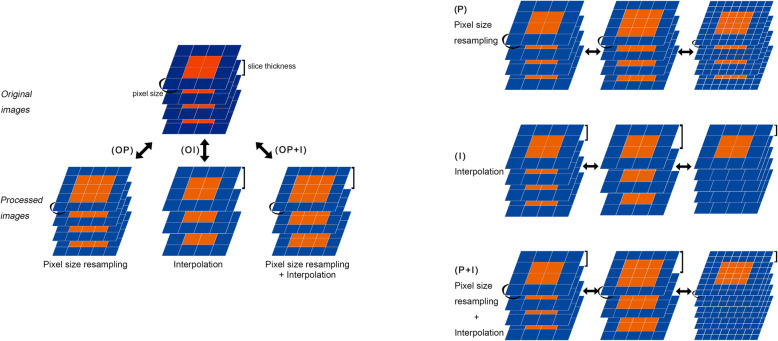
This retrospective study included 254 patients with a pathological diagnosis of cervical cancer stages IB to IVA who received definitive chemoradiation at our institution between January 2006 and June 2020. Pretreatment MR scans were analyzed. Each region of cervical cancer was segmented on the axial gadolinium-enhanced T1- and T2-weighted images; 107 radiomic features were extracted. MR scans were interpolated and resampled using various slice thicknesses and pixel spaces. Intraclass correlation coefficients (ICCs) were calculated between the original images and images that underwent pixel size resampling (OP), interpolation (OI), or pixel size resampling and interpolation (OP+I) as well as among processed image sets with various pixel spaces (P), various slice thicknesses (I), and both (P + I).
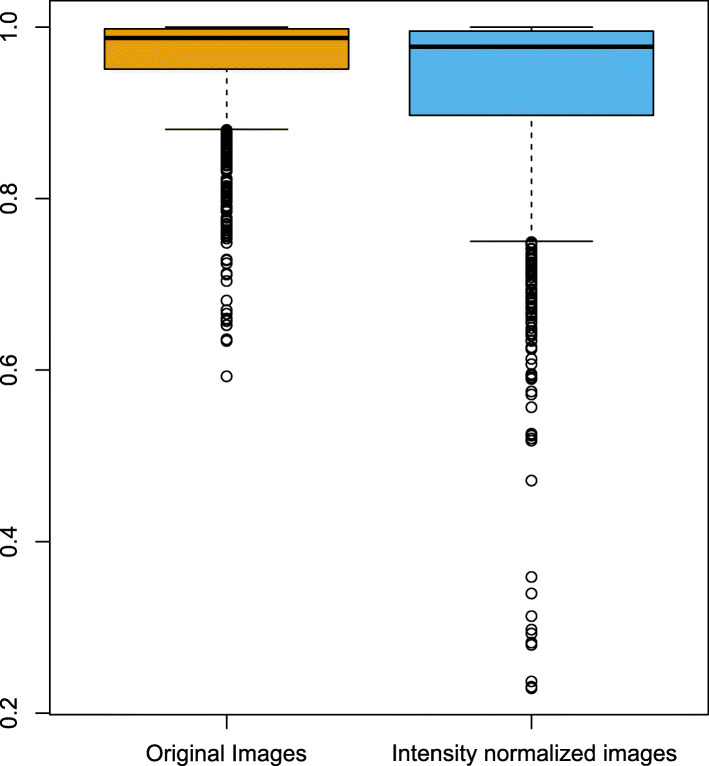
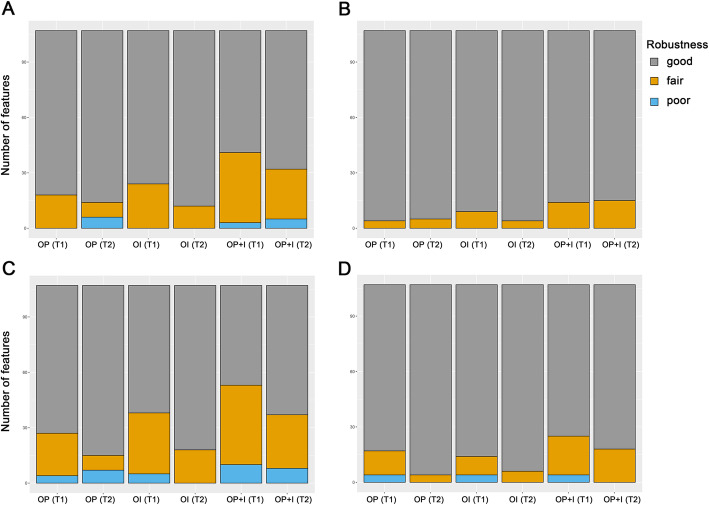
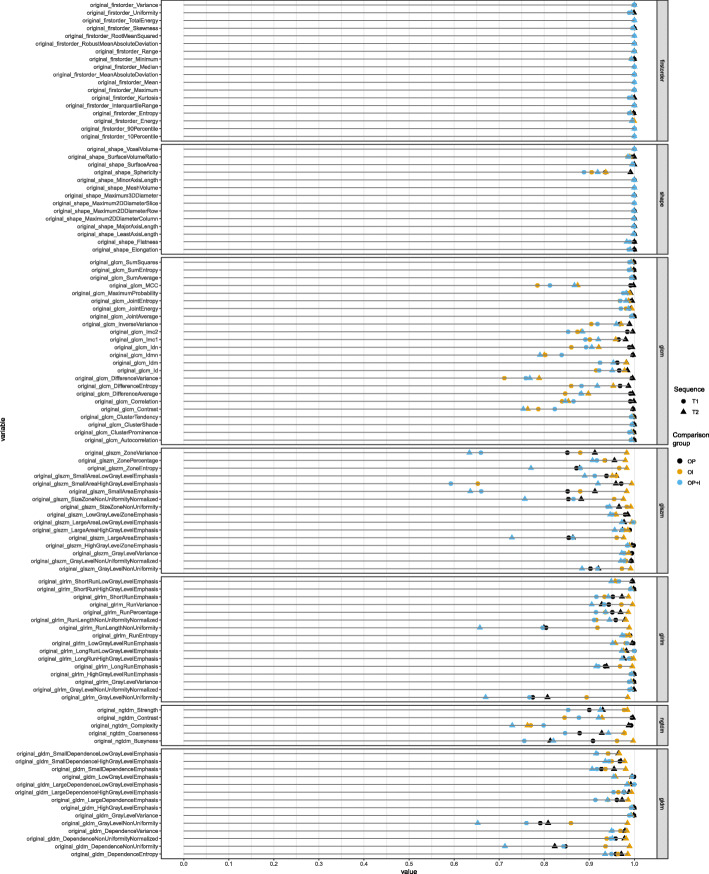
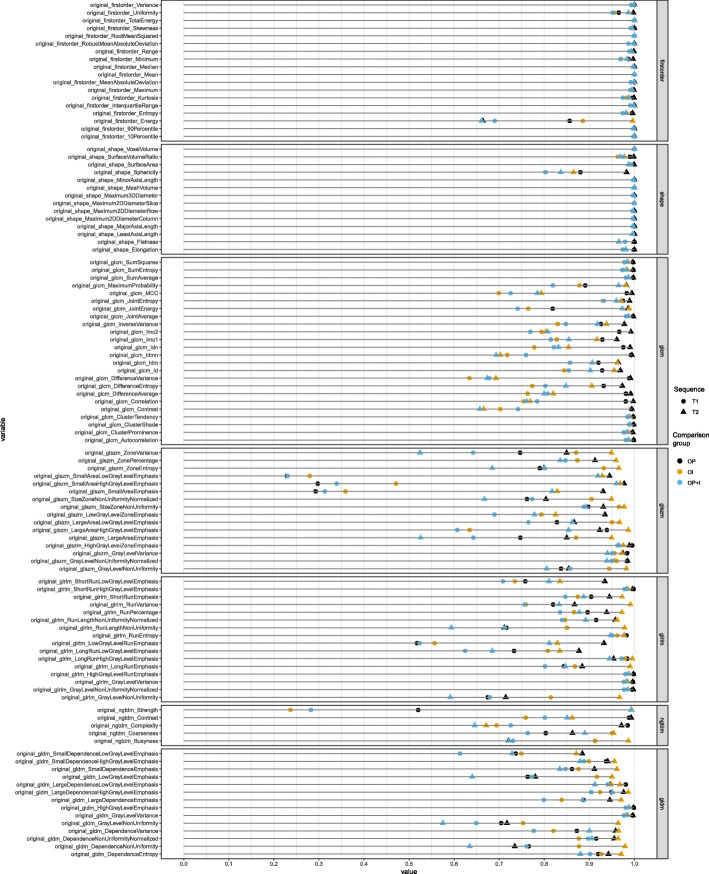
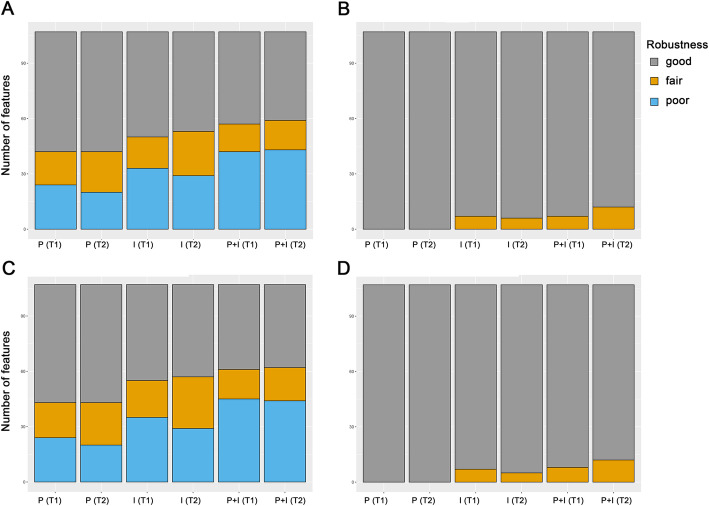
After feature standardization, ≥86.0% of features showed good robustness when compared between the original and processed images (OP, OI, and OP+I) and ≥ 88.8% of features showed good robustness when processed images were compared (P, I, and P + I). Although most first-order, shape, and texture features showed good robustness, GLSZM small-area emphasis-related features and NGTDM strength were sensitive to variations in pixel size and slice thickness.
Most MR radiomic features in patients with cervical cancer were robust after pixel size resampling and interpolation following the feature standardization process. The understanding regarding the robustness of individual features after pixel size resampling and interpolation could help future radiomics research.
放射组学是肿瘤影像学中一个很有前途的领域。然而,由于其稳健性尚不清楚,放射组学在临床上的应用一直受到限制。之前的 CT 和 PET 研究表明,放射组学特征对图像的像素大小和切片厚度变化敏感。本研究旨在评估宫颈癌患者磁共振(MR)放射组学特征对像素大小重采样和插值的稳健性。
这是一项回顾性研究,纳入了 2006 年 1 月至 2020 年 6 月在我院接受根治性放化疗的宫颈癌病理分期为 IB 至 IVA 的 254 例患者。对预处理的 MR 扫描进行了分析。在轴向钆增强 T1 加权和 T2 加权图像上对宫颈癌每个区域进行分割;提取了 107 个放射组学特征。使用不同的切片厚度和像素间距对 MR 扫描进行插值和重采样。计算了原始图像与像素大小重采样(OP)、插值(OI)或像素大小重采样和插值(OP+I)图像之间的以及不同像素间距(P)、不同切片厚度(I)和两者(P+I)处理的图像组之间的组内相关系数(ICC)。
经过特征标准化后,≥86.0%的特征在原始图像与处理图像(OP、OI 和 OP+I)之间的比较中具有良好的稳健性,≥88.8%的特征在处理图像之间的比较中具有良好的稳健性(P、I 和 P+I)。虽然大多数一阶、形状和纹理特征具有良好的稳健性,但 GLSZM 小面积强调相关特征和 NGTDM 强度对像素大小和切片厚度的变化敏感。
在经过特征标准化的像素大小重采样和插值后,宫颈癌患者的大多数 MR 放射组学特征都具有稳健性。了解像素大小重采样和插值后单个特征的稳健性有助于未来的放射组学研究。