Yu Anthony C, Lian Huada, Kong Xian, Lopez Hernandez Hector, Qin Jian, Appel Eric A
Department of Materials Science & Engineering, Stanford University, Stanford, CA, USA.
Department of Chemical Engineering, Stanford University, Stanford, CA, USA.
Nat Commun. 2021 Feb 2;12(1):746. doi: 10.1038/s41467-021-21024-7.
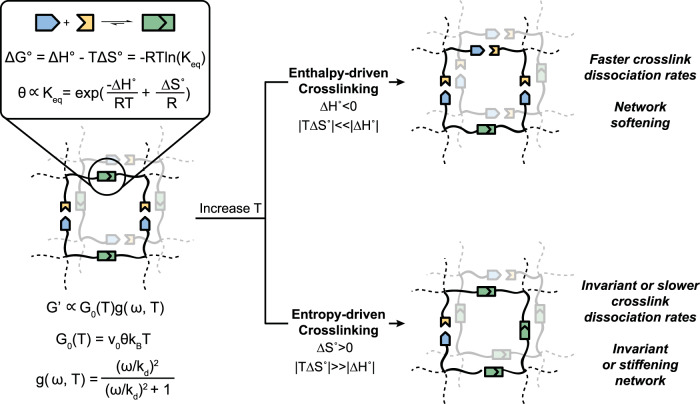
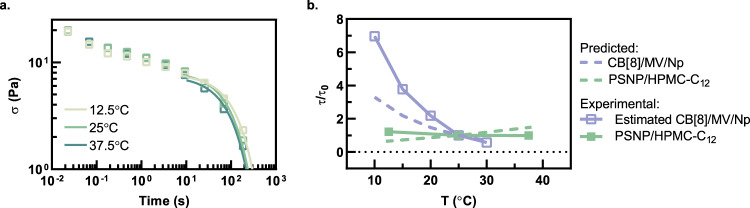
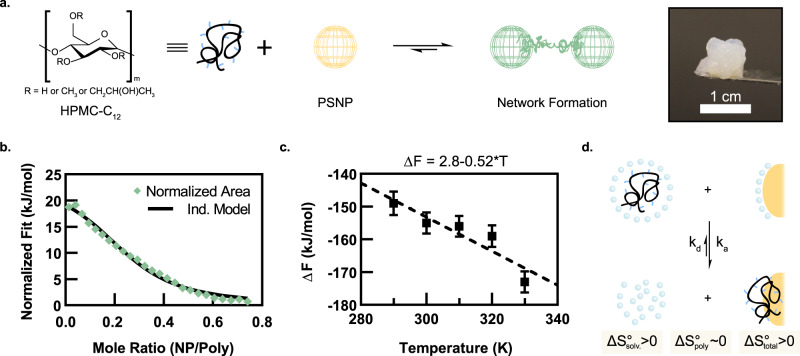
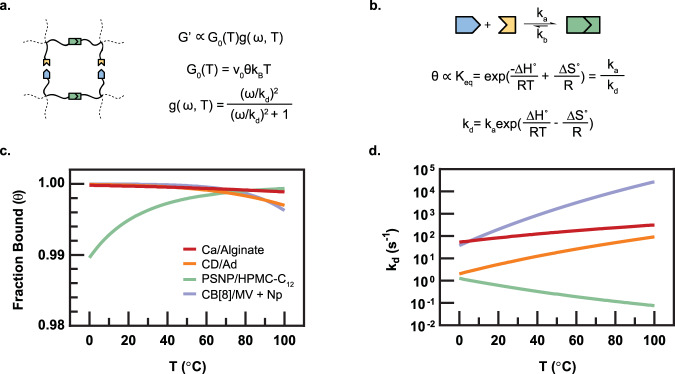
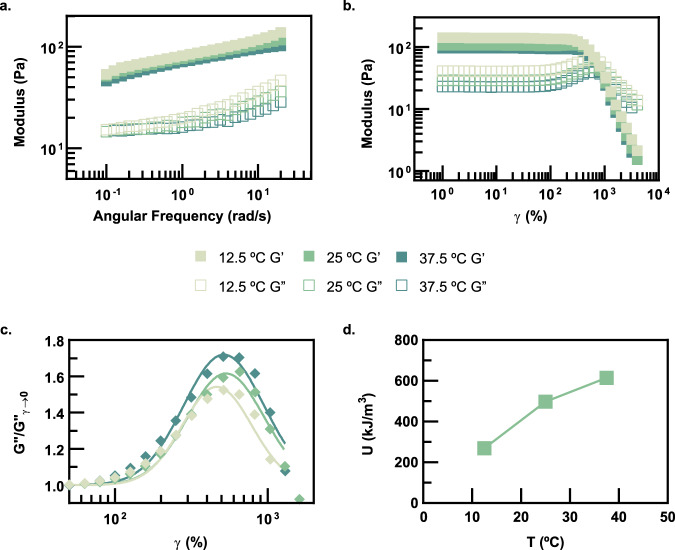
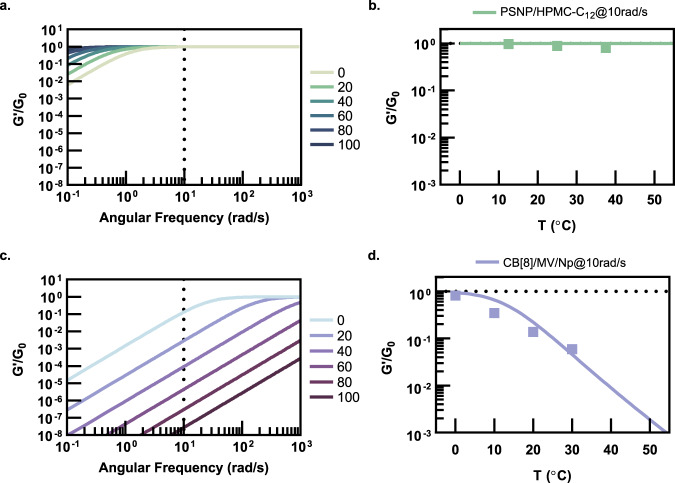
Physical networks typically employ enthalpy-dominated crosslinking interactions that become more dynamic at elevated temperatures, leading to network softening. Moreover, standard mathematical frameworks such as time-temperature superposition assume network softening and faster dynamics at elevated temperatures. Yet, deriving a mathematical framework connecting the crosslinking thermodynamics to the temperature-dependent viscoelasticity of physical networks suggests the possibility for entropy-driven crosslinking interactions to provide alternative temperature dependencies. This framework illustrates that temperature negligibly affects crosslink density in reported systems, but drastically influences crosslink dynamics. While the dissociation rate of enthalpy-driven crosslinks is accelerated at elevated temperatures, the dissociation rate of entropy-driven crosslinks is negligibly affected or even slowed under these conditions. Here we report an entropy-driven physical network based on polymer-nanoparticle interactions that exhibits mechanical properties that are invariant with temperature. These studies provide a foundation for designing and characterizing entropy-driven physical crosslinking motifs and demonstrate how these physical networks access thermal properties that are not observed in current physical networks.
物理网络通常采用以焓为主导的交联相互作用,这种相互作用在高温下会变得更加动态,从而导致网络软化。此外,诸如时间-温度叠加等标准数学框架假定在高温下网络会软化且动力学更快。然而,推导一个将交联热力学与物理网络的温度依赖性粘弹性联系起来的数学框架表明,熵驱动的交联相互作用有可能提供不同的温度依赖性。该框架表明,在已报道的体系中温度对交联密度的影响可忽略不计,但对交联动力学有显著影响。虽然焓驱动的交联在高温下的解离速率会加快,但在这些条件下,熵驱动的交联的解离速率受影响可忽略不计甚至会减慢。在此,我们报道了一种基于聚合物-纳米粒子相互作用的熵驱动物理网络,其展现出与温度无关的机械性能。这些研究为设计和表征熵驱动的物理交联基序提供了基础,并展示了这些物理网络如何获得当前物理网络中未观察到的热性能。