Department of Soil & Environmental Sciences, College of Agriculture and Natural Resources, National Chung Hsing University, Taichung, 40227, Taiwan, ROC.
Innovation and Development Center of Sustainable Agriculture (IDCSA), National Chung Hsing University, Taichung, 40227, Taiwan, ROC.
Sci Rep. 2021 Feb 2;11(1):2788. doi: 10.1038/s41598-021-82442-7.
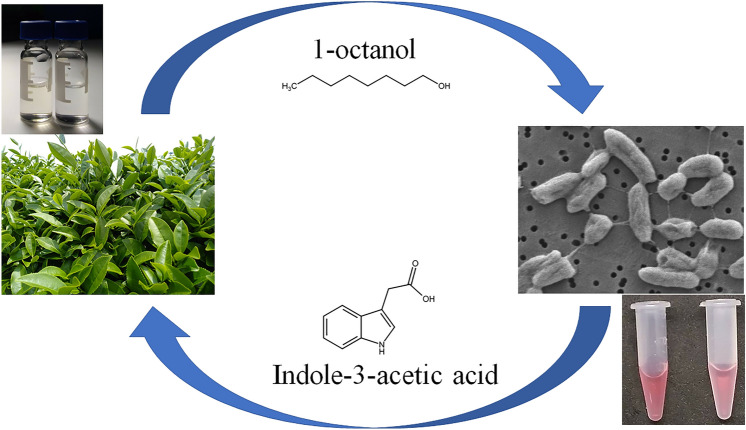
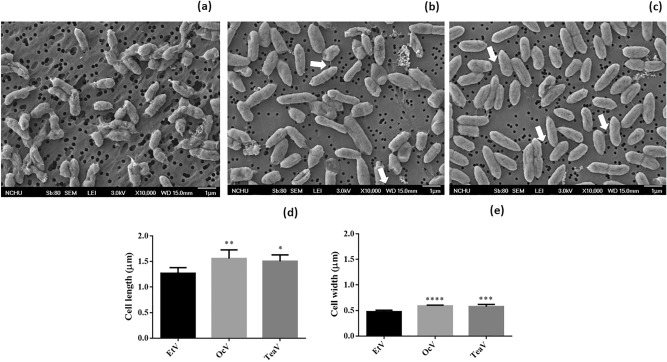
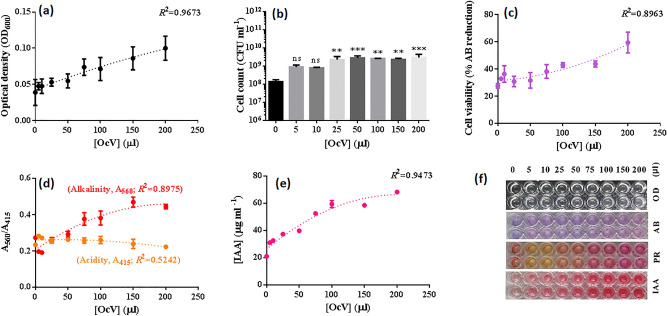
Tea leaves possess numerous volatile organic compounds (VOC) that contribute to tea's characteristic aroma. Some components of tea VOC were known to exhibit antimicrobial activity; however, their impact on bacteria remains elusive. Here, we showed that the VOC of fresh aqueous tea leaf extract, recovered through hydrodistillation, promoted cell division and tryptophan-dependent indole-3-acetic acid (IAA) production in Pseudomonas sp. NEEL19, a solvent-tolerant isolate of the tea phylloplane. 1-octanol was identified as one of the responsible volatiles stimulating cell division, metabolic change, swimming motility, putative pili/nanowire formation and IAA production, through gas chromatography-mass spectrometry, microscopy and partition petri dish culture analyses. The bacterial metabolic responses including IAA production increased under 1-octanol vapor in a dose-dependent manner, whereas direct-contact in liquid culture failed to elicit such response. Thus, volatile 1-octanol emitting from tea leaves is a potential modulator of cell division, colonization and phytohormone production in NEEL19, possibly influencing the tea aroma.
茶叶含有多种挥发性有机化合物(VOC),这些化合物赋予了茶叶独特的香气。一些茶叶 VOC 的成分具有抗菌活性,但它们对细菌的影响仍不清楚。在这里,我们发现通过水蒸馏回收的新鲜水茶叶提取物中的 VOC 促进了耐溶剂的茶叶生境分离株 Pseudomonas sp. NEEL19 的细胞分裂和色氨酸依赖的吲哚-3-乙酸(IAA)的产生。通过气相色谱-质谱、显微镜和分区培养皿分析,鉴定出 1-辛醇是刺激细胞分裂、代谢变化、游动性、推测的菌毛/纳米线形成和 IAA 产生的挥发性物质之一。细菌的代谢反应包括 IAA 的产生,随着 1-辛醇蒸气的剂量依赖性增加,而在液体培养中的直接接触则不能引起这种反应。因此,从茶叶中释放的挥发性 1-辛醇可能是 NEEL19 细胞分裂、定殖和植物激素产生的潜在调节剂,可能会影响茶叶的香气。