Li Shu, Cao Zhi, Yang Hongxi, Zhang Yuan, Xu Fusheng, Wang Yaogang
1School of Public Health, Tianjin Medical University, Tianjin, China.
2School of Public Health, Yale University, New Haven, CT, USA.
Aging Dis. 2021 Feb 1;12(1):61-71. doi: 10.14336/AD.2020.1108. eCollection 2021 Feb.
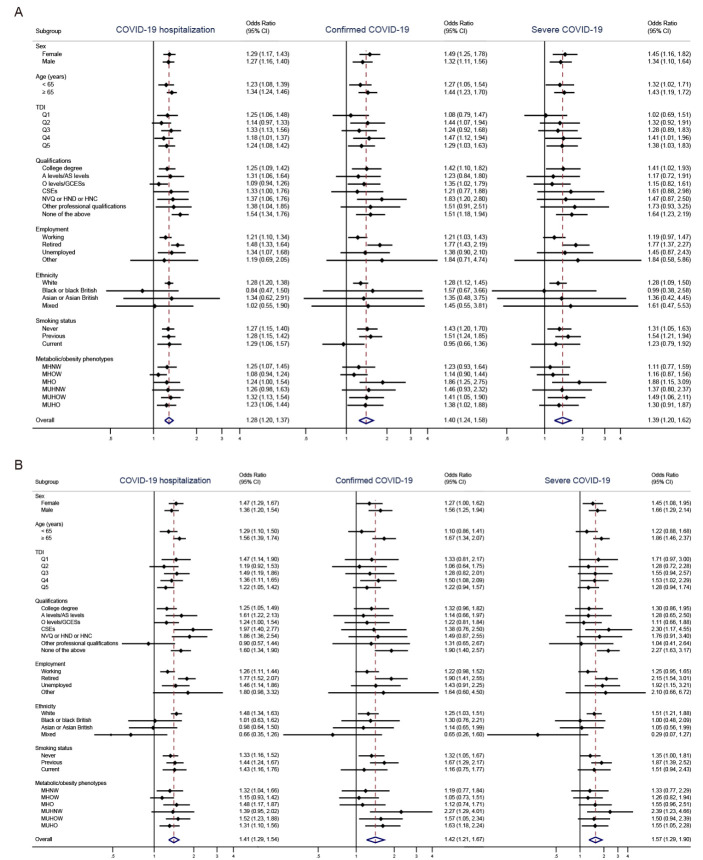
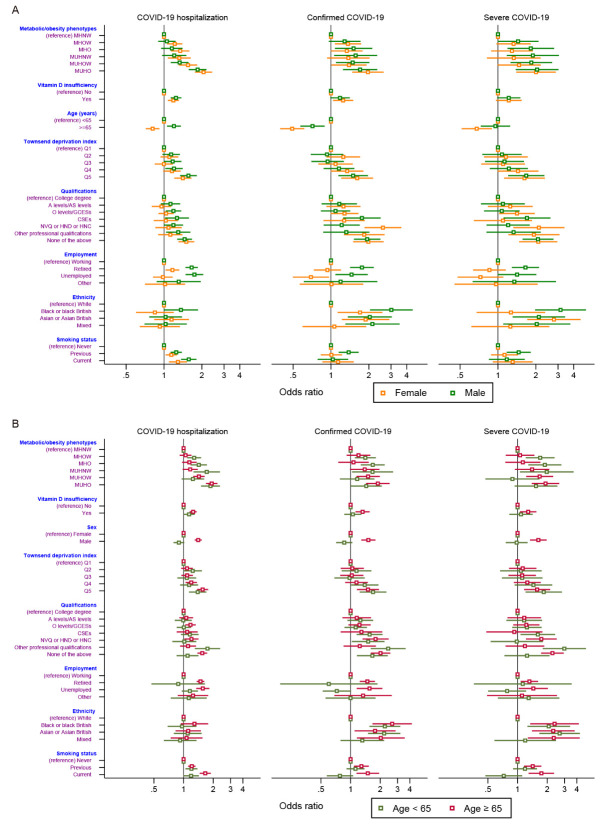
Aging and obesity-related conditions seem to worsen the effect of Coronavirus Disease 2019 (COVID-19). This study assessed the possible roles of metabolic/obesity phenotypes and vitamin D status in increasing the greater severity of COVID-19. We studied 353,299 UK Biobank participants from England with a mean age of 67.7 years. Metabolic/obesity phenotypes were defined as a combination of metabolic components (hypertension, high cholesterol, and diabetes) and obesity. Multivariate logistic regression analysis was performed to test whether the addition of metabolic disorders and vitamin D insufficiency increased obesity associations with COVID-19 hospitalization, confirmed COVID-19, and severe COVID-19. Metabolically unhealthy obesity (MUHO) represented 12.3% of the total analytic samples, and 21.5%, 18.5%, and 19.8% of the included subpopulations with COVID-19 hospitalization, confirmed COVID-19, and severe COVID-19, respectively. Vitamin D insufficiency phenotypes represented 53.5% of the total analytic samples, and 59.5%, 61.7%, and 61.5% of the included subpopulations with COVID-19 hospitalization, confirmed COVID-19, and severe COVID-19, respectively. In multivariate logistic regression, MUHO and vitamin D insufficiency and their combination were significantly associated with COVID-19 illness severity (odds ratio [OR] for COVID-19 hospitalization = 2.33, 95% confidence interval [CI], 2.02-2.70; OR for confirmed COVID-19 = 2.06, 95% CI, 1.58-2.70; OR for severe COVID-19 = 2.06, 95% CI, 1.47-2.87). Elderly men were prone to have a higher risk of COVID-19 than women. Our findings showed that MUHO and vitamin D insufficiency are associated with a significantly increased risk of COVID-19 severity, especially for adults 65 years and older. Susceptible individuals should be aware of their conditions and avoid contact with new coronavirus.
衰老和肥胖相关病症似乎会加剧2019冠状病毒病(COVID-19)的影响。本研究评估了代谢/肥胖表型和维生素D状态在增加COVID-19严重程度方面可能发挥的作用。我们研究了来自英国生物银行的353299名英格兰参与者,他们的平均年龄为67.7岁。代谢/肥胖表型被定义为代谢成分(高血压、高胆固醇和糖尿病)与肥胖的组合。进行多变量逻辑回归分析,以检验代谢紊乱和维生素D不足是否会增加肥胖与COVID-19住院、确诊COVID-19以及重症COVID-19之间的关联。代谢不健康肥胖(MUHO)占总分析样本的12.3%,在因COVID-19住院、确诊COVID-19以及重症COVID-19的纳入亚组人群中分别占21.5%、18.5%和19.8%。维生素D不足表型占总分析样本的53.5%,在因COVID-19住院、确诊COVID-19以及重症COVID-19的纳入亚组人群中分别占59.5%、61.7%和61.5%。在多变量逻辑回归中,MUHO、维生素D不足及其组合与COVID-19疾病严重程度显著相关(COVID-19住院的比值比[OR]=2.33,95%置信区间[CI],2.02 - 2.70;确诊COVID-19的OR = 2.06,95%CI,1.58 - 2.70;重症COVID-19的OR = 2.06,95%CI,1.47 - 2.87)。老年男性感染COVID-19的风险往往高于女性。我们的研究结果表明,MUHO和维生素D不足与COVID-19严重程度风险显著增加相关,尤其是对于65岁及以上的成年人。易感个体应了解自身状况并避免接触新型冠状病毒。