Forrester Sarah N, Zmora Rachel, Schreiner Pamela J, Jacobs David R, Roger Veronique L, Thorpe Roland J, Kiefe Catarina I
University of Massachusetts Medical School, Department of Population and Quantitative Health Sciences, USA.
University of Minnesota School of Public Health, Division of Epidemiology and Community Health, USA.
SSM Popul Health. 2021 Jan 12;13:100733. doi: 10.1016/j.ssmph.2021.100733. eCollection 2021 Mar.
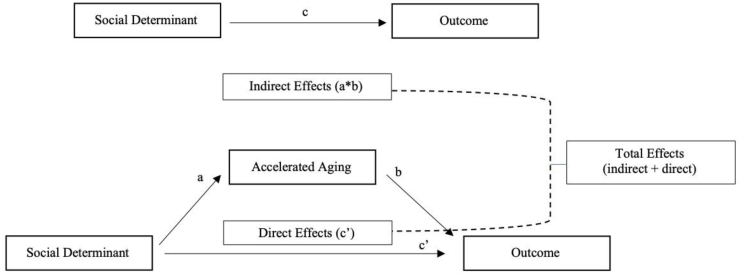
Medicine and public health are shifting away from a purely "personal responsibility" model of cardiovascular disease (CVD) prevention towards a societal view targeting social and environmental conditions and how these result in disease. Given the strong association between social conditions and CVD outcomes, we hypothesize that accelerated aging, measuring earlier health decline associated with chronological aging through a combination of biomarkers, may be a marker for the association between social conditions and CVD.
We used data from the Coronary Artery Risk Development in Young Adults study (CARDIA). Accelerated aging was defined as the difference between biological and chronological age. Biological age was derived as a combination of 7 biomarkers (total cholesterol, HDL, glucose, BMI, CRP, FEV1/h, MAP), representing the physiological effect of "wear and tear" usually associated with chronological aging. We studied accelerated aging measured in 2005-06 as a mediator of the association between social factors measured in 2000-01 and 1) any incident CVD event; 2) stroke; and 3) all-cause mortality occurring from 2007 through 18.
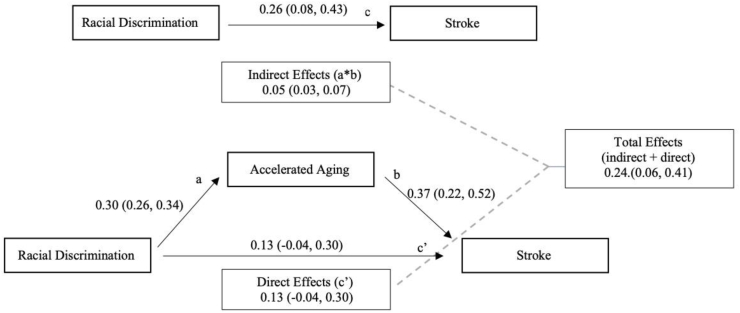
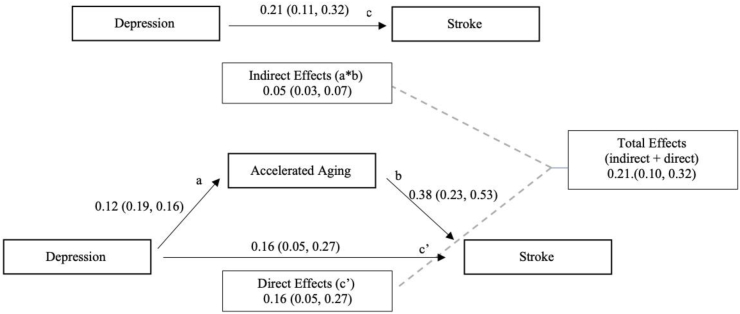
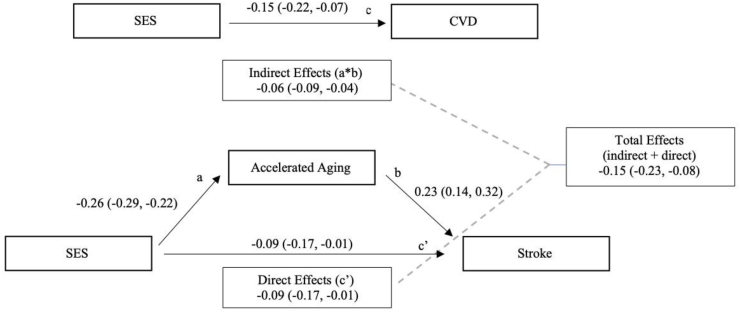
Among 2978 middle-aged participants, mean (SD) accelerated aging was 3.6 (11.6) years, i.e., the CARDIA cohort appeared to be, on average, 3 years older than its chronological age. Accelerated aging partially mediated the association between social factors and CVD (N=219), stroke (N=36), and mortality (N=59). Accelerated aging mediated 41% of the total effects of racial discrimination on stroke after adjustment for covariates. Accelerated aging also mediated other relationships but to lesser degrees.
We provide new evidence that accelerated aging based on easily measurable biomarkers may be a viable marker to partially explain how social factors can lead to cardiovascular outcomes and death.
医学和公共卫生正在从单纯的心血管疾病(CVD)预防“个人责任”模式,转向以社会和环境状况以及这些状况如何导致疾病为目标的社会视角。鉴于社会状况与CVD结果之间存在密切关联,我们推测,加速衰老(通过生物标志物组合来衡量与实际年龄相关的早期健康衰退)可能是社会状况与CVD之间关联的一个标志。
我们使用了青年成人冠状动脉风险发展研究(CARDIA)的数据。加速衰老被定义为生物学年龄与实际年龄之间的差异。生物学年龄是由7种生物标志物(总胆固醇、高密度脂蛋白、血糖、体重指数、C反应蛋白、第一秒用力呼气容积/用力肺活量、平均动脉压)组合得出的,代表了通常与实际年龄相关的“磨损”的生理效应。我们研究了2005 - 06年测量的加速衰老,作为2000 - 01年测量的社会因素与以下三者之间关联的中介变量:1)任何新发CVD事件;2)中风;3)2007年至2018年期间的全因死亡率。
在2978名中年参与者中,平均(标准差)加速衰老为3.6(11.6)岁,即CARDIA队列的参与者平均比其实际年龄大3岁。加速衰老部分介导了社会因素与CVD(N = 219)、中风(N = 36)和死亡率(N = 59)之间的关联。在调整协变量后,加速衰老介导了种族歧视对中风总效应的41%。加速衰老还介导了其他关系,但程度较小。
我们提供了新的证据,表明基于易于测量的生物标志物的加速衰老可能是一个可行的标志,可部分解释社会因素如何导致心血管疾病结局和死亡。