Willigenburg Thomas, de Muinck Keizer Daan M, Peters Max, Claes An, Lagendijk Jan J W, de Boer Hans C J, van der Voort van Zyp Jochem R N
Department of Radiation Oncology, University Medical Center Utrecht, The Netherlands.
Clin Transl Radiat Oncol. 2021 Jan 14;27:50-56. doi: 10.1016/j.ctro.2021.01.002. eCollection 2021 Mar.
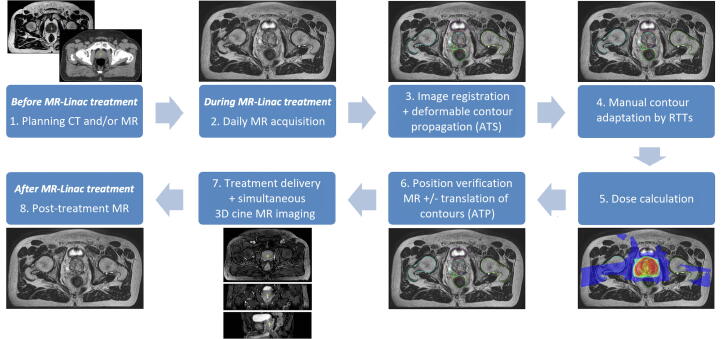
Magnetic resonance (MR)-guided linear accelerator (MR-Linac) systems have changed radiotherapy workflows. The addition of daily online contour adaptation allows for higher precision treatment, but also increases the workload of those involved. We train radiation therapists (RTTs) to perform daily online contour adaptation for MR-Linac treatment of prostate cancer (PCa) patients. The purpose of this study was to evaluate these prostate contours by performing an interfraction and interobserver analysis.
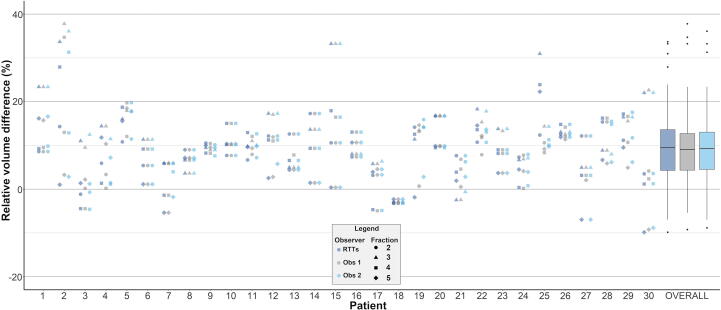
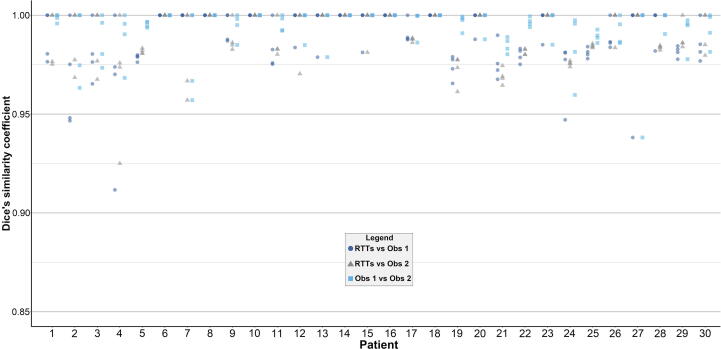
Clinical target volume (CTV) contours generated online by RTTs from 30 low-intermediate risk PCa patients, treated with 5x7.25 Gy, were used. Two physicians (Observers) judged the RTTs contours and performed adaptations when necessary. Interfraction relative volume differences between the first and the subsequent fractions were calculated for the RTTs, Observer 1, and Observer 2. Additionally, interobserver dice's similarity coefficient (DSC) for fraction 2-5 was calculated with the RTTs- and physician-adapted contours. Clinical acceptability of the RTTs contours was judged by a third observer.
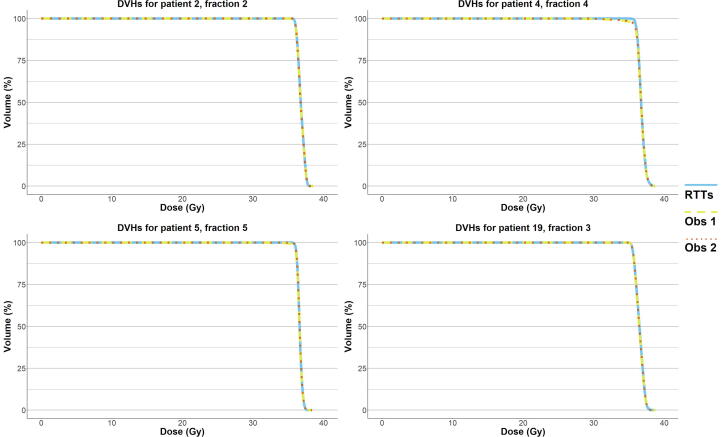
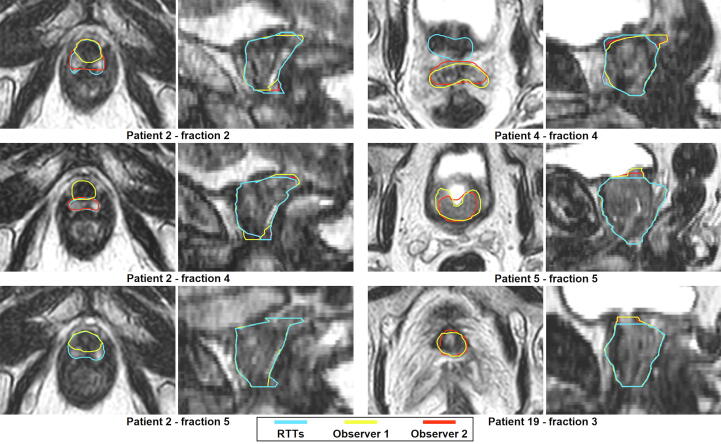
Mean (SD) online contour adaptation time was 12.6 (±3.8) minutes and overall median (interquartile range [IQR]) relative volume difference was 9.3% (4.4-13.0). Adaptations by the observers were mostly performed at the apex and base of the prostate. Median (IQR) interobserver DSC between RTTs and Observer 1, RTTs and Observer 2, and Observer 1 and 2 was 0.99 (0.98-1.00), 1.00 (0.98-1.00), and 1.00 (0.99-1.00), respectively. Contours were acceptable for clinical use in 113 (94.2%) fractions. Dose-volume histogram (DVH) analysis showed significant CTV underdosage for one of the seven identified outliers.
Daily online contour adaptation by RTTs is clinically feasible for MR-Linac treatment of PCa.
磁共振(MR)引导直线加速器(MR-Linac)系统改变了放射治疗流程。每日在线轮廓适配的加入使得治疗精度更高,但也增加了相关人员的工作量。我们培训放射治疗师(RTT)对前列腺癌(PCa)患者进行MR-Linac治疗的每日在线轮廓适配。本研究的目的是通过进行分次间和观察者间分析来评估这些前列腺轮廓。
使用了30例低中危PCa患者的临床靶区(CTV)轮廓,这些轮廓由RTT在线生成,患者接受5×7.25 Gy治疗。两名医生(观察者)评判RTT的轮廓并在必要时进行调整。计算了RTT、观察者1和观察者2在第一次和后续分次之间的分次间相对体积差异。此外,计算了第2至5分次中观察者间的骰子相似系数(DSC),使用的是RTT和医生调整后的轮廓。由第三位观察者评判RTT轮廓的临床可接受性。
平均(标准差)在线轮廓适配时间为12.6(±3.8)分钟,总体中位数(四分位间距[IQR])相对体积差异为9.3%(4.4 - 13.0)。观察者的调整大多在前列腺的尖部和底部进行。RTT与观察者1、RTT与观察者2以及观察者1与观察者2之间的中位数(IQR)观察者间DSC分别为0.99(0.98 - 1.00)、1.00(0.98 - 1.00)和1.00(0.99 - 1.00)。在113次(94.2%)分次中,轮廓在临床上可接受。剂量体积直方图(DVH)分析显示,在七个识别出的异常值中有一个出现了显著的CTV剂量不足。
RTT进行的每日在线轮廓适配对于PCa的MR-Linac治疗在临床上是可行的。