Fernandes Rui
Instituto de Inovação e Investigação na Saúde - i3S, Universidade do Porto, Porto, Portugal.
Porto Biomed J. 2021 Jan 26;6(1):e113. doi: 10.1097/j.pbj.0000000000000113. eCollection 2021 Jan-Feb.
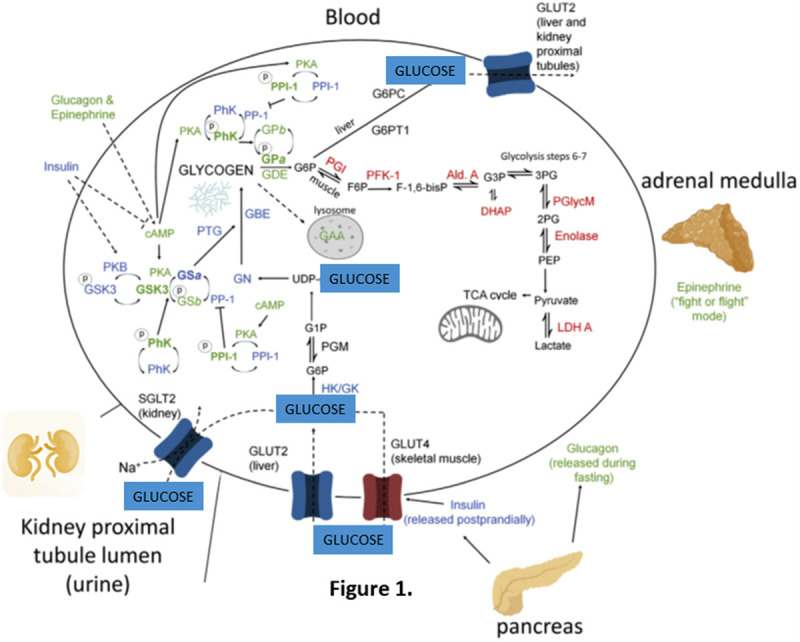
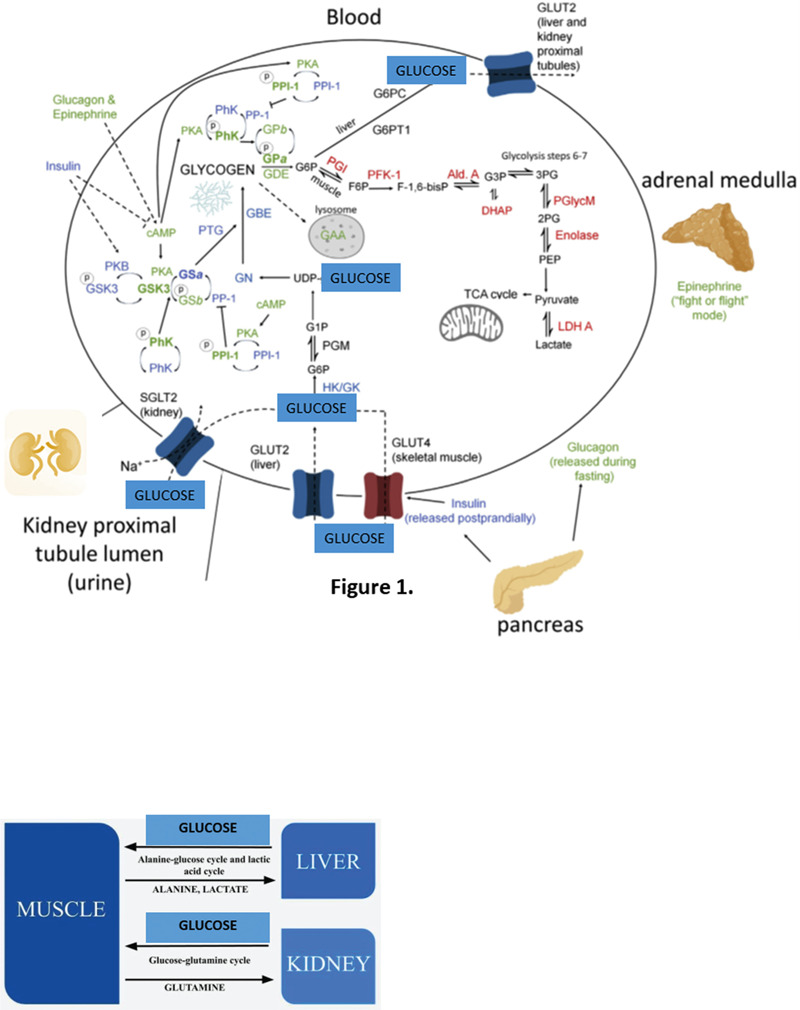
The kidneys play an important role in maintaining glucose homeostasis being the main mechanisms, the gluconeogenesis, renal glucose consumption and glucose reabsorption in the proximal tubules. In this review, we present the main research into the role of glycogen-the stored form of glucose, and how it accumulates in the cells, providing new information on the link between diabetes and diabetic kidney disease. In the last 10 years, research under the scope of renal insulin handling, glucose transport in the proximal tubules, renal gluconeogenesis and renal insulin resistance, made possible to relate the roles of glucose and glycogen in the kidney with other several organs, like the liver. On the one hand, insulin positively regulates kidney uptake and degradation, and there is probably a specific action and resistance to insulin at the renal site. Moreover, insulin regulates the bioavailability of the sodium-glucose co-transporters-SGLT2 inhibitor, and inhibits renal gluconeogenesis. Only the liver and kidneys can supply glucose to the circulation through the process of gluconeogenesis, which involves the synthesis of glucose again from non-glycemic substrates; and the decomposition of stored glycogen. In the mind of nephrologists, diabetologists and scientists, glucose metabolism in the kidney is the focus, with the relevant success of inhibitors in reducing kidney and cardiovascular diseases in individuals with diabetes. However, these new data led to the intriguing paradigm that many of the beneficial effects on the renal and cardiovascular system appear to be independent of the systemic glucose-lowering actions of these agents. The goal of this work puts in context a highly relevant research area for renal glucose metabolism, of glycogen accumulation and metabolism in the diabetic kidney.
肾脏在维持葡萄糖稳态中发挥着重要作用,其主要机制包括糖异生、肾脏葡萄糖消耗以及近端小管中的葡萄糖重吸收。在本综述中,我们介绍了关于糖原(葡萄糖的储存形式)的作用及其在细胞中积累方式的主要研究,为糖尿病与糖尿病肾病之间的联系提供了新信息。在过去十年中,在肾脏胰岛素处理、近端小管中的葡萄糖转运、肾脏糖异生和肾脏胰岛素抵抗等方面的研究,使得将肾脏中葡萄糖和糖原的作用与肝脏等其他多个器官联系起来成为可能。一方面,胰岛素对肾脏摄取和降解具有正向调节作用,并且在肾脏部位可能存在对胰岛素的特定作用和抵抗。此外,胰岛素调节钠-葡萄糖协同转运蛋白2(SGLT2)抑制剂的生物利用度,并抑制肾脏糖异生。只有肝脏和肾脏能够通过糖异生过程(即从非糖底物再次合成葡萄糖)以及储存糖原的分解向循环系统供应葡萄糖。在肾病学家、糖尿病学家和科学家看来,肾脏中的葡萄糖代谢是重点,抑制剂在降低糖尿病患者肾脏和心血管疾病方面取得了相关成功。然而,这些新数据引发了一个有趣的范式,即这些药物对肾脏和心血管系统的许多有益作用似乎独立于其全身性降糖作用。这项工作的目标是将肾脏葡萄糖代谢、糖尿病肾脏中糖原积累和代谢这一高度相关的研究领域置于背景之中。