Goldberg Scott A, Cash Rebecca E, Peters Gregory, Weiner Scott G, Greenough P Gregg, Seethala Raghu
Department of Emergency Medicine Brigham and Women's Hospital Boston Massachusetts USA.
Harvard Medical School Boston Massachusetts USA.
J Am Coll Emerg Physicians Open. 2021 Jan 4;2(1):e12351. doi: 10.1002/emp2.12351. eCollection 2021 Feb.
To evaluate the impact of coronavirus disease 2019 (COVID-19) on emergency medical services (EMS) use for time-sensitive medical conditions. We examined EMS use for cardiac arrest, stroke, and other cardiac emergencies across Massachusetts during the peak of the COVID-19 pandemic, evaluating their relationship to statewide COVID-19 incidence and a statewide emergency declaration.
A retrospective analysis of all EMS calls between February 15 and May 15, 2020 and the same time period for 2019. EMS call volumes were compared before and after March 10, the date of a statewide emergency declaration.
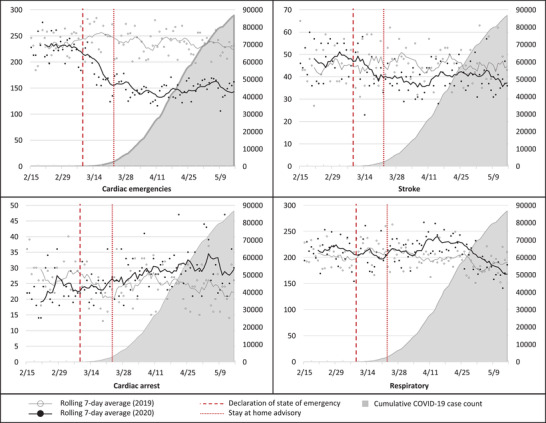
A total of 408,758 calls were analyzed, of which 49,405 (12.1%) represented stroke, cardiac arrest, or other cardiac emergencies. Average call volume before March 10 was similar in both years but decreased significantly after March 10, 2020 by 18.7% ( < 0.001). Compared to 2019, there were 35.6% fewer calls for cardiac emergencies after March 10, 2020 (153.6 vs 238.4 calls/day, < 0.001) and 12.3% fewer calls for stroke (40.0 vs 45.6 calls/day, = 0.04). Calls for cardiac arrest increased 18.2% (28.6 vs 24.2 calls/day, < 0.001). Calls for respiratory concerns also increased (208.8 vs 199.7 calls/day, < 0.001). There was no significant association between statewide incidence of COVID-19 and EMS call volume.
EMS use for certain time-sensitive conditions decreased after a statewide emergency declaration, irrespective of actual COVID-19 incidence, suggesting the decrease was related to perception instead of actual case counts. These findings have implications for public health messaging. Measures must be taken to clearly inform the public that immediate emergency care for time-sensitive conditions remains imperative.
评估2019冠状病毒病(COVID-19)对用于治疗时间敏感型疾病的紧急医疗服务(EMS)使用情况的影响。我们研究了在COVID-19大流行高峰期马萨诸塞州各地对心脏骤停、中风及其他心脏急症的紧急医疗服务使用情况,评估它们与全州COVID-19发病率及全州紧急声明之间的关系。
对2020年2月15日至5月15日以及2019年同一时期的所有紧急医疗服务呼叫进行回顾性分析。比较了3月10日(全州发布紧急声明之日)前后的紧急医疗服务呼叫量。
共分析了408,758次呼叫,其中49,405次(12.1%)为中风、心脏骤停或其他心脏急症。2020年3月10日前两年的平均呼叫量相似,但在2020年3月10日后显著下降了18.7%(P<0.001)。与2019年相比,2020年3月10日后心脏急症呼叫减少了35.6%(每天153.6次对238.4次,P<0.001),中风呼叫减少了12.3%(每天40.0次对45.6次,P=0.04)。心脏骤停呼叫增加了18.2%(每天28.6次对24.2次,P<0.001)。呼吸相关问题的呼叫也有所增加(每天208.8次对199.7次,P<0.001)。全州COVID-19发病率与紧急医疗服务呼叫量之间无显著关联。
在全州发布紧急声明后,用于某些时间敏感型疾病的紧急医疗服务使用量下降,与实际的COVID-19发病率无关,这表明下降与认知有关而非实际病例数。这些发现对公共卫生信息传播有影响。必须采取措施向公众明确告知,对于时间敏感型疾病,立即进行紧急治疗仍然至关重要。