Imrie Fergus, Bradley Anthony R, Deane Charlotte M
Oxford Protein Informatics Group, Department of Statistics, University of Oxford, Oxford OX1 3LB, UK.
Exscientia Ltd, The Schröđinger Building, Oxford Science Park, Oxford OX4 4GE, UK.
Bioinformatics. 2021 Aug 9;37(15):2134-2141. doi: 10.1093/bioinformatics/btab080.
An essential step in the development of virtual screening methods is the use of established sets of actives and decoys for benchmarking and training. However, the decoy molecules in commonly used sets are biased meaning that methods often exploit these biases to separate actives and decoys, and do not necessarily learn to perform molecular recognition. This fundamental issue prevents generalization and hinders virtual screening method development.
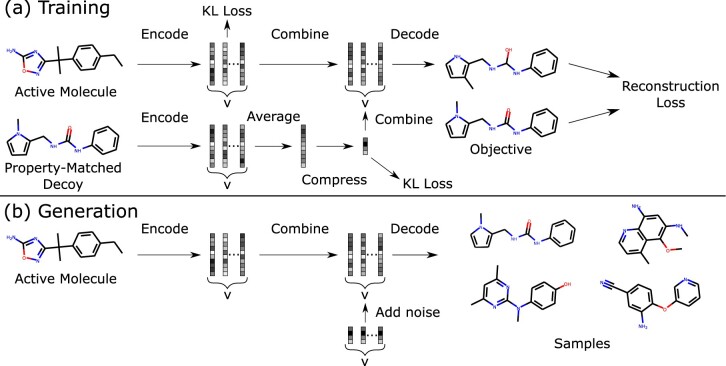
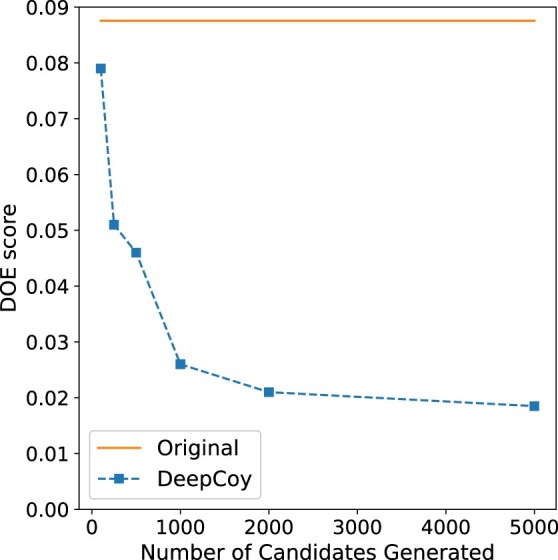
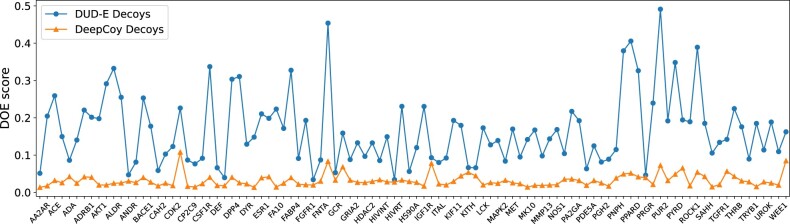
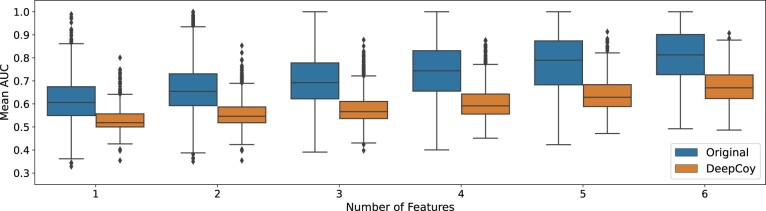
We have developed a deep learning method (DeepCoy) that generates decoys to a user's preferred specification in order to remove such biases or construct sets with a defined bias. We validated DeepCoy using two established benchmarks, DUD-E and DEKOIS 2.0. For all 102 DUD-E targets and 80 of the 81 DEKOIS 2.0 targets, our generated decoy molecules more closely matched the active molecules' physicochemical properties while introducing no discernible additional risk of false negatives. The DeepCoy decoys improved the Deviation from Optimal Embedding (DOE) score by an average of 81% and 66%, respectively, decreasing from 0.166 to 0.032 for DUD-E and from 0.109 to 0.038 for DEKOIS 2.0. Further, the generated decoys are harder to distinguish than the original decoy molecules via docking with Autodock Vina, with virtual screening performance falling from an AUC ROC of 0.70 to 0.63.
The code is available at https://github.com/oxpig/DeepCoy. Generated molecules can be downloaded from http://opig.stats.ox.ac.uk/resources.
Supplementary data are available at Bioinformatics online.
虚拟筛选方法开发中的一个关键步骤是使用已建立的活性化合物和诱饵化合物集进行基准测试和训练。然而,常用集中的诱饵分子存在偏差,这意味着方法常常利用这些偏差来区分活性化合物和诱饵化合物,而不一定学会进行分子识别。这个基本问题阻碍了方法的泛化,也妨碍了虚拟筛选方法的开发。
我们开发了一种深度学习方法(DeepCoy),该方法可以根据用户的偏好生成诱饵化合物,以消除此类偏差或构建具有特定偏差的化合物集。我们使用两个已建立的基准DUD-E和DEKOIS 2.0对DeepCoy进行了验证。对于所有102个DUD-E靶点以及DEKOIS 2.0的81个靶点中的80个,我们生成的诱饵分子与活性分子的物理化学性质更匹配,同时没有引入明显的假阴性额外风险。DeepCoy诱饵分别将最优嵌入偏差(DOE)分数平均提高了81%和66%,DUD-E从0.166降至0.032,DEKOIS 2.0从0.109降至0.038。此外,通过与Autodock Vina对接,生成的诱饵比原始诱饵分子更难区分,虚拟筛选性能的曲线下面积(AUC ROC)从0.70降至0.63。
代码可在https://github.com/oxpig/DeepCoy获取。生成的分子可从http://opig.stats.ox.ac.uk/resources下载。
补充数据可在《生物信息学》在线获取。