Department of Rehabilitation, Physical Therapy Science & Sports, UMC Utrecht Brain Center, University Medical Center Utrecht, Utrecht, The Netherlands.
Department of Psychosocial Research and Epidemiology, Netherlands Cancer Institute, Amsterdam, The Netherlands.
Psychooncology. 2021 May;30(5):635-648. doi: 10.1002/pon.5623. Epub 2021 Feb 2.
Patients with breast cancer face cognitive impairment that affects their quality of life; partially attributable to treatment. Our aim was to detail the prevalence and change of cognitive impairment during the course of treatment. We also investigated the effect of therapy (chemotherapy [CT]) vs. radiotherapy and/or endocrine therapy vs. healthy controls).
This article reviews longitudinal cohort studies published to date in Medline and Embase that (i) assess cognition before and after therapy, (ii) report prevalence cognitive impairment or change, and (iii) use standardized and valid neuropsychological tests. We used the original authors' criteria for cognitive impairment.
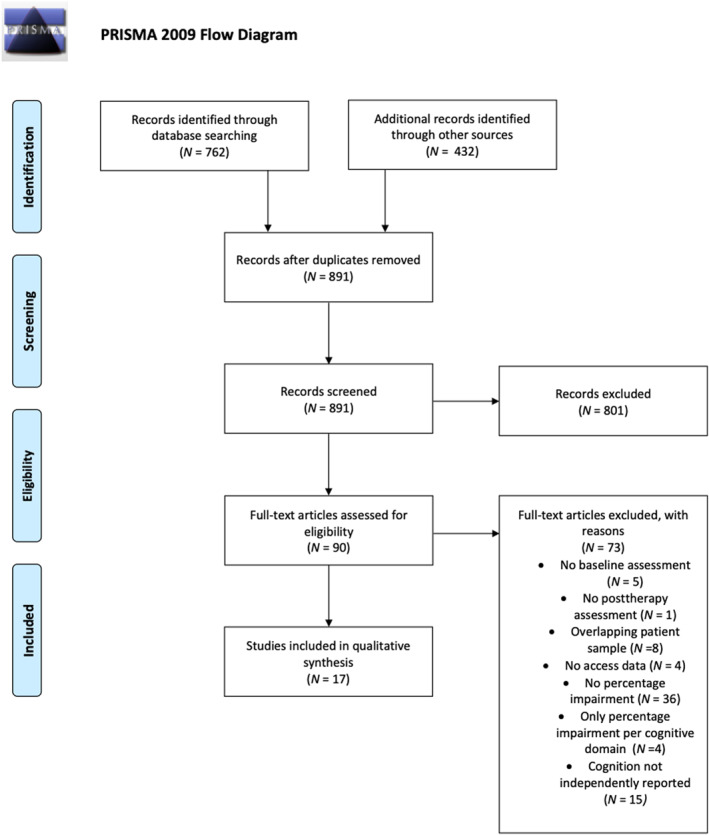
The title and abstract of 891 articles were screened, resulting in the identification of 90 potentially relevant articles while applying the eligibility criteria. After full-text examination, 17 studies were included. Prevalence of cognitive impairment range from 25% before therapy, through 24% after therapy to 21% at maximal 1-year follow-up (FU). Compared to their pretreatment cognitive functioning, 24% of patients decline after treatment and 24% at 1-year FU. Some studies also reported cognitive improvement showing that 15% and 31% of patients improve, respectively. In general, patients undergoing CT have a higher chance of cognitive impairment and decline than no-CT patients and healthy controls.
This study shows that one out of four breast cancer patients shows cognitive impairment prior to treatment administration CT and a significant number of patients decline during the course of disease, suggesting that cognitive impairment is not exclusively related to CT and/or no-CT therapies. This study shows that assessment of cognitive functioning, ideally over time, is crucial and may help the implementation of personalized rehabilitation pathways.
乳腺癌患者面临影响生活质量的认知障碍;部分原因是治疗。我们的目的是详细描述治疗过程中认知障碍的发生率和变化。我们还研究了治疗(化疗[CT])与放疗和/或内分泌治疗与健康对照组的影响。
本文综述了迄今为止在 Medline 和 Embase 上发表的纵向队列研究,这些研究(i)评估治疗前后的认知功能,(ii)报告认知障碍的发生率或变化,以及(iii)使用标准化和有效的神经心理学测试。我们使用原始作者的认知障碍标准。
筛选了 891 篇文章的标题和摘要,应用纳入标准后确定了 90 篇可能相关的文章。经过全文检查,共纳入 17 项研究。认知障碍的发生率范围从治疗前的 25%,到治疗后的 24%,再到 1 年最大随访时的 21%。与治疗前的认知功能相比,24%的患者在治疗后和 1 年随访时下降。一些研究还报告了认知改善,分别显示 15%和 31%的患者有所改善。一般来说,接受 CT 的患者比未接受 CT 的患者和健康对照组更容易出现认知障碍和下降。
本研究表明,四分之一的乳腺癌患者在接受 CT 治疗前存在认知障碍,且在疾病过程中有相当数量的患者出现认知障碍下降,这表明认知障碍不仅仅与 CT 和/或非 CT 治疗有关。本研究表明,评估认知功能,理想情况下是随时间进行,是至关重要的,这可能有助于实施个性化的康复途径。