Center of Infectious Diseases, the Fifth Affiliated Hospital, Sun Yat-Sen University, 52 Meihua East Road, Zhuhai, 519000, Guangdong, China.
Jining Medical University, Jining, 272057, Shandong, China.
Hepatol Int. 2021 Feb;15(1):60-70. doi: 10.1007/s12072-020-10125-y. Epub 2021 Feb 3.
HBV integration is suspected to be an obstinate risk factor for hepatocellular carcinoma (HCC) in the era of antiviral therapy. Integration events start to occur in the immunotolerance phase, but their fates in the immune clearance phase have not yet been clarified. Here, we report the influences of liver damage on HBV integration and clonal hepatocyte expansion in patients with chronic hepatitis B (CHB).
HBV integration breakpoints in liver biopsy samples from 54 CHB patients were detected using a modified next-generation sequencing assay.
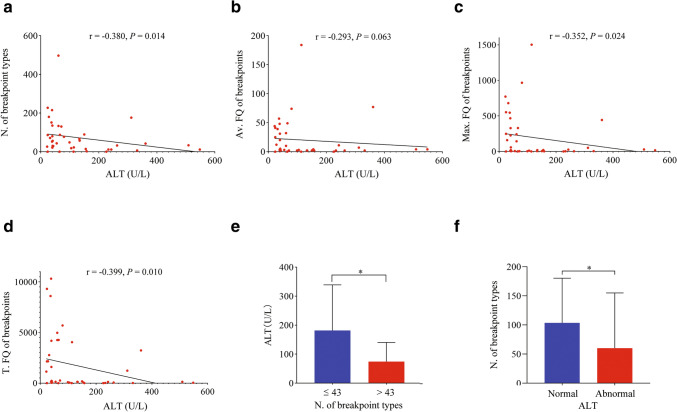
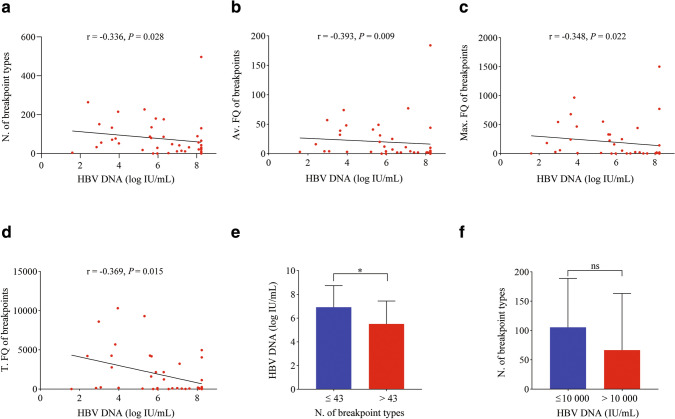
A total of 3729 (69 per sample) integration breakpoints were found in the human genome, including some hotspot genes and KEGG pathways, especially in patients with abnormal transaminases. The number of breakpoint types, an integration risk parameter, was negatively correlated with HBV DNA load and transaminase levels. The average, maximum and total frequencies of given breakpoint types, parameters of clonal hepatocyte expansion, were negatively correlated with HBV DNA load, transaminase levels and liver inflammation activity grade score. The HBV DNA load and inflammation activity grade score were further found to be positively correlated with transaminase levels. Moreover, nucleos(t)ide analog (NUC) treatment that normalized transaminases nonsignificantly reduced the types, but significantly increased the average frequency and negated the enrichments of integration breakpoints.
Liver damage mainly removed the inventories of viral integration and clonal hepatocytes in CHB. NUC treatment may have reduced HBV integration but clearly increased clonal hepatocyte expansion, which may explain why HCC risk cannot be ruled out by NUC treatment.
HBV 整合被怀疑是抗病毒治疗时代肝细胞癌(HCC)的一个顽固危险因素。整合事件始于免疫耐受期,但它们在免疫清除期的命运尚未阐明。在这里,我们报告了肝损伤对慢性乙型肝炎(CHB)患者 HBV 整合和克隆性肝细胞扩张的影响。
使用改良的下一代测序检测 54 例 CHB 患者肝活检样本中的 HBV 整合断点。
在人类基因组中总共发现了 3729 个(每个样本 69 个)整合断点,包括一些热点基因和 KEGG 途径,尤其是在转氨酶异常的患者中。断点类型的数量,一个整合风险参数,与 HBV DNA 载量和转氨酶水平呈负相关。给定断点类型的平均、最大和总频率,即克隆性肝细胞扩张的参数,与 HBV DNA 载量、转氨酶水平和肝炎症活动度评分呈负相关。HBV DNA 载量和炎症活动度评分进一步与转氨酶水平呈正相关。此外,核苷(酸)类似物(NUC)治疗使转氨酶正常化虽未显著减少断点类型,但显著增加了平均频率并否定了整合断点的富集。
肝损伤主要消除了 CHB 中病毒整合和克隆性肝细胞的库存。NUC 治疗可能减少了 HBV 整合,但明显增加了克隆性肝细胞的扩张,这可能解释了为什么 NUC 治疗不能排除 HCC 风险。