Osuafor Christopher N, Davidson Catriona, Mackett Alistair J, Goujon Marie, Van Der Poel Lelane, Taylor Vince, Preller Jacobus, Goudie Robert J B, Keevil Victoria L
Department of Medicine for the Elderly, Addenbrooke's Hospital, Cambridge University Hospitals NHS Foundation Trust, Hills Road, Cambridge CB2 0QQ, UK.
Department of Clinical Neurosciences, University of Cambridge, Cambridge CB2 0QQ, UK.
Geriatrics (Basel). 2021 Feb 1;6(1):11. doi: 10.3390/geriatrics6010011.
We describe the clinical features and inpatient trajectories of older adults hospitalized with COVID-19 and explore relationships with frailty.
This retrospective observational study included older adults admitted as an emergency to a University Hospital who were diagnosed with COVID-19. Patient characteristics and hospital outcomes, primarily inpatient death or death within 14 days of discharge, were described for the whole cohort and by frailty status. Associations with mortality were further evaluated using Cox Proportional Hazards Regression (Hazard Ratio (HR), 95% Confidence Interval).
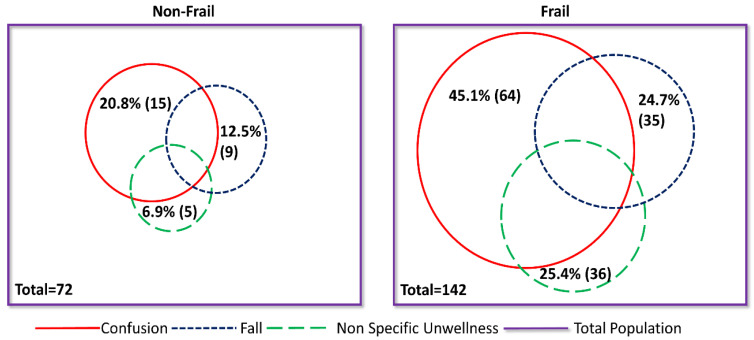
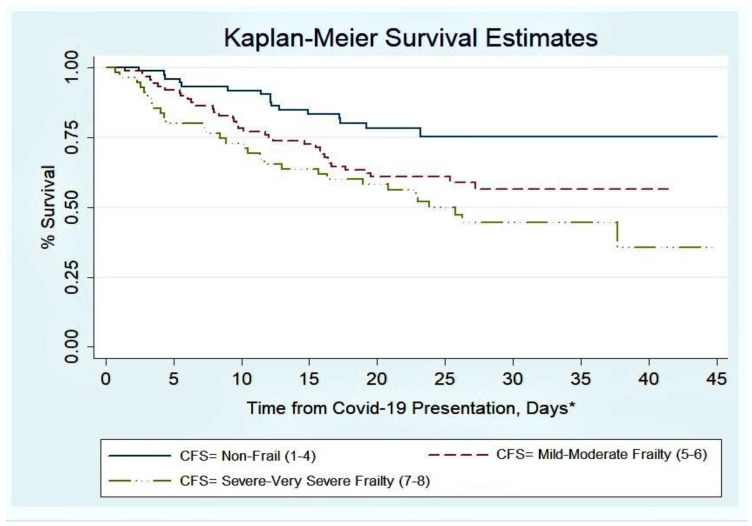
214 patients (94 women) were included of whom 142 (66.4%) were frail with a median Clinical Frailty Scale (CFS) score of 6. Frail compared to nonfrail patients were more likely to present with atypical symptoms including new or worsening confusion (45.1% vs. 20.8%, < 0.001) and were more likely to die (66% vs. 16%, = 0.001). Older age, being male, presenting with high illness acuity and high frailty were independent predictors of death and a dose-response association between frailty and mortality was observed (CFS 1-4: reference; CFS 5-6: HR 1.78, 95% CI 0.90, 3.53; CFS 7-8: HR 2.57, 95% CI 1.26, 5.24).
Clinicians should have a low threshold for testing for COVID-19 in older and frail patients during periods of community viral transmission, and diagnosis should prompt early advanced care planning.
我们描述了因新冠肺炎住院的老年人的临床特征和住院病程,并探讨了与虚弱的关系。
这项回顾性观察研究纳入了因急诊入住大学医院并被诊断为新冠肺炎的老年人。描述了整个队列以及按虚弱状态划分的患者特征和医院结局,主要是住院死亡或出院后14天内死亡情况。使用Cox比例风险回归(风险比(HR),95%置信区间)进一步评估与死亡率的关联。
纳入了214例患者(94名女性),其中142例(66.4%)虚弱,临床虚弱量表(CFS)中位数评分为6分。与非虚弱患者相比,虚弱患者更有可能出现非典型症状,包括新发或加重的意识模糊(45.1%对20.8%,<0.001),且更有可能死亡(66%对16%,=0.001)。年龄较大、男性、疾病严重程度高和虚弱程度高是死亡的独立预测因素,并且观察到虚弱与死亡率之间存在剂量反应关系(CFS 1 - 4:参照;CFS 5 - 6:HR 1.78,95% CI 0.90,3.53;CFS 7 - 8:HR 2.57,95% CI 1.26,5.24)。
在社区病毒传播期间,临床医生对老年和虚弱患者进行新冠肺炎检测的阈值应较低,并且诊断应促使尽早进行高级护理规划。