Department of Hepatobiliary Surgery, the Second Affiliated Hospital of Chongqing Medical University, Chongqing, China.
Department of Gastrointestinal Surgery, the Second Affiliated Hospital of Chongqing Medical University, Chongqing, China.
Int J Behav Nutr Phys Act. 2021 Feb 3;18(1):21. doi: 10.1186/s12966-021-01081-3.
Ultra-processed foods have now become dominant in the global food system. Whether their consumption is associated with cardiovascular mortality remains controversial. Moreover, data on ultra-processed foods and cardiovascular outcomes are scarce in the US population. We aimed to examine the association of ultra-processed food consumption with cardiovascular mortality in a US population.
A population-based cohort of 91,891 participants was identified from the Prostate, Lung, Colorectal, and Ovarian Cancer Screening Trial. Dietary data were collected through a validated 137-item food frequency questionnaire. Ultra-processed foods were defined by the NOVA classification. Cox regression was used to calculate hazard ratios (HRs) and 95% confidence intervals (CIs) for cardiovascular mortality. Restricted cubic spline regression was used to test nonlinearity. Subgroup analyses were conducted to identify the potential effect modifiers.
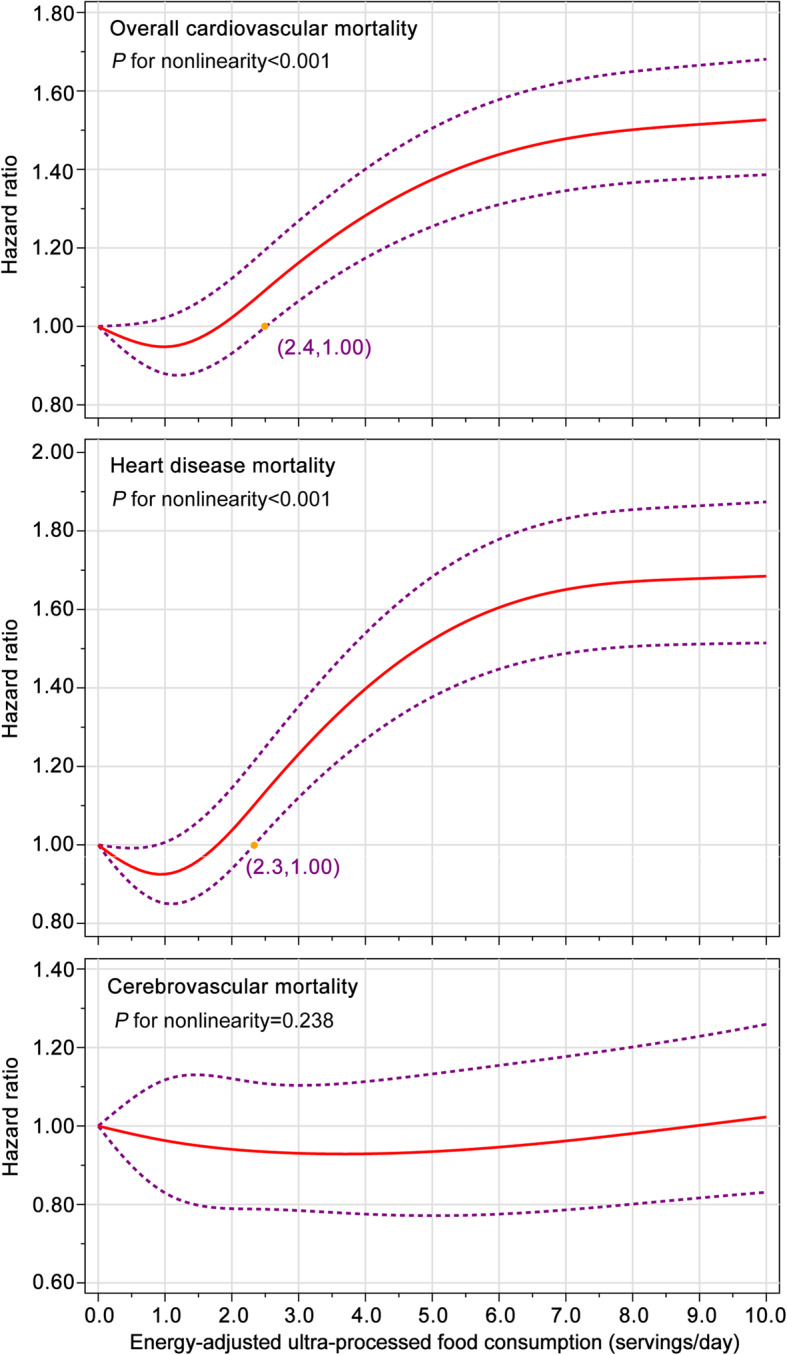
After an average follow-up of 13.5 years (1,236,049.2 person-years), 5490 cardiovascular deaths were documented, including 3985 heart disease deaths and 1126 cerebrovascular deaths. In the fully adjusted model, participants in the highest vs. the lowest quintiles of ultra-processed food consumption had higher risks of death from cardiovascular disease (HR, 1.50; 95% CI, 1.36-1.64) and heart disease (HR, 1.68; 95% CI, 1.50-1.87) but not cerebrovascular disease (HR, 0.94; 95% CI, 0.76-1.17). A nonlinear dose-response pattern was observed for overall cardiovascular and heart disease mortality (all P < 0.05), with a threshold effect observed at ultra-processed food consumption of 2.4 servings/day and 2.3 servings/day, respectively; below the thresholds, no significant associations were observed for these two outcomes. Subgroup analyses showed that the increased risks of mortality from ultra-processed foods were significantly higher in women than in men (all P < 0.05).
High consumption of ultra-processed foods is associated with increased risks of overall cardiovascular and heart disease mortality. These harmful associations may be more pronounced in women. Our findings need to be confirmed in other populations and settings.
超加工食品现已成为全球食品系统的主流。它们的消费是否与心血管死亡率有关仍存在争议。此外,美国人群中超加工食品与心血管结局的数据稀缺。我们旨在研究美国人群中超加工食品消费与心血管死亡率之间的关系。
从前列腺癌、肺癌、结直肠癌和卵巢癌筛查试验中确定了一个基于人群的 91891 名参与者的队列。通过验证的 137 项食物频率问卷收集饮食数据。超加工食品通过 NOVA 分类法定义。使用 Cox 回归计算心血管死亡率的危险比(HR)和 95%置信区间(CI)。使用限制性三次样条回归检验非线性。进行亚组分析以确定潜在的效应修饰剂。
平均随访 13.5 年后(1236049.2 人年),记录了 5490 例心血管死亡,包括 3985 例心脏病死亡和 1126 例脑血管病死亡。在完全调整的模型中,与超加工食品摄入量最低五分位数相比,摄入量最高五分位数的参与者死于心血管疾病(HR,1.50;95%CI,1.36-1.64)和心脏病(HR,1.68;95%CI,1.50-1.87)的风险更高,但死于脑血管病的风险没有增加(HR,0.94;95%CI,0.76-1.17)。观察到全因心血管疾病和心脏病死亡率呈非线性剂量反应模式(均 P<0.05),分别在超加工食品摄入量为 2.4 份/天和 2.3 份/天时出现阈值效应;在这两个阈值以下,这两个结局没有显著的相关性。亚组分析表明,超加工食品导致的死亡率增加风险在女性中明显高于男性(均 P<0.05)。
超加工食品的高摄入量与全因心血管疾病和心脏病死亡率的增加风险相关。这些有害关联在女性中可能更为明显。我们的研究结果需要在其他人群和环境中得到证实。