Markonis Yannis, Kumar Rohini, Hanel Martin, Rakovec Oldrich, Máca Petr, AghaKouchak Amir
Faculty of Environmental Sciences, Czech University of Life Sciences Prague, Praha-Suchdol 16500, Czech Republic.
UFZ-Helmholtz Centre for Environmental Research, Leipzig 04318, Germany.
Sci Adv. 2021 Feb 3;7(6). doi: 10.1126/sciadv.abb9668. Print 2021 Feb.
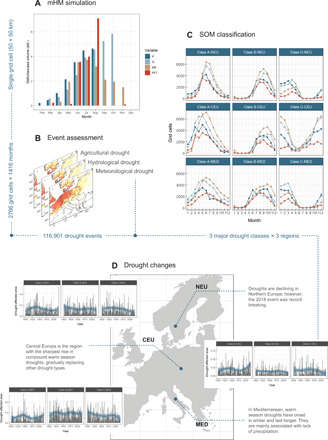
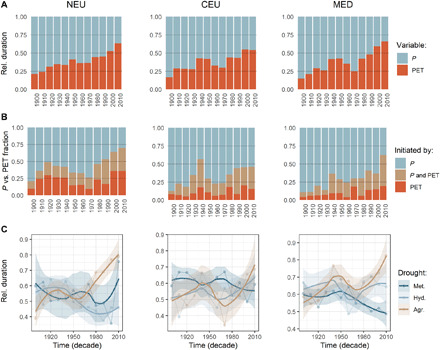
Drought is one of the main threats to food security and ecosystem productivity. During the past decades, Europe has experienced a series of droughts that caused substantial socioeconomic losses and environmental impacts. A key question is whether there are some similar characteristics in these droughts, especially when compared to the droughts that occurred further in the past. Answering this question is impossible with traditional single-index approaches and also short-term and often spatially inconsistent records. Here, using a multidimensional machine learning-based clustering algorithm and the hydrologic reconstruction of European drought, we determine the dominant drought types and investigate the changes in drought typology. We report a substantial increase in shorter warm-season droughts that are concurrent with an increase in potential evapotranspiration. If shifts reported here persist, then we will need new adaptive water management policies and, in the long run, we may observe considerable alterations in vegetation regimes and ecosystem functioning.
干旱是对粮食安全和生态系统生产力的主要威胁之一。在过去几十年里,欧洲经历了一系列干旱,造成了巨大的社会经济损失和环境影响。一个关键问题是,这些干旱是否有一些相似特征,特别是与过去更久远时期发生的干旱相比。用传统的单一指标方法以及短期且往往在空间上不一致的记录是无法回答这个问题的。在此,我们使用基于多维机器学习的聚类算法和欧洲干旱的水文重建,确定主要的干旱类型并研究干旱类型的变化。我们报告称,较短的暖季干旱显著增加,同时潜在蒸发散也在增加。如果此处报告的变化持续下去,那么我们将需要新的适应性水资源管理政策,从长远来看,我们可能会观察到植被状况和生态系统功能发生相当大的改变。