Department of Cardiology, Rinku General Medical Center.
Tokyo Medical and Dental University.
J Atheroscler Thromb. 2021 Sep 1;28(9):974-996. doi: 10.5551/jat.60764. Epub 2021 Feb 2.
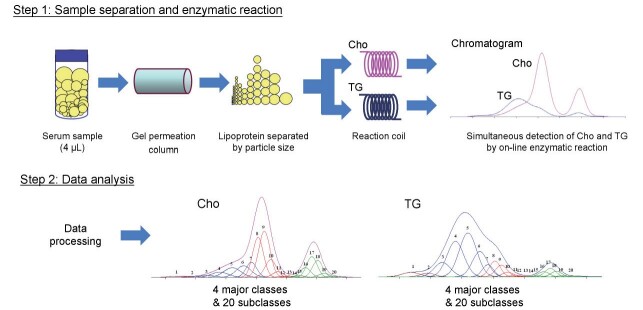
We established a method to evaluate the lipid concentrations, size and particle numbers (PNs) of lipoprotein subclasses by gel permeation chromatography (GP-HPLC). Nuclear magnetic resonance (NMR) is widely used to analyze these parameters of lipoprotein subclasses, but differences of the two methods are unknown. Current study compared the PNs of each lipoprotein subclass measured by GP-HPLC and NMR, and assessed the effect of a selective PPARα modulator, pemafibrate.
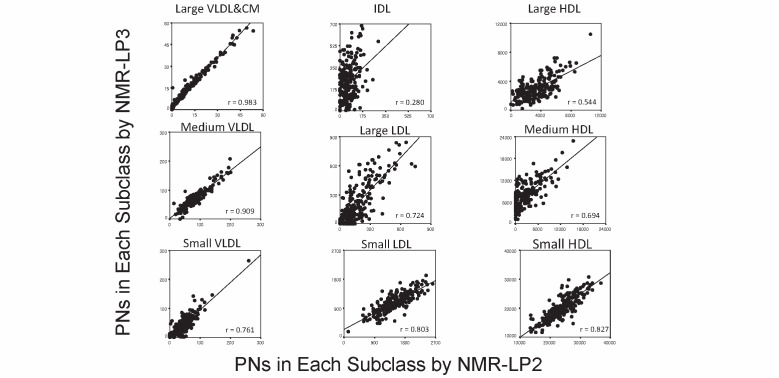
Lipoprotein profiles of 212 patients with dyslipidemia who participated in the phase 2 clinical trial of a selective PPARα modulator, pemafibrate, were analyzed by two methods, GP-HPLC and NMR, which were performed with LipoSEARCH (Skylight Biotech) and LipoProfile 3 (LabCorp), respectively. GP-HPLC evaluated the PNs of 18 subclasses, consisting of CM, VLDL1-5, LDL1-6, and HDL1-6. NMR evaluated the PNs of 9 subclasses, consisting of large VLDL & CM, medium VLDL, small VLDL, IDL, large LDL, small LDL, large HDL, medium HDL and small HDL.
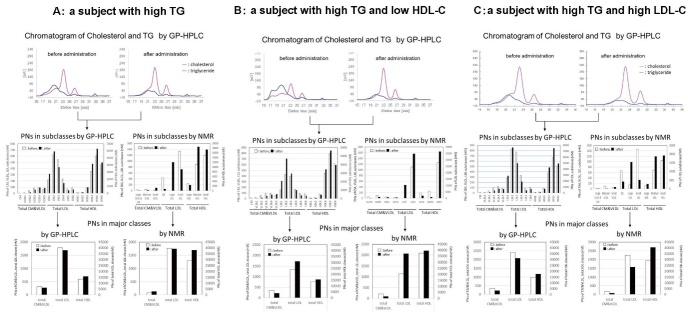
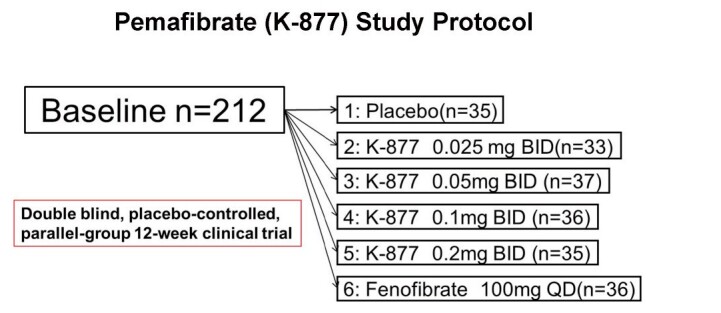
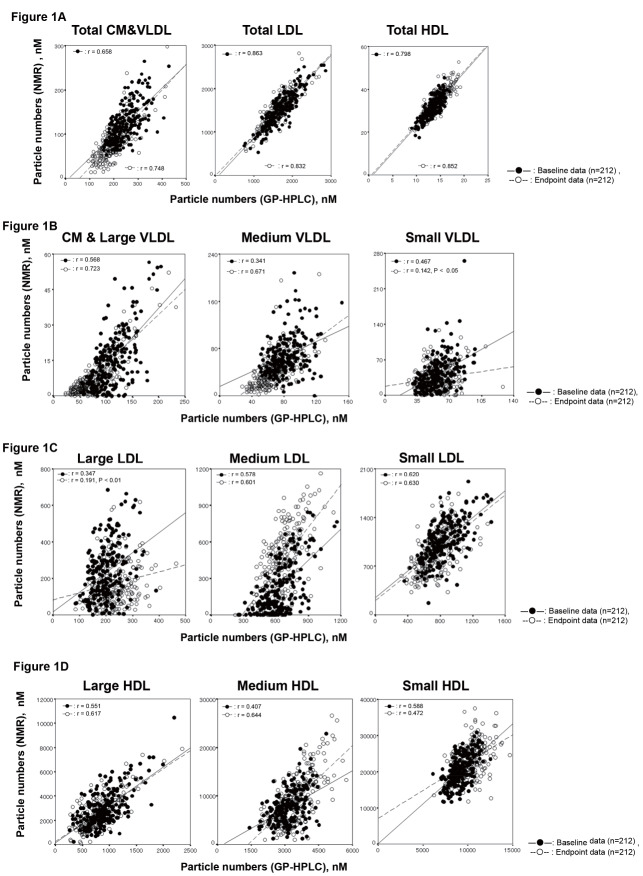
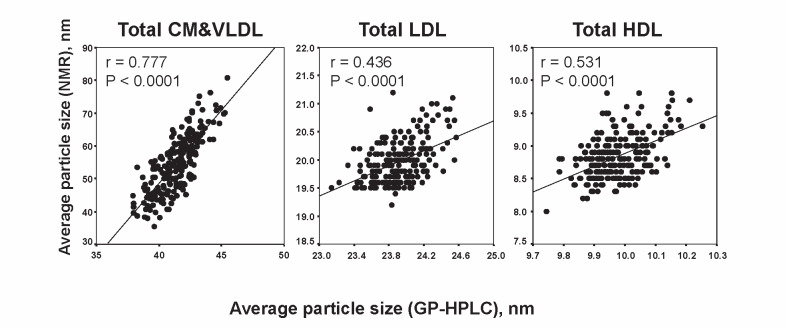
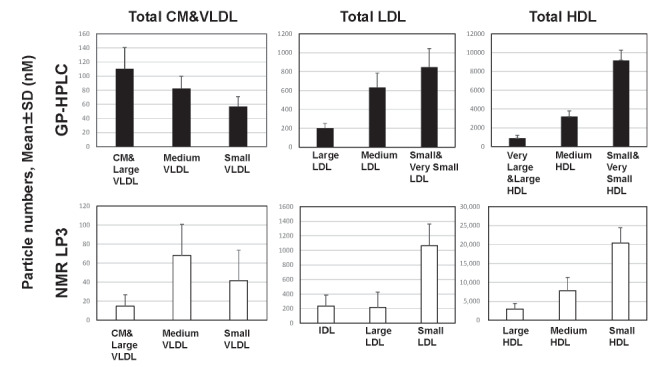
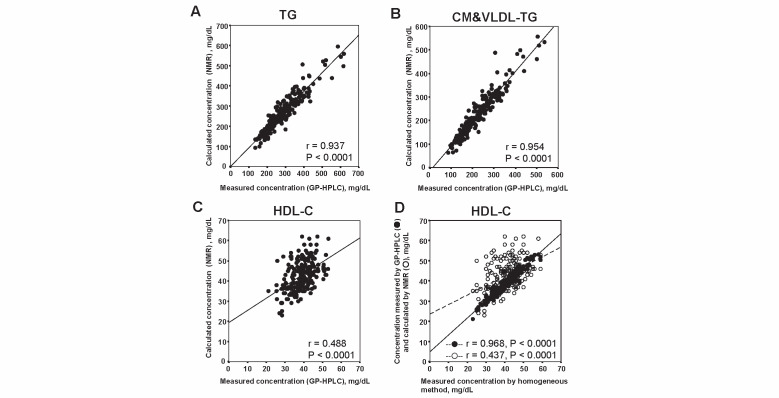
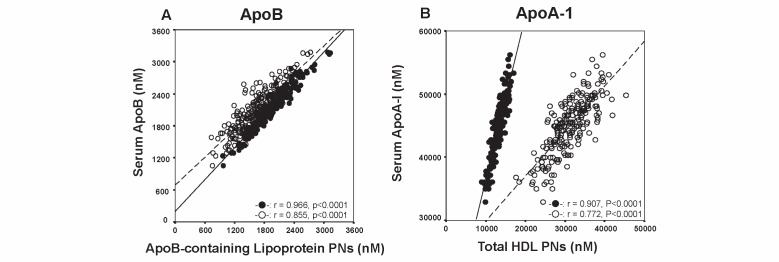
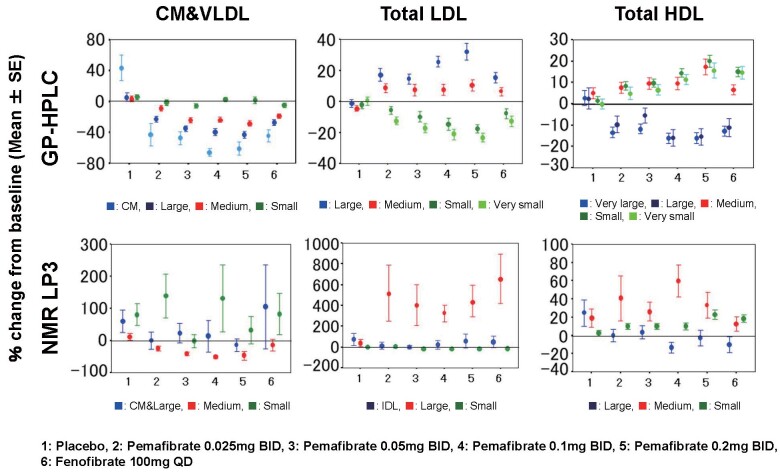
Three major classes, total CM&VLDL, total LDL and total HDL were obtained by grouping of corresponding subclasses in both methods and PNs of these classes analyzed by GP-HPLC were correlated positively with those by NMR. The correlation coefficients in total CM&VLDL, total LDL and total HDL between GP-HPLC and NMR was 0.658, 0.863 and 0.798 (all p<0.0001), respectively. The PNs of total CM&VLDL, total LDL and total HDL analyzed by GP-HPLC was 249.5±51.7nM, 1,679±359 nM and 13,273±1,564 nM, respectively, while those by NMR was 124.6±41.8 nM, 1,514±386 nM and 31,161±4,839 nM, respectively. A marked difference in the PNs between the two methods was demonstrated especially in total HDL. The number of apolipoprotein (Apo) B molecule per one ApoB-containing lipoprotein particle, total CM&VLDL plus total LDL, was 1.10±0.05 by GP-HPLC, while 1.32±0.18 by NMR. The number of ApoA-I per one HDL particle was 3.40±0.17 by GP-HPLC, but only 1.46±0.15 by NMR, much less than reported previously.From the phase 2 clinical trial, randomizing 212 patients to pemafibrate 0.025-0.2 mg BID, fenofibrate 100 mg QD, or placebo groups, pemafibrate reduced the PNs of CM, large VLDL1-VLDL3 and medium VLDL4, but not small VLDL5 by GP-HPLC. It significantly decreased the PNs of smaller LDL and larger HDL particles, but increased those of larger LDL and smaller HDL particles. In contrast, NMR showed marked variations in the effect of pemafibrate on lipoprotein PNs, and no significant size-dependent changes.
GP-HPLC evaluates the lipoprotein PNs more accurately than NMR and can be used for assessing the effects of lipid-lowering drugs on lipoprotein subclasses.
我们建立了一种通过凝胶渗透色谱(GP-HPLC)评估脂蛋白亚类的脂质浓度、大小和颗粒数(PNs)的方法。核磁共振(NMR)广泛用于分析脂蛋白亚类的这些参数,但两种方法的差异尚不清楚。本研究比较了 GP-HPLC 和 NMR 测量的每个脂蛋白亚类的 PNs,并评估了选择性过氧化物酶体增殖物激活受体α调节剂 pemafibrate 的效果。
对 212 名参加选择性过氧化物酶体增殖物激活受体α调节剂 pemafibrate Ⅱ期临床试验的血脂异常患者的脂蛋白谱进行了分析,采用两种方法,即 GP-HPLC 和 NMR,分别采用 LipoSEARCH(Skylight Biotech)和 LipoProfile 3(LabCorp)进行。GP-HPLC 评估了 18 个亚类的 PNs,包括 CM、VLDL1-5、LDL1-6 和 HDL1-6。NMR 评估了 9 个亚类的 PNs,包括大 VLDL & CM、中 VLDL、小 VLDL、IDL、大 LDL、小 LDL、大 HDL、中 HDL 和小 HDL。
通过两种方法对相应亚类进行分组,得到三个主要类别,即总 CM&VLDL、总 LDL 和总 HDL,并用 GP-HPLC 分析这些类别的 PNs,并与 NMR 呈正相关。GP-HPLC 和 NMR 中总 CM&VLDL、总 LDL 和总 HDL 的相关系数分别为 0.658、0.863 和 0.798(均 P<0.0001)。GP-HPLC 分析的总 CM&VLDL、总 LDL 和总 HDL 的 PNs 分别为 249.5±51.7nM、1,679±359 nM 和 13,273±1,564 nM,而 NMR 分析的 PNs 分别为 124.6±41.8 nM、1,514±386 nM 和 31,161±4,839 nM。两种方法在 PNs 上存在明显差异,尤其是在总 HDL 上。每一个载有载脂蛋白(Apo)B 的脂蛋白颗粒中的 ApoB 分子数,即总 CM&VLDL 加总 LDL,用 GP-HPLC 检测为 1.10±0.05,而用 NMR 检测为 1.32±0.18。每一个 HDL 颗粒中的 ApoA-I 数用 GP-HPLC 检测为 3.40±0.17,而用 NMR 检测为 1.46±0.15,远低于之前报道的值。从Ⅱ期临床试验中,将 212 名患者随机分为 pemafibrate 0.025-0.2 mg BID、fenofibrate 100 mg QD 或安慰剂组,pemafibrate 降低了 CM、大 VLDL1-VLDL3 和中 VLDL4 的 PNs,但用 GP-HPLC 检测不到小 VLDL5 的 PNs。它显著降低了较小 LDL 和较大 HDL 颗粒的 PNs,但增加了较大 LDL 和较小 HDL 颗粒的 PNs。相比之下,NMR 显示了 pemafibrate 对脂蛋白 PNs 的影响明显不同,且没有明显的大小依赖性变化。
GP-HPLC 比 NMR 更准确地评估脂蛋白 PNs,可用于评估降脂药物对脂蛋白亚类的影响。