School of Biological Sciences, Victoria University of Wellington, P.O. Box 600, Wellington, 6140, New Zealand.
Centre for Biodiscovery, Victoria University of Wellington, Wellington, New Zealand.
Sci Rep. 2021 Feb 3;11(1):2966. doi: 10.1038/s41598-021-82667-6.
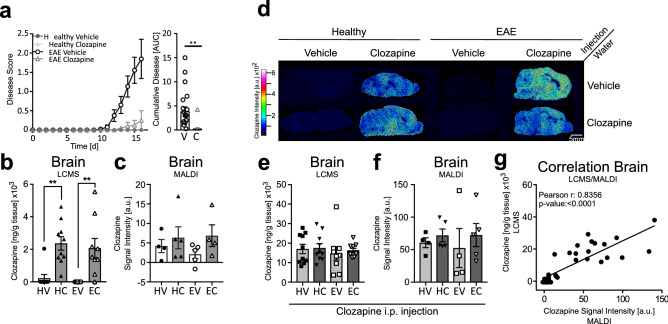
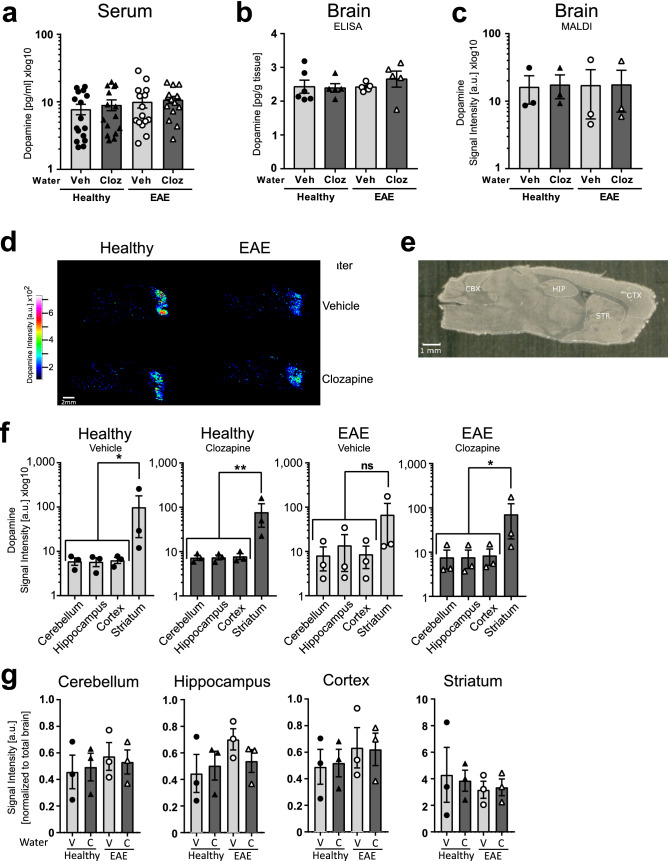
Multiple sclerosis is a disease characterised by axonal demyelination in the central nervous system (CNS). The atypical antipsychotic drug clozapine attenuates experimental autoimmune encephalomyelitis (EAE), a mouse model used to study multiple sclerosis, but the precise mechanism is unknown and could include both peripheral and CNS-mediated effects. To better understand where clozapine exerts its protective effects, we investigated the tissue distribution and localisation of clozapine using matrix-assisted laser desorption ionization imaging mass spectrometry and liquid chromatography-mass spectrometry. We found that clozapine was detectable in the brain and enriched in specific brain regions (cortex, thalamus and olfactory bulb), but the distribution was not altered by EAE. Furthermore, although not altered in other organs, clozapine levels were significantly elevated in serum during EAE. Because clozapine antagonises dopamine receptors, we analysed dopamine levels in serum and brain as well as dopamine receptor expression on brain-resident and infiltrating immune cells. While neither clozapine nor EAE significantly affected dopamine levels, we observed a significant downregulation of dopamine receptors 1 and 5 and up-regulation of dopamine receptor 2 on microglia and CD4+-infiltrating T cells during EAE. Together these findings provide insight into how neuroinflammation, as modelled by EAE, alters the distribution and downstream effects of clozapine.
多发性硬化症是一种以中枢神经系统(CNS)轴突脱髓鞘为特征的疾病。非典型抗精神病药物氯氮平可减轻实验性自身免疫性脑脊髓炎(EAE),这是一种用于研究多发性硬化症的小鼠模型,但确切机制尚不清楚,可能包括外周和中枢介导的作用。为了更好地了解氯氮平发挥其保护作用的部位,我们使用基质辅助激光解吸电离成像质谱和液相色谱-质谱法研究了氯氮平的组织分布和定位。我们发现氯氮平可在大脑中检测到,并在特定的大脑区域(皮质、丘脑和嗅球)富集,但 EAE 并未改变其分布。此外,尽管在其他器官中没有改变,但 EAE 期间血清中的氯氮平水平显著升高。由于氯氮平拮抗多巴胺受体,我们分析了血清和大脑中的多巴胺水平以及大脑驻留和浸润免疫细胞上的多巴胺受体表达。虽然氯氮平和 EAE 都没有显著影响多巴胺水平,但我们观察到 EAE 期间小胶质细胞和 CD4+浸润 T 细胞上的多巴胺受体 1 和 5 显著下调,多巴胺受体 2 上调。这些发现提供了有关神经炎症如何改变 EAE 模型中氯氮平的分布和下游作用的深入了解。