Cortés-Ríos Javiera, Rodriguez-Fernandez Maria
Institute for Biological and Medical Engineering, Schools of Engineering, Medicine and Biological Sciences, Pontificia Universidad Catolica de Chile, Santiago, Chile.
Front Physiol. 2021 Jan 18;11:536146. doi: 10.3389/fphys.2020.536146. eCollection 2020.
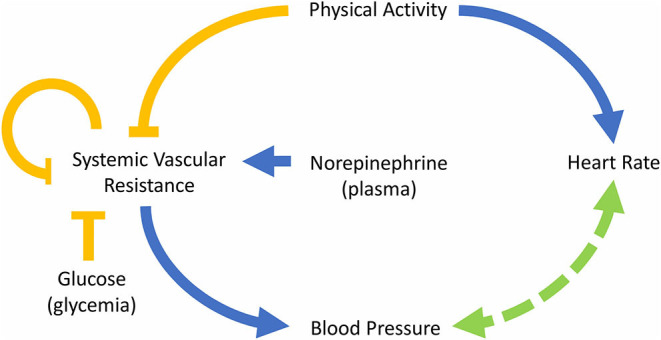
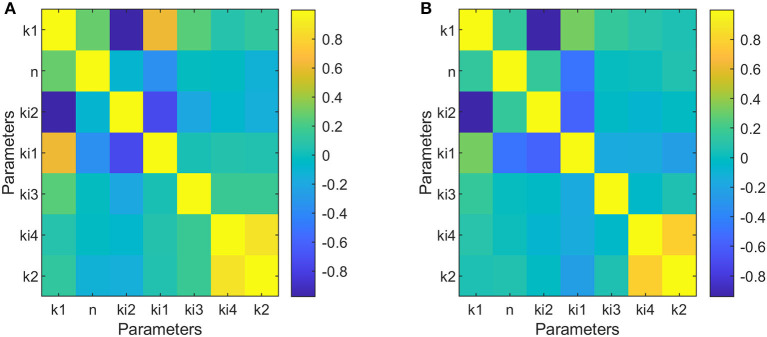
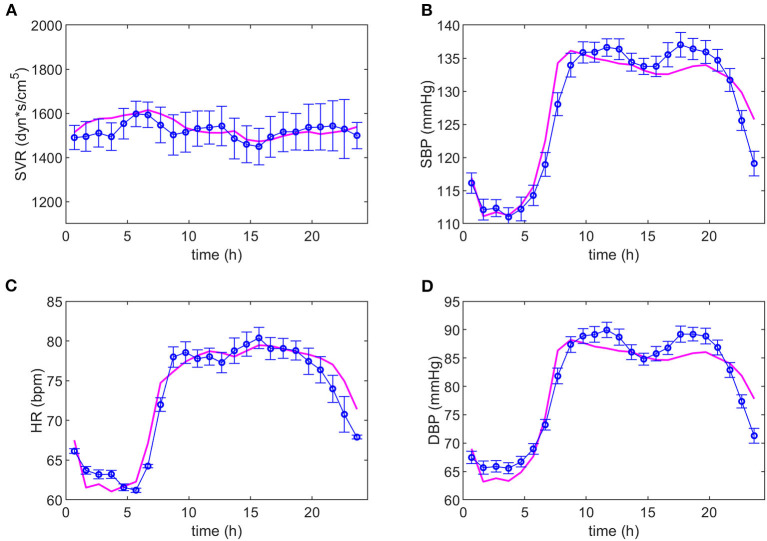
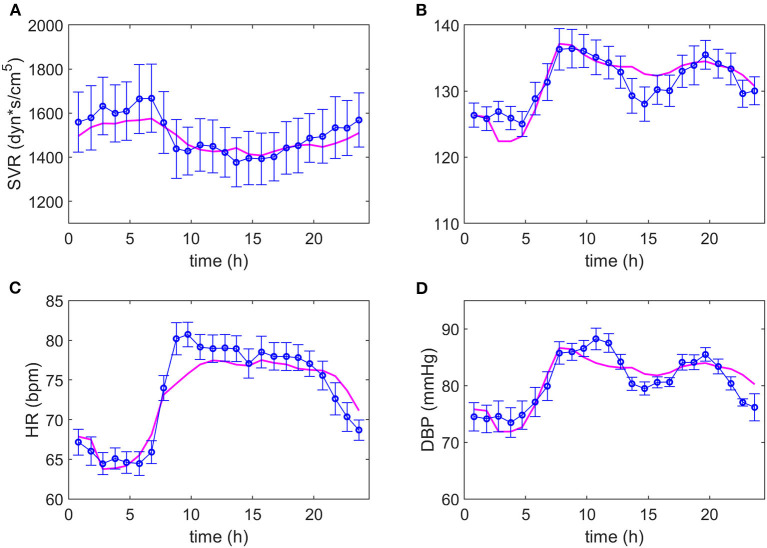
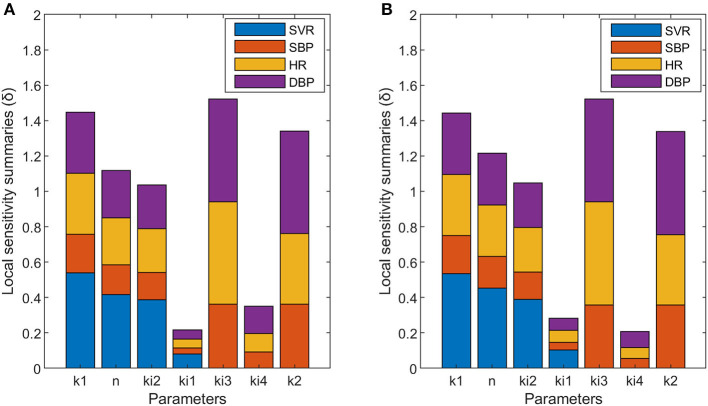
Blood pressure in humans presents a circadian variation profile with a morning increase, a small postprandial valley, and a deeper descent during night-time rest. Under certain conditions, the nocturnal decline in blood pressure can be reduced or even reversed (non-dipper), which is related to a significantly worse prognosis than a normal fall pattern (dipper). Despite several advances in recent years, our understanding of blood pressure's temporal structure, its sources and mechanisms is far from complete. In this work, we developed an ordinary differential equation-based mathematical model capable of capturing the circadian rhythm of blood pressure in dipper and non-dipper patients with arterial hypertension. The model was calibrated by means of global optimization, using 24-h data of systolic and diastolic blood pressure, physical activity, heart rate, blood glucose and norepinephrine, obtained from the literature. After fitting the model, the mean of the normalized error for each data point was <0.2%, and confidence intervals indicate that all parameters were identifiable. Sensitivity analysis allowed identifying the most relevant parameters and therefore inferring the most important blood pressure regulatory mechanisms involved in the non-dipper status, namely, increase in sympathetic over parasympathetic nervous tone, lower influence of physical activity on heart rate and greater influence of physical activity and glucose on the systemic vascular resistance. In summary, this model allows explaining the circadian rhythm of blood pressure and deepening the understanding of the underlying mechanisms and interactions integrating the results of previous works.
人类血压呈现出昼夜变化模式,早晨血压升高,餐后有一个小低谷,夜间休息时血压下降幅度更大。在某些情况下,夜间血压下降可能会减少甚至逆转(非勺型),这与比正常下降模式(勺型)明显更差的预后相关。尽管近年来有了一些进展,但我们对血压的时间结构、其来源和机制的理解仍远未完善。在这项工作中,我们开发了一个基于常微分方程的数学模型,该模型能够捕捉患有动脉高血压的勺型和非勺型患者的血压昼夜节律。该模型通过全局优化进行校准,使用了从文献中获取的收缩压和舒张压、身体活动、心率、血糖和去甲肾上腺素的24小时数据。拟合模型后,每个数据点的归一化误差平均值<0.2%,置信区间表明所有参数都是可识别的。敏感性分析有助于确定最相关的参数,从而推断出与非勺型状态相关的最重要的血压调节机制,即交感神经张力相对于副交感神经张力增加、身体活动对心率的影响较小以及身体活动和葡萄糖对全身血管阻力的影响较大。总之,该模型有助于解释血压的昼夜节律,并加深对整合先前研究结果的潜在机制和相互作用的理解。