Yi Juanjuan, Kang Lijing, Li Jun, Gu Jianfang
Department of Infectious Diseases and Public Health, Jockey Club College of Veterinary Medicine and Life Sciences, City University of Hong Kong, Hong Kong, China.
State Key Laboratory of Medical Neurobiology, Department of Translational Neuroscience, Ministry of Education Frontiers Center for Brain Science, Institutes of Brain Science, Jing'an District Centre Hospital of Shanghai, Fudan University, Shanghai, China.
Front Psychiatry. 2021 Jan 18;11:590101. doi: 10.3389/fpsyt.2020.590101. eCollection 2020.
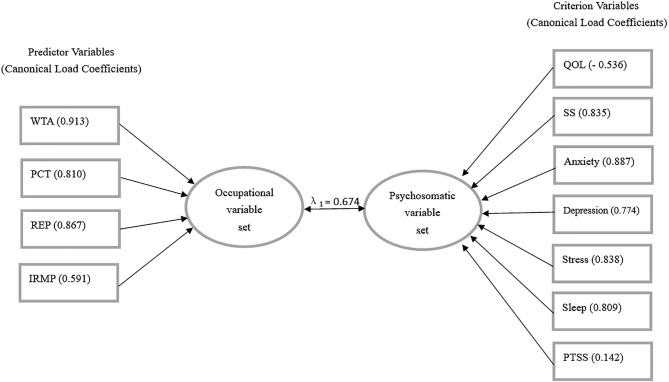
The global outbreak of COVID-19 has severely affected the entire population, especially healthcare staff on the frontline, who bear heavy psychosomatic burdens. A cross-sectional study was conducted with 723 participants in China from April 26 to May 9, 2020. We evaluated the psychosomatic status, including depression, anxiety, quality of life, somatic symptoms, stress, sleep disturbances, and posttraumatic stress symptoms in different exposure groups. We explored the risk factors that affect psychosomatic burdens and analyzed the relationship between psychosomatic problems and medical occupations. We found that the psychosomatic burdens of medical staff were significantly greater than those of non-medical staff ( < 0.01) and were positively related with the number of COVID-19 patients they came in contact with. Occupational pressure was a key factor for healthcare staff's psychosomatic problems ( < 0.01 for quality of life, somatic symptoms, anxiety, depression, stress; = 0.012 for sleep disturbances), and it had a strong canonical correlation ( < 0.01). Workload and time allocation (WTA), one of the subdimensional indicators of occupational pressure, was strongly correlated with psychosomatic indicators. We suggest that rationalization of WTA is a desirable approach for anti-epidemic medical employees to alleviate psychosomatic burdens. Public health interventions should be undertaken to reduce the occupational pressure on this special population, which is critical for mitigation. This study presents results regarding the psychosomatic burdens of the healthcare workforce related to occupational pressure and provides multilevel data with groups of different exposure risks for policymakers to protect medical personnel. These findings draw attention to the working environments of healthcare workers and provide applicable results for clinical practice.
新型冠状病毒肺炎(COVID-19)的全球大流行严重影响了全体民众,尤其是一线医护人员,他们承受着沉重的身心负担。2020年4月26日至5月9日,在中国对723名参与者进行了一项横断面研究。我们评估了不同暴露组的身心状况,包括抑郁、焦虑、生活质量、躯体症状、压力、睡眠障碍和创伤后应激症状。我们探讨了影响身心负担的风险因素,并分析了身心问题与医疗职业之间的关系。我们发现,医务人员的身心负担明显高于非医务人员(<0.01),且与他们接触的COVID-19患者数量呈正相关。职业压力是医护人员身心问题的关键因素(生活质量、躯体症状、焦虑、抑郁、压力方面<0.01;睡眠障碍方面=0.012),且具有很强的典型相关性(<0.01)。职业压力的子维度指标之一工作量和时间分配(WTA)与身心指标密切相关。我们建议,合理安排WTA是抗疫医务人员减轻身心负担的理想方法。应采取公共卫生干预措施以减轻这一特殊人群的职业压力,这对缓解压力至关重要。本研究展示了与职业压力相关的医护人员身心负担的结果,并为政策制定者提供了不同暴露风险组的多层次数据,以保护医务人员。这些发现引起了人们对医护人员工作环境的关注,并为临床实践提供了可应用的结果。