Koge Junpei, Shiozawa Masayuki, Toyoda Kazunori
Department of Cerebrovascular Medicine, National Cerebral and Cardiovascular Center, Suita, Japan.
Front Neurol. 2021 Jan 18;11:611504. doi: 10.3389/fneur.2020.611504. eCollection 2020.
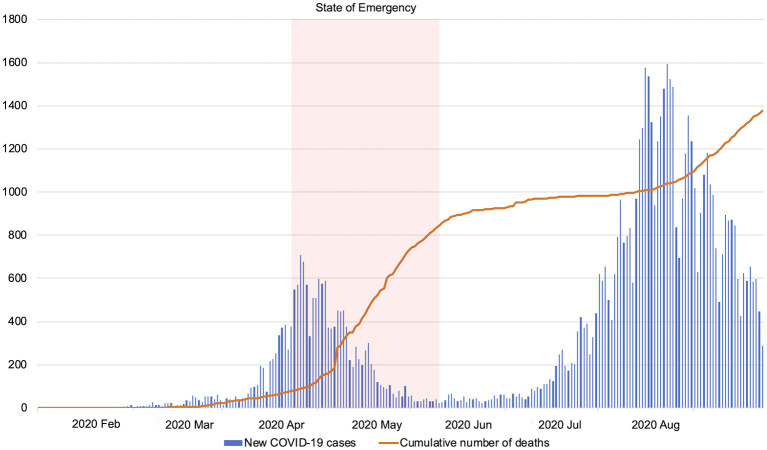
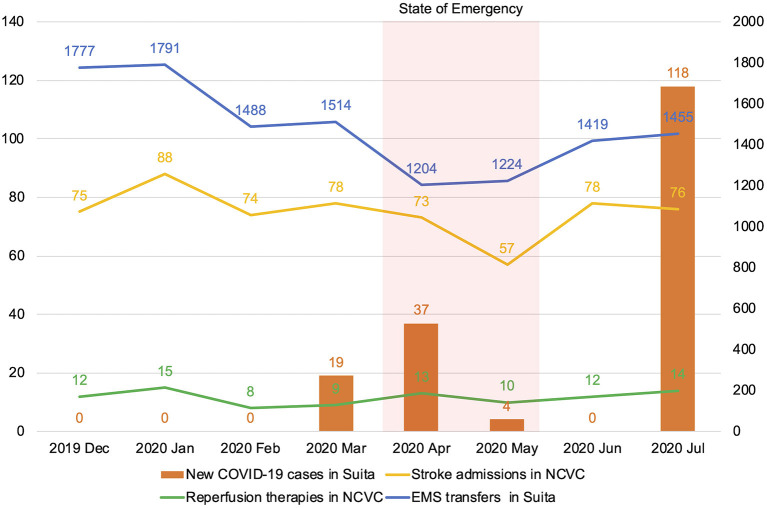
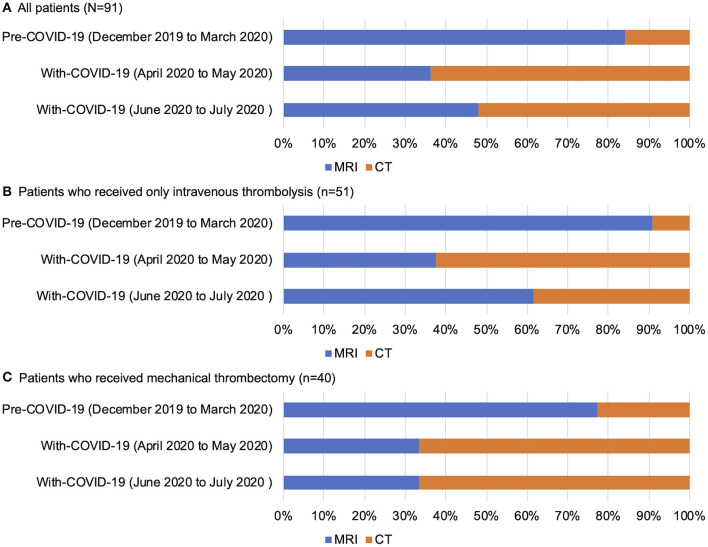
The pandemic of coronavirus disease 2019 (COVID-19) has had a significant impact on stroke healthcare, including the prehospital care system and in-hospital workflow. Japan experienced the outbreak of COVID-19, and the State of Emergency was declared during April 2020 and May 2020. The aim of the present study was to clarify the effect of the COVID-19 pandemic on a comprehensive stroke center in Japan. We retrospectively reviewed consecutive patients with acute ischemic stroke admitted in our institute between December 2019 and July 2020. The patients who underwent reperfusion therapy (intravenous thrombolysis and/or mechanical thrombectomy) were divided into the pre-COVID-19 period (December 2019 to March 2020) and the With-COVID-19 period (April 2020 to July 2020). Study outcomes were the number of stroke admissions in our institute, workflow time metrics, the frequency of modified Rankin Scale score 0-2 at discharge, and brain imaging modalities before reperfusion therapy in patients who underwent reperfusion therapy. In our institute, the number of stroke admissions decreased during the State of Emergency and then increased after the lifting of the State of Emergency. Among patients who underwent reperfusion therapy (median age, 77 years; female 27%; median baseline National Institutes of Health Stroke Scale score, 10), times from hospital arrival to imaging [25 (21-33) min vs. 30 (25-38) min, = 0.03] and to thrombolysis [38 (31-52) min vs. 51 (37-64) min, = 0.03] were prolonged compared with the pre-COVID-19 period. There was no significant difference in the frequency of modified Rankin Scale score 0-2 at discharge between the two periods (32 vs. 45%, = 0.21). The proportion of computed tomography vs. magnetic resonance imaging as an emergency brain imaging tool before reperfusion therapy changed, with computed tomography having become predominant in the With-COVID-19 period. In our institute, the number of stroke admissions, workflow time metrics, and imaging modalities for reperfusion therapy were affected by the COVID-19 pandemic.
2019年冠状病毒病(COVID-19)大流行对中风医疗保健产生了重大影响,包括院前护理系统和院内工作流程。日本经历了COVID-19疫情,并在2020年4月至2020年5月期间发布了紧急状态声明。本研究的目的是阐明COVID-19大流行对日本一家综合性中风中心的影响。我们回顾性分析了2019年12月至2020年7月期间在我院连续收治的急性缺血性中风患者。接受再灌注治疗(静脉溶栓和/或机械取栓)的患者被分为COVID-19之前时期(2019年12月至2020年3月)和COVID-19期间(2020年4月至2020年7月)。研究结果包括我院中风住院患者数量、工作流程时间指标、出院时改良Rankin量表评分为0 - 2分的频率,以及接受再灌注治疗患者在再灌注治疗前的脑成像方式。在我院,中风住院患者数量在紧急状态期间减少,紧急状态解除后增加。在接受再灌注治疗的患者中(中位年龄77岁;女性占27%;基线美国国立卫生研究院卒中量表中位评分10分),与COVID-19之前时期相比,从入院到成像的时间[25(21 - 33)分钟对30(25 - 3)分钟,P = 0.03]和到溶栓的时间[38(31 - 52)分钟对51(37 - 64)分钟,P = 0.03]延长。两个时期出院时改良Rankin量表评分为0 - 2分的频率无显著差异(32%对45%,P = 0.21)。再灌注治疗前作为紧急脑成像工具的计算机断层扫描与磁共振成像的比例发生了变化,在COVID-19期间计算机断层扫描占主导地位。在我院,中风住院患者数量、工作流程时间指标和再灌注治疗的成像方式受到COVID-19大流行的影响。