Dengler Julius, Prass Konstantin, Palm Frederick, Hohenstein Sven, Pellisier Vincent, Stoffel Michael, Hong Bujung, Meier-Hellmann Andreas, Kuhlen Ralf, Bollmann Andreas, Rosahl Steffen
Faculty of Health Sciences Brandenburg, Brandenburg Medical School Theodor Fontane, Campus Bad Saarow, Bad Saarow, Germany.
Department of Neurosurgery, HELIOS Hospital Bad Saarow, Bad Saarow, Germany.
Eur Stroke J. 2022 Jun;7(2):166-174. doi: 10.1177/23969873221089152. Epub 2022 Apr 7.
In the early stages of the global COVID-19 pandemic hospital admissions for acute ischemic stroke (AIS) decreased substantially. As health systems have become more experienced in dealing with the pandemic, and as the proportion of the population vaccinated rises, it is of interest to determine whether the prevalence of AIS hospitalization and outcomes from hospitalization have returned to normal.
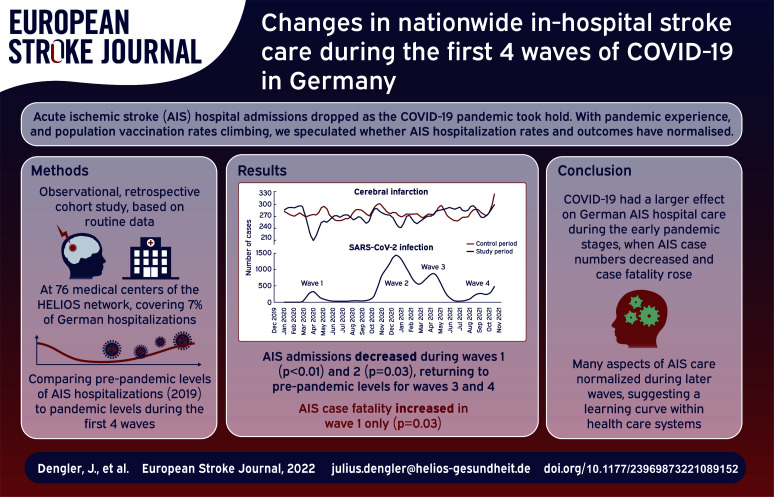
In this observational, retrospective cohort study, we compared the prevalence and outcomes of AIS during the first four waves of the pandemic to corresponding pre-pandemic periods in 2019 using administrative data collected from a nationwide network of 76 hospitals that manages 7% of all in-hospital cases in Germany.
We included 25,821 AIS cases in the study period (2020/2021) and used 26,295 AIS cases as controls (2019). Compared to pre-pandemic numbers, mean daily AIS admissions decreased only during wave 1 (from 39.6 to 34.1; p < 0.01) and wave 2 (from 39.9 to 38.3; p = 0.03) and returned to normal levels during waves 3 and 4. AIS case fatality increased in wave 1 only (from 6.0% to 7.6%; p = 0.03). We observed a consistent decrease in the prevalences of arterial hypertension, diabetes, and obesity among AIS cases throughout the pandemic and no changes in rates of systemic thrombolysis, mechanical thrombectomy, or decompressive craniectomy. The rate of transfer to stroke units increased only during waves 2 (by 4.6%; p < 0.01) and 3 (by 3.0%; p < 0.01). The proportion of patients with coinciding SARS-CoV-2 and AIS was low, peaking at 3.4% in wave 2 and subsequently decreasing to 0.4% in wave 4.
In Germany, the COVID-19 pandemic seems to have had a larger effect on nationwide in-hospital AIS care during the early pandemic stages, in which AIS case numbers decreased and case fatality rose. This may reflect a nationwide "learning curve" within health care systems in providing AIS care in times of a pandemic.
在全球新冠疫情的早期阶段,急性缺血性卒中(AIS)的住院人数大幅下降。随着卫生系统在应对疫情方面经验日益丰富,以及接种疫苗的人口比例上升,确定AIS住院率和住院治疗结果是否已恢复正常变得很有意义。
在这项观察性回顾性队列研究中,我们使用从德国一个管理全国7%住院病例的由76家医院组成的网络收集的行政数据,将疫情前四波期间AIS的患病率和治疗结果与2019年相应的疫情前时期进行了比较。
我们在研究期间(2020/2021年)纳入了25821例AIS病例,并将26295例AIS病例作为对照(2019年)。与疫情前的数字相比,平均每日AIS入院人数仅在第1波(从39.6降至34.1;p<0.01)和第2波(从39.9降至38.3;p=0.03)期间有所下降,并在第3波和第4波期间恢复到正常水平。仅在第1波中AIS病死率有所上升(从6.0%升至7.6%;p=0.03)。在整个疫情期间,我们观察到AIS病例中动脉高血压、糖尿病和肥胖症的患病率持续下降,全身溶栓、机械取栓或减压颅骨切除术的比率没有变化。转至卒中单元的比率仅在第2波(上升4.6%;p<0.01)和第3波(上升3.0%;p<0.01)期间有所增加。同时感染SARS-CoV-2和AIS的患者比例较低,在第2波达到峰值3.4%,随后在第4波降至0.4%。
在德国,新冠疫情似乎在疫情早期阶段对全国范围内的住院AIS治疗产生了更大影响,在此期间AIS病例数减少且病死率上升。这可能反映了卫生保健系统在疫情期间提供AIS治疗方面的全国性“学习曲线”。