Katsube Makoto, Ebara Natsuki, Maeda Megumi, Kimura Yoshinobu
Department of Biofunctional Chemistry, Graduate School of Environmental and Life Science, Okayama University, Okayama, Japan.
Front Plant Sci. 2021 Jan 18;11:610124. doi: 10.3389/fpls.2020.610124. eCollection 2020.
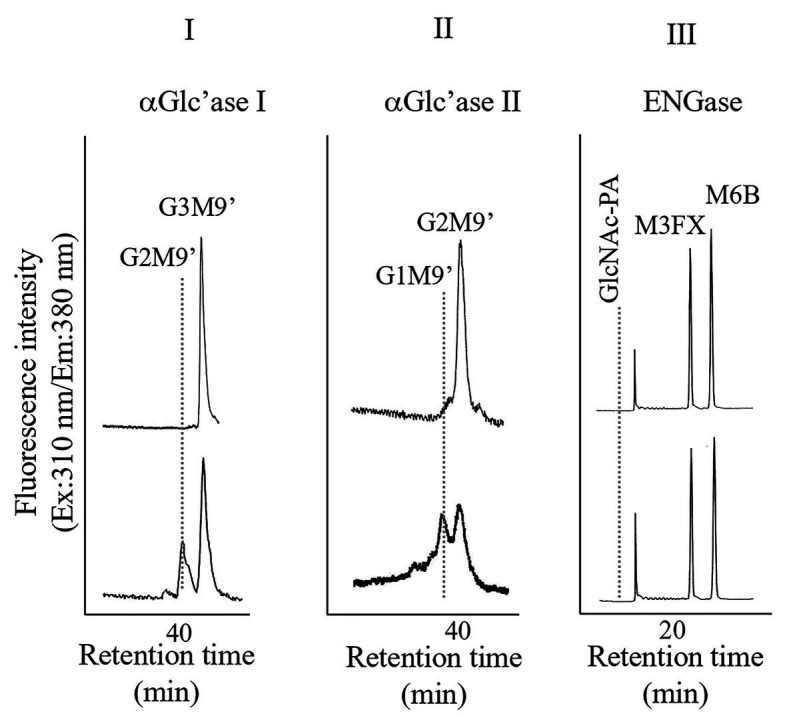
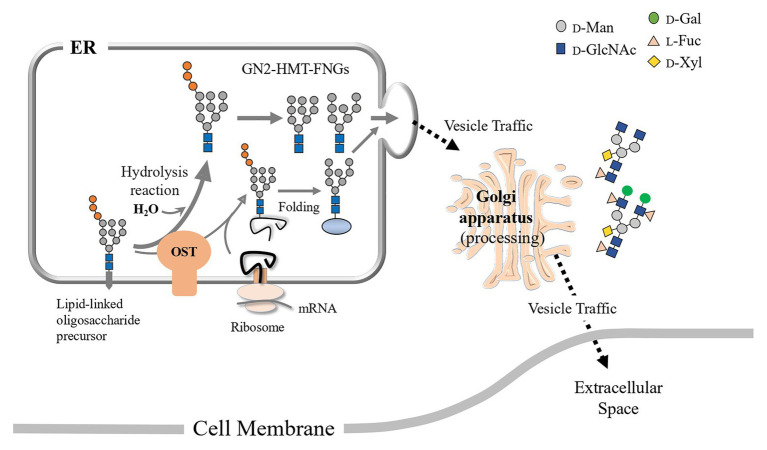
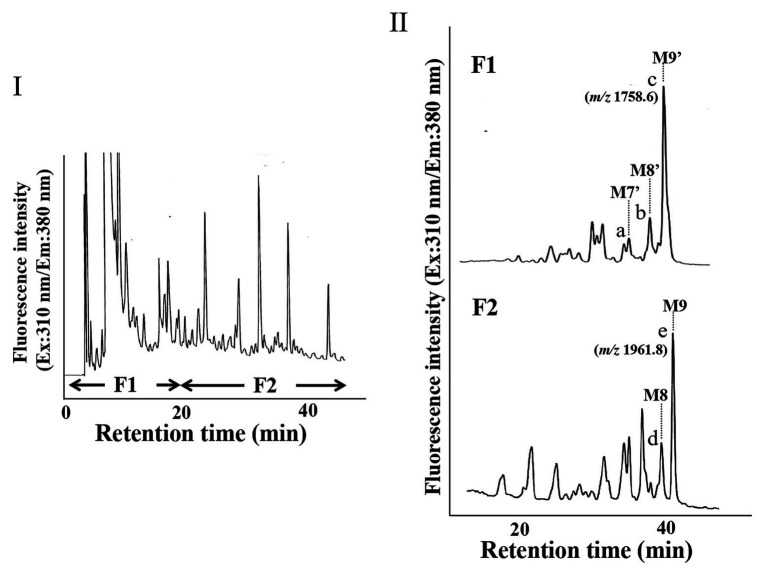
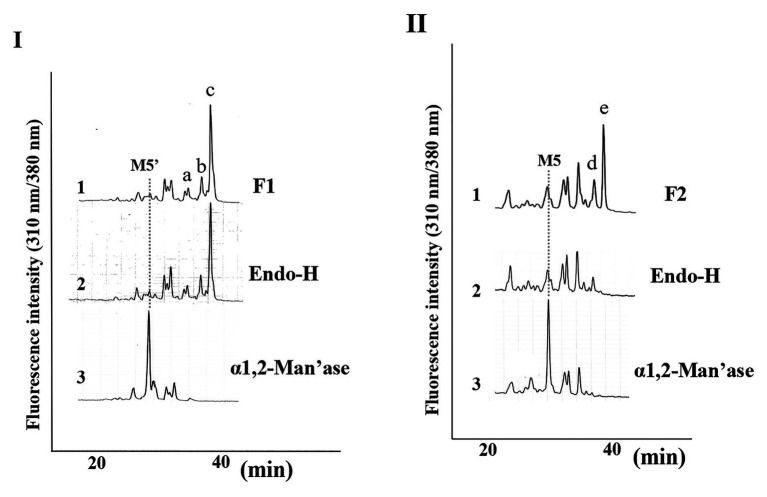
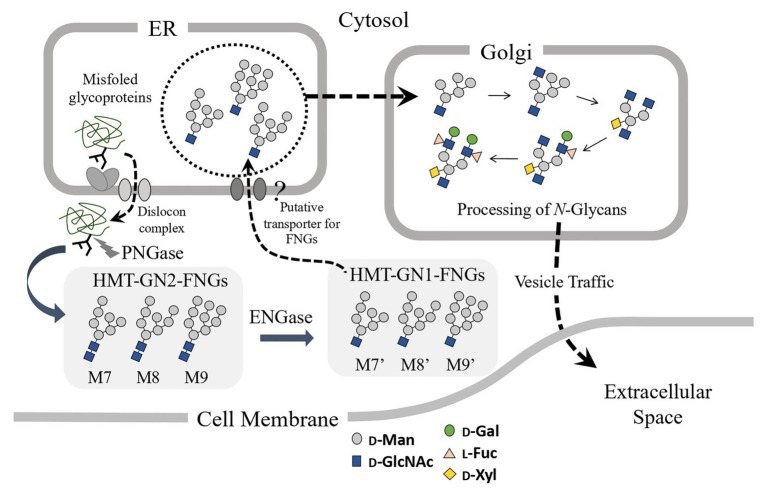
During endoplasmic reticulum (ER)-associated degradation, free -glycans (FNGs) are produced from misfolded nascent glycoproteins the combination of the cytosolic peptide -glycanase (cPNGase) and endo-β--acetylglucosaminidase (ENGase) in the plant cytosol. The resulting high-mannose type (HMT)-FNGs, which carry one GlcNAc residue at the reducing end (GN1-FNGs), are ubiquitously found in developing plant cells. In a previous study, we found that HMT-FNGs assisted in protein folding and inhibited β-amyloid fibril formation, suggesting a possible biofunction of FNGs involved in the protein folding system. However, whether these HMT-FNGs occur in the ER, an organelle involved in protein folding, remained unclear. On the contrary, we also reported the presence of plant complex type (PCT)-GN1-FNGs, which carry the Lewis epitope at the non-reducing end, indicating that these FNGs had been fully processed in the Golgi apparatus. Since plant ENGase was active toward HMT--glycans but not PCT--glycans that carry β1-2xylosyl and/or α1-3 fucosyl residue(s), these PCT-GN1-FNGs did not appear to be produced from fully processed glycoproteins that harbored PCT--glycans ENGase activity. Interestingly, PCT-GN1-FNGs were found in the extracellular space, suggesting that HMT-GN1-FNGs formed in the cytosol might be transported back to the ER and processed in the Golgi apparatus through the protein secretion pathway. As the first step in elucidating the production mechanism of PCT-GN1-FNGs, we analyzed the structures of free oligosaccharides in plant microsomes and proved that HMT-FNGs (ManGlcNAc and ManGlcNAc) could be found in microsomes, which almost consist of the ER compartments.
在内质网(ER)相关降解过程中,错误折叠的新生糖蛋白在植物细胞质中通过胞质肽聚糖酶(cPNGase)和内切β-N-乙酰氨基葡萄糖苷酶(ENGase)的联合作用产生游离聚糖(FNGs)。由此产生的高甘露糖型(HMT)-FNGs在还原端带有一个GlcNAc残基(GN1-FNGs),在发育中的植物细胞中普遍存在。在先前的一项研究中,我们发现HMT-FNGs有助于蛋白质折叠并抑制β-淀粉样蛋白原纤维的形成,这表明FNGs可能在蛋白质折叠系统中具有生物功能。然而,这些HMT-FNGs是否存在于参与蛋白质折叠的细胞器内质网中仍不清楚。相反,我们还报道了植物复合型(PCT)-GN1-FNGs的存在,它们在非还原端带有Lewis表位,这表明这些FNGs已在高尔基体中被完全加工。由于植物ENGase对携带β1-2木糖基和/或α1-3岩藻糖基残基的HMT-聚糖有活性,但对PCT-聚糖没有活性,这些PCT-GN1-FNGs似乎不是由具有ENGase活性的完全加工的糖蛋白产生的。有趣的是,PCT-GN1-FNGs存在于细胞外空间,这表明在细胞质中形成的HMT-GN1-FNGs可能通过蛋白质分泌途径被转运回内质网并在高尔基体中加工。作为阐明PCT-GN1-FNGs产生机制的第一步,我们分析了植物微粒体中游离寡糖的结构,并证明在几乎由内质网区室组成的微粒体中可以发现HMT-FNGs(ManGlcNAc和Man2GlcNAc)。