State Key Laboratory of Chemo/Biosensing and Chemometrics, College of Chemistry and Chemical Engineering, Hunan University, Changsha 410082, P. R China.
Department of Chemistry and Chemical Engineering, Beijing University of Technology, Beijing, 100124, P. R. China.
Theranostics. 2021 Jan 19;11(7):3502-3511. doi: 10.7150/thno.55014. eCollection 2021.
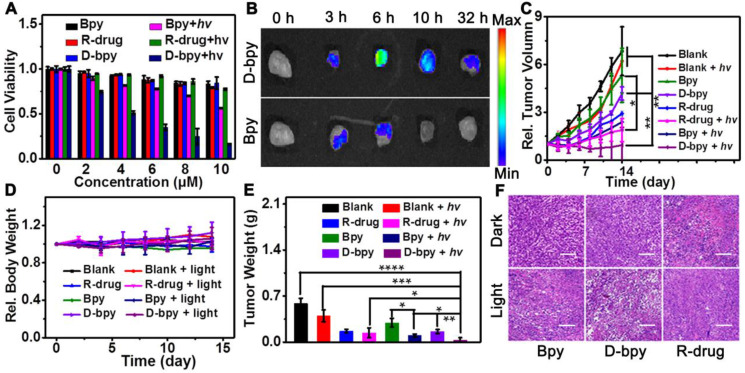
Photodynamic therapy (PDT) has emerged as one of the most up-and-coming non-invasive therapeutic modalities for cancer therapy in rencent years. However, its therapeutic effect was still hampered by the short life span, limited diffusion distance and ineluctable depletion of singlet oxygen (O), as well as the hypoxic microenvironment in the tumor tissue. Such problems have limited the application of PDT and appropriate solutions are highly demand. Herein, a programmatic treatment strategy is proposed for the development of a smart molecular prodrug (), which comprise a two-photon photosensitizer and a hypoxia-activated chemotherapeutic prodrug. A rhodamine dye was designed to connect them and track the drug release by the fluorescent signal generated through azo bond cleavage. The prodrug () can stay on the cell membrane and enrich at the tumor site. Upon light irradiation, the therapeutic effect was enhanced by a stepwise treatment: (i) direct generation of O on the cell membrane induced membrane destruction and promoted the uptake; (ii) deep tumor hypoxia caused by two-photon PDT process further triggered the activation of the chemotherapy prodrug. Both and experiments, have exhabited excellent tumor treatment effect. The innovative treatment strategy provides new strategy for the design of follow-up anticancer drugs.
光动力疗法(PDT)近年来已成为癌症治疗中最有前途的非侵入性治疗方法之一。然而,其治疗效果仍受到短寿命、有限的扩散距离和不可避免的单线态氧(O)耗竭以及肿瘤组织中的缺氧微环境的限制。这些问题限制了 PDT 的应用,因此需要寻找适当的解决方案。
在此,我们提出了一种智能分子前药()的程序化治疗策略,它包含一个双光子光敏剂和一个缺氧激活的化疗前药。我们设计了一个罗丹明染料将它们连接起来,并通过偶氮键断裂产生的荧光信号来跟踪药物释放。前药()可以留在细胞膜上,并在肿瘤部位富集。在光照射下,治疗效果通过逐步治疗得到增强:(i)细胞膜上直接生成 O 诱导膜破坏并促进摄取;(ii)双光子 PDT 过程引起的深部肿瘤缺氧进一步触发化疗前药的激活。细胞和动物实验都表现出了优异的肿瘤治疗效果。
这项创新的治疗策略为后续抗癌药物的设计提供了新的策略。