Department of Pharmacy, Northwestern Memorial Hospital, Chicago, IL, USA.
Department of Pharmacy Practice, Midwestern University Chicago College of Pharmacy, Downers Grove, IL, USA.
Am J Health Syst Pharm. 2021 Mar 18;78(7):568-577. doi: 10.1093/ajhp/zxaa426.
In a multicenter point-prevalence study, we found that the rate of supportive care was high; among those receiving COVID-19 drug therapies, adverse reactions occurred in 12% of patients.
There are currently no FDA-approved medications for the treatment of coronavirus disease 2019 (COVID-19). At the onset of the pandemic, off-label medication use was supported by limited or no clinical data. We sought to characterize experimental COVID-19 therapies and identify safety signals during this period.
We conducted a noninterventional, multicenter, point prevalence study of patients hospitalized with suspected/confirmed COVID-19. Clinical and treatment characteristics within a 24-hour window were evaluated in a random sample of up to 30 patients per site. The primary objective was to describe COVID-19-targeted therapies. The secondary objective was to describe adverse drug reactions (ADRs).
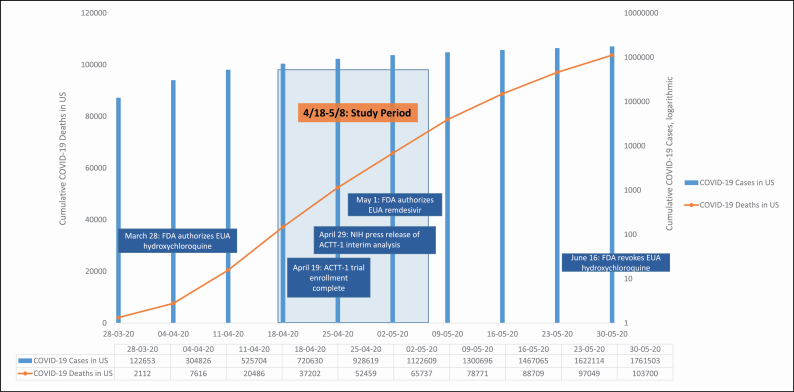
A total of 352 patients treated for COVID-19 at 15 US hospitals From April 18 to May 8, 2020, were included in the study. Most patients were treated at academic medical centers (53.4%) or community hospitals (42.6%). Sixty-seven patients (19%) were receiving drug therapy in addition to supportive care. Drug therapies used included hydroxychloroquine (69%), remdesivir (10%), and interleukin-6 antagonists (9%). Five patients (7.5%) were receiving combination therapy. The rate of use of COVID-19-directed drug therapy was higher in patients with vs patients without a history of asthma (14.9% vs 7%, P = 0.037) and in patients enrolled in clinical trials (26.9% vs 3.2%, P < 0.001). Among those receiving drug therapy, 8 patients (12%) experienced an ADR, and ADRs were recognized at a higher rate in patients enrolled in clinical trials (62.5% vs 22%; odds ratio, 5.9; P = 0.028).
While we observed high rates of supportive care for patients with COVID-19, we also found that ADRs were common among patients receiving drug therapy, including those enrolled in clinical trials. Comprehensive systems are needed to identify and mitigate ADRs associated with experimental COVID-19 treatments.
在一项多中心时点患病率研究中,我们发现支持性治疗的比率很高;在接受 COVID-19 药物治疗的患者中,12%的患者出现不良反应。
目前尚无 FDA 批准的药物可用于治疗 2019 年冠状病毒病(COVID-19)。在大流行初期,标签外用药的使用得到了有限或没有临床数据的支持。在此期间,我们试图描述实验性 COVID-19 治疗方法并确定安全信号。
我们对疑似/确诊 COVID-19 住院患者进行了一项非干预性、多中心、时点患病率研究。在每个地点,对最多 30 名患者进行随机抽样,评估 24 小时内的临床和治疗特征。主要目标是描述 COVID-19 靶向治疗。次要目标是描述药物不良反应(ADR)。
共有 352 名患者于 2020 年 4 月 18 日至 5 月 8 日在 15 家美国医院接受 COVID-19 治疗,纳入研究。大多数患者在学术医疗中心(53.4%)或社区医院(42.6%)接受治疗。67 名患者(19%)除了支持性治疗外还接受了药物治疗。使用的药物治疗包括羟氯喹(69%)、瑞德西韦(10%)和白细胞介素-6 拮抗剂(9%)。5 名患者(7.5%)接受联合治疗。有哮喘病史(14.9%对 7%,P=0.037)和入组临床试验的患者(26.9%对 3.2%,P<0.001)COVID-19 靶向药物治疗的使用率更高。在接受药物治疗的患者中,有 8 名(12%)出现了药物不良反应,入组临床试验的患者中药物不良反应的发生率更高(62.5%对 22%;比值比,5.9;P=0.028)。
尽管我们观察到 COVID-19 患者支持性治疗的比率很高,但我们也发现接受药物治疗的患者中药物不良反应很常见,包括入组临床试验的患者。需要建立全面的系统来识别和减轻与实验性 COVID-19 治疗相关的药物不良反应。