Faculty of Science, University of Sydney, Camperdown, 2006, NSW, Australia.
Sydney Informatics Hub, University of Sydney, Camperdown, 2006, NSW, Australia.
Anim Genet. 2021 Apr;52(2):198-207. doi: 10.1111/age.13040. Epub 2021 Feb 4.
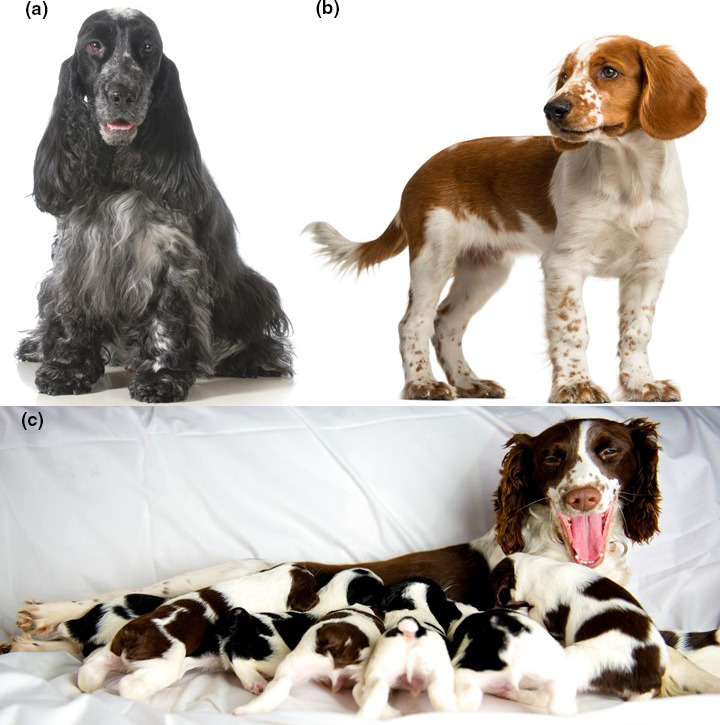
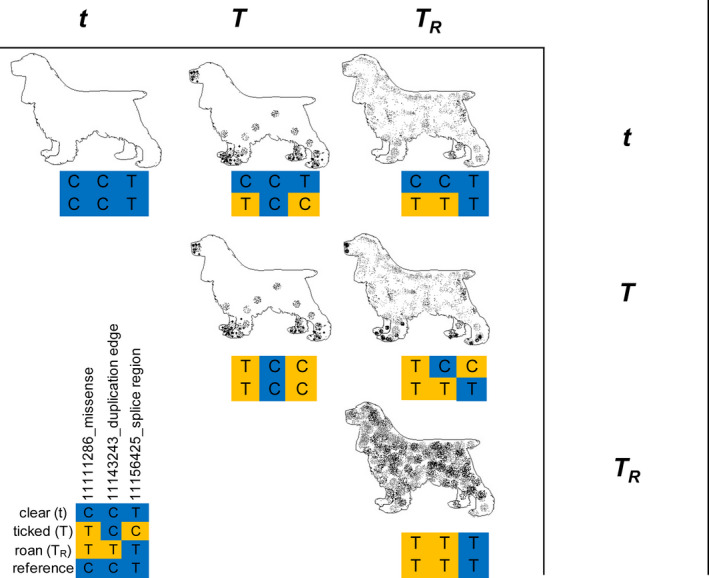
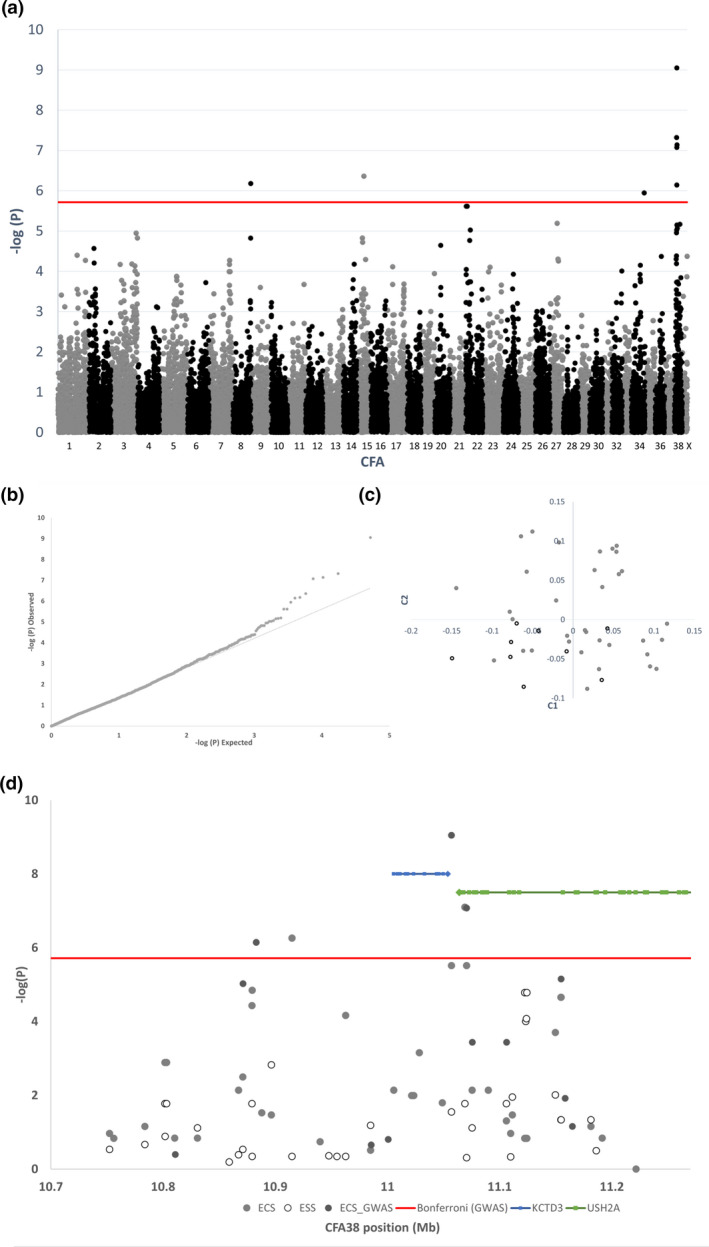
White coat patterning is a feature of many dog breeds and is known to be coded primarily by the gene micropthalmia-associated transcription factor (MITF). This patterning in the coat can be modified by other factors to produce the attractive phenotypes termed 'ticked' and 'roan' that describe the presence of flecks of color that vary in distribution and intensity within otherwise 'clear' white markings. The appearance of the pigment in the white patterning caused by ticking and roaning intensifies in the weeks after birth. We applied genome-wide association to compare English Cocker Spaniels of roan phenotype (N = 34) with parti-color (non-roan) English Cocker Spaniels (N = 9) and identified an associated locus on CFA 38, CFA38:11 057 040 (P = 8.9 × 10 , P = 2.7 × 10 ). A local case-control association in English Springer Spaniels comparing 11 ticked and six clear dogs identified indicative association with a different haplotype, CFA38:11 122 467G>T (P = 1.7 × 10 ) and CFA38:11 124 294A>C (P = 1.7 × 10 ). We characterize three haplotypes in Spaniels according to their putative functional variant profiles at CFA38:11 111 286C>T (missense), CFA38:11 131 841-11 143 239DUP.insTTAA (using strongly linked marker CFA38:11 143 243C>T) and CFA38:11 156 425T>C (splice site). In Spaniels, the haplotypes work as an allelic series including alleles (t, recessive clear; T, dominant ticked/parti-color; and T , incomplete dominant roan) to control the appearance of pigmented spots or flecks in otherwise white areas of the canine coat. In Spaniels the associated haplotypes are t (CCT), T (TCC) and T (TTT) for SNP markers on CFA38 at 11 111 286C>T, 11 143 243C>T and 11 156 425T>C respectively. It is likely that other alleles exist in this series and together the haplotypes result in a complex range of patterning that is only visible when dogs have white patterning resulting from the epistatic gene Micropthalmia-associated transcription factor (the S-locus).
白色外套图案是许多犬种的特征,已知主要由小眼相关转录因子(MITF)基因编码。外套上的这种图案可以通过其他因素进行修改,产生所谓的“点状”和“杂色”的有吸引力的表型,描述的是存在颜色斑点,其分布和强度在其他“清晰”的白色标记内有所不同。在 ticking 和 roaning 引起的白色图案中,色素的出现会在出生后几周内加剧。我们应用全基因组关联分析比较了杂色(非 roan)英国可卡犬(N=9)和具有杂色表型的英国可卡犬(N=34),并在 CFA 38 上确定了一个相关的位置,CFA38:11 057 040(P=8.9×10^-7,P=2.7×10^-6)。在比较 11 只点状和 6 只清晰的英国史宾格犬的局部病例对照关联中,确定了与不同单倍型的指示性关联,CFA38:11 111 286C>T(P=1.7×10^-7)和 CFA38:11 111 286C>T(P=1.7×10^-7)。我们根据 CFA38:11 111 286C>T(错义)、CFA38:11 131 841-11 143 239DUP.insTTAA(使用强连锁标记 CFA38:11 143 243C>T)和 CFA38:11 156 425T>C(剪接位点)在 CFA38 上的假定功能变异谱,对史宾格犬中的三个单倍型进行了特征描述。在史宾格犬中,这些单倍型作为等位基因系列起作用,包括等位基因(t,隐性清晰;T,显性点状/杂色;和 T,不完全显性杂色),以控制犬外套中白色区域出现有色斑点或斑纹。在史宾格犬中,与 SNP 标记相关的单倍型分别为 CFA38 上的 11 111 286C>T(CCT)、11 143 243C>T(TCC)和 11 156 425T>C(TTT)。在这个系列中可能存在其他等位基因,这些单倍型共同导致了一种复杂的图案,只有当狗的毛色是由上位基因小眼相关转录因子(S 基因座)引起的白色图案时才可见。