National CJD Research & Surveillance Unit, Centre for Clinical Brain Sciences, University of Edinburgh, Western General Hospital, Crewe Road, Edinburgh EH4 2XU, UK.
Biomolecules. 2021 Feb 2;11(2):207. doi: 10.3390/biom11020207.
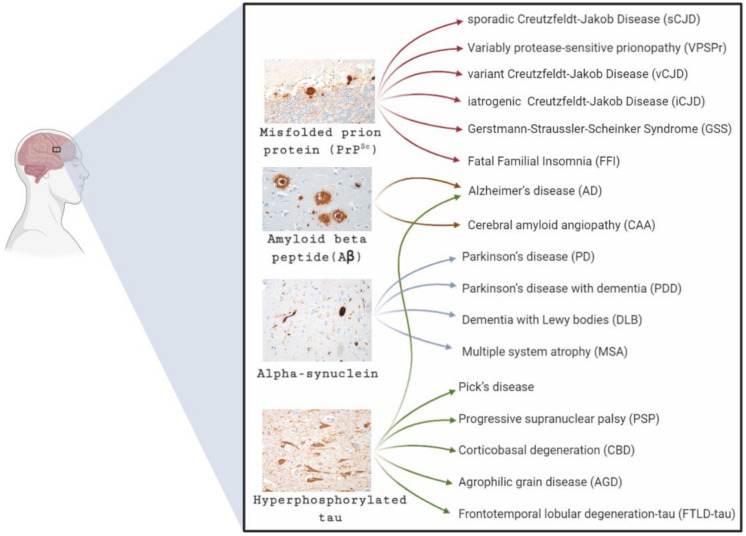
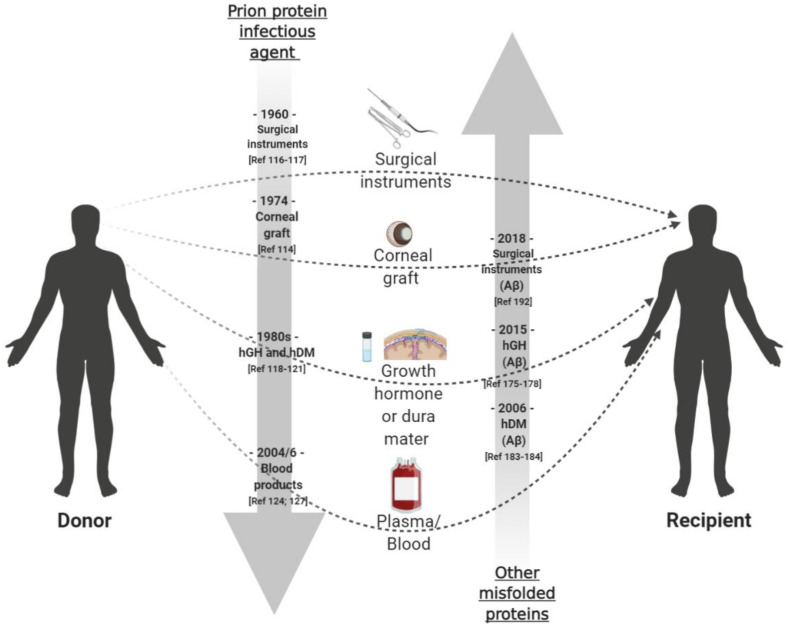
The accumulation and propagation in the brain of misfolded proteins is a pathological hallmark shared by many neurodegenerative diseases such as Alzheimer's disease (Aβ and tau), Parkinson's disease (α-synuclein), and prion disease (prion protein). Currently, there is no epidemiological evidence to suggest that neurodegenerative disorders are infectious, apart from prion diseases. However, there is an increasing body of evidence from experimental models to suggest that other pathogenic proteins such as Aβ and tau can propagate in vivo and in vitro in a prion-like mechanism, inducing the formation of misfolded protein aggregates such as amyloid plaques and neurofibrillary tangles. Such similarities have raised concerns that misfolded proteins, other than the prion protein, could potentially transmit from person-to-person as rare events after lengthy incubation periods. Such concerns have been heightened following a number of recent reports of the possible inadvertent transmission of Aβ pathology via medical and surgical procedures. This review will provide a historical perspective on the unique transmissible nature of prion diseases, examining their impact on public health and the ongoing concerns raised by this rare group of disorders. Additionally, this review will provide an insight into current evidence supporting the potential transmissibility of other pathogenic proteins associated with more common neurodegenerative disorders and the potential implications for public health.
错误折叠蛋白在大脑中的积累和传播是许多神经退行性疾病(如阿尔茨海默病(Aβ和tau)、帕金森病(α-突触核蛋白)和朊病毒病(朊病毒蛋白))的共同病理标志。目前,除朊病毒病外,没有流行病学证据表明神经退行性疾病具有传染性。然而,越来越多的实验模型证据表明,其他致病蛋白,如 Aβ和 tau,可以在体内和体外以类似于朊病毒的机制传播,诱导错误折叠蛋白聚集体(如淀粉样斑块和神经原纤维缠结)的形成。这种相似性引发了人们的担忧,即除朊病毒蛋白外,错误折叠蛋白可能会在长时间潜伏期后,作为罕见事件从一个人传播到另一个人。在最近的一些关于通过医疗和手术程序可能无意中传播 Aβ病理学的报道之后,这种担忧加剧了。本综述将提供对朊病毒病独特的可传播性质的历史视角,探讨其对公共卫生的影响以及这一罕见疾病群体所引起的持续关注。此外,本综述还将深入探讨目前支持与更常见神经退行性疾病相关的其他致病蛋白潜在可传播性的证据,以及对公共卫生的潜在影响。