Department of Preventive Medicine, Seoul National University College of Medicine, Seoul, Korea.
Division of Cancer Control and Policy, National Cancer Control Institute, National Cancer Center, Goyang, Korea.
Epidemiol Health. 2021;43:e2021011. doi: 10.4178/epih.e2021011. Epub 2021 Feb 3.
Biliary tract cancers (BTCs) are rare but highly fatal. Although the etiology of BTC is poorly understood, gallstones are proposed to be a major risk factor. We conducted a systematic review and meta-analysis to examine the associations between gallstone characteristics and BTC risk.
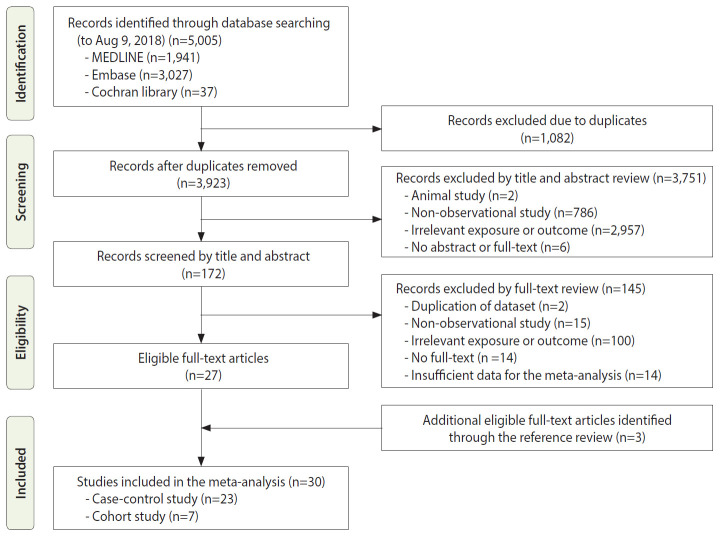
We searched the MEDLINE, Embase, and Cochrane Central databases and systematically reviewed cohort and case-control studies published before April 9, 2018. All the included studies reported appropriate risk estimates and confidence intervals (CIs) for associations between the presence, size, number, or duration of gallstones and the risk of BTC, including gallbladder cancer (GBC), extrahepatic bile duct cancer (EBDC), and ampulla of Vater cancer (AOVC). Summary odds ratios (ORs) and their 95% CIs were calculated using a random-effects model in the meta-analysis. Subgroup analyses were conducted to inspect sources of potential heterogeneity, and the Egger test was performed to assess publication bias.
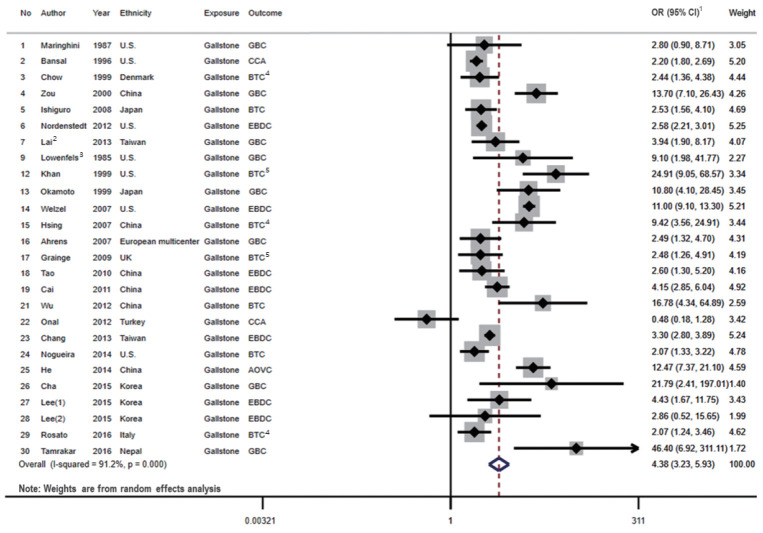
Seven cohort studies and 23 case-control studies in Asian, European, and American populations were included. The presence of gallstones was associated with an increased risk of BTC (OR, 4.38; 95% CI, 3.23 to 5.93; I2=91.2%), GBC (OR, 7.26; 95% CI, 4.33 to 12.18), EBDC (OR, 3.17; 95% CI, 2.24 to 4.50), and AOVC (OR, 3.28; 95% CI, 1.33 to 8.11). Gallstone size (>1 vs. <1 cm; OR, 1.88; 95% CI, 1.10 to 3.22) was significantly associated with the risk of GBC.
Gallstone characteristics, such as presence, size, and number, are associated with an increased risk of BTC. However, significantly high heterogeneity in the meta-analyses is a limitation of this study.
胆道癌(BTC)较为罕见,但病死率极高。BTC 的病因尚不清楚,而胆结石被认为是一个主要的危险因素。我们进行了一项系统评价和荟萃分析,以研究胆结石特征与 BTC 风险之间的关系。
我们检索了 MEDLINE、Embase 和 Cochrane 中央数据库,并系统地回顾了 2018 年 4 月 9 日之前发表的队列研究和病例对照研究。所有纳入的研究都报告了胆结石的存在、大小、数量或持续时间与 BTC 风险(包括胆囊癌[GBC]、肝外胆管癌[EBDC]和壶腹癌[AOVC])之间的关联的适当风险估计值和置信区间(CI)。使用随机效应模型在荟萃分析中计算汇总优势比(OR)及其 95%CI。进行亚组分析以检查潜在异质性的来源,并使用 Egger 检验评估发表偏倚。
纳入了亚洲、欧洲和北美的 7 项队列研究和 23 项病例对照研究。胆结石的存在与 BTC(OR,4.38;95%CI,3.23 至 5.93;I2=91.2%)、GBC(OR,7.26;95%CI,4.33 至 12.18)、EBDC(OR,3.17;95%CI,2.24 至 4.50)和 AOVC(OR,3.28;95%CI,1.33 至 8.11)的风险增加相关。胆结石大小(>1 与<1 cm;OR,1.88;95%CI,1.10 至 3.22)与 GBC 的风险显著相关。
胆结石的特征,如存在、大小和数量,与 BTC 的风险增加相关。然而,荟萃分析中存在显著的高度异质性是本研究的一个局限性。