The Medical Research Council Mitochondrial Biology Unit, University of Cambridge, Cambridge, CB2 0XY, United Kingdom.
The Medical Research Council Mitochondrial Biology Unit, University of Cambridge, Cambridge, CB2 0XY, United Kingdom
Proc Natl Acad Sci U S A. 2021 Feb 23;118(8). doi: 10.1073/pnas.2021012118.
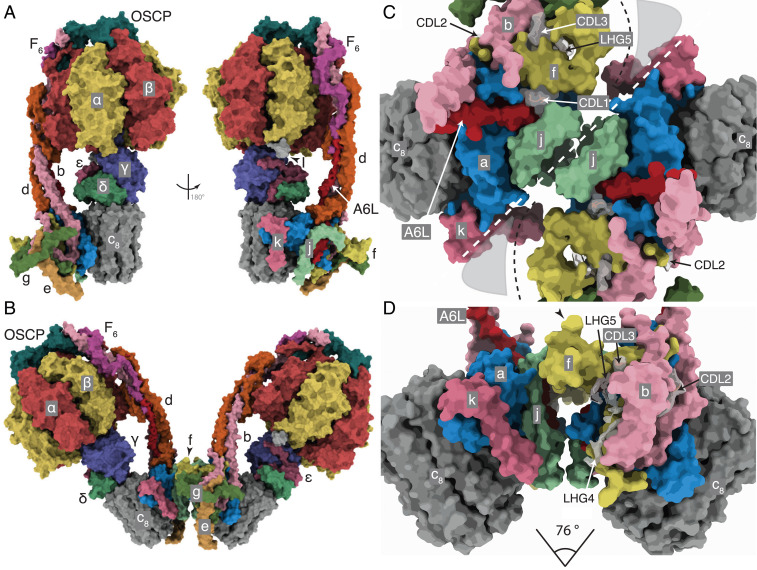
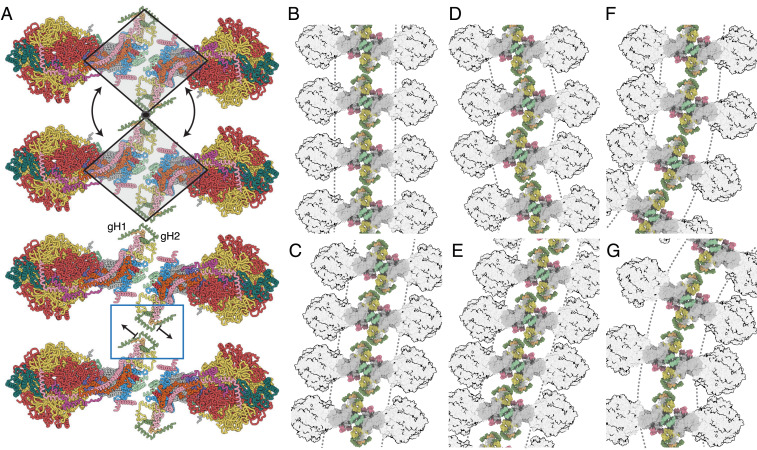
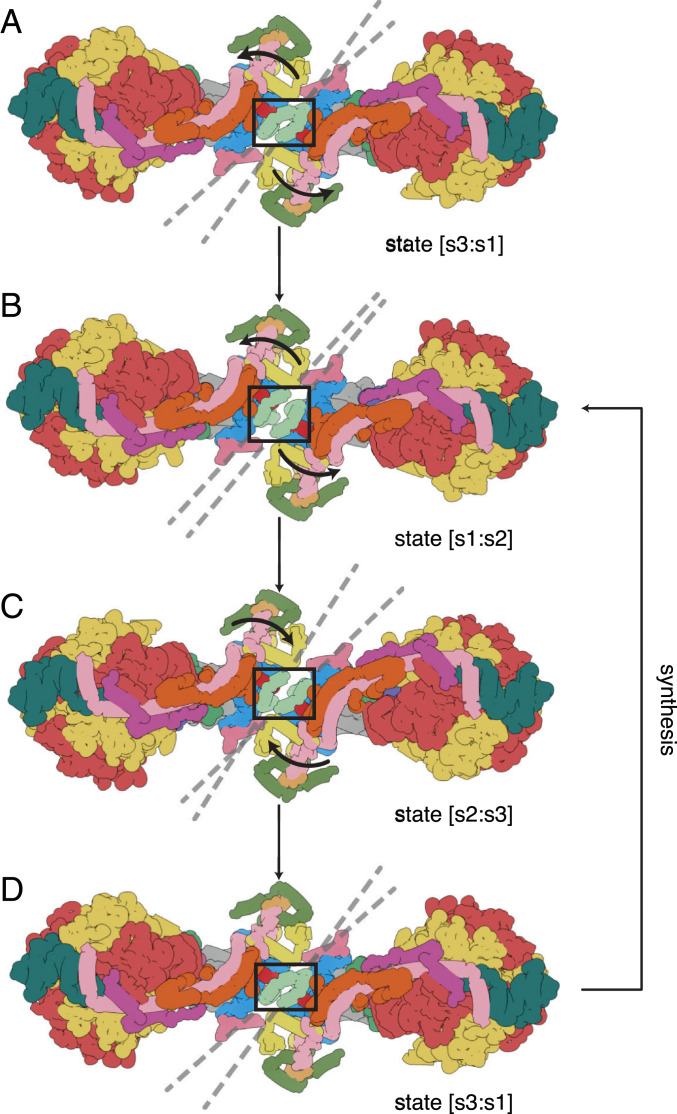
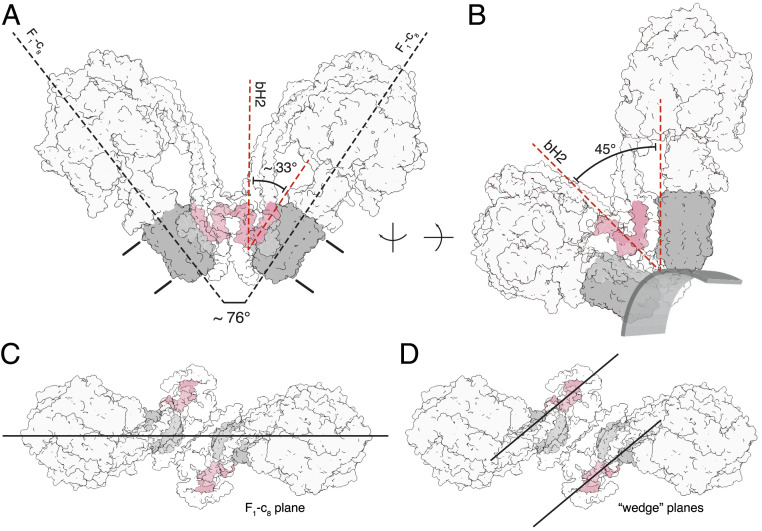
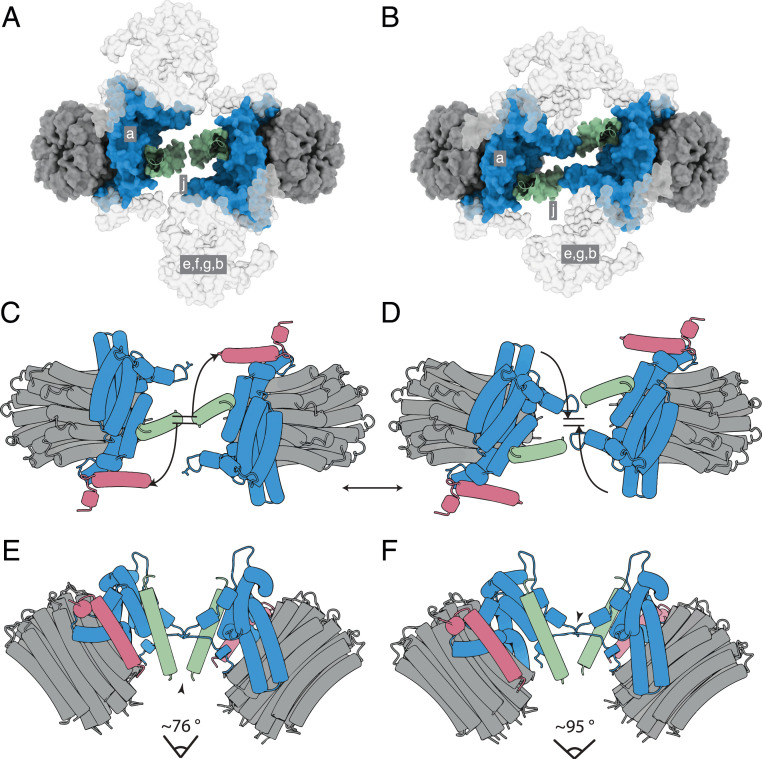
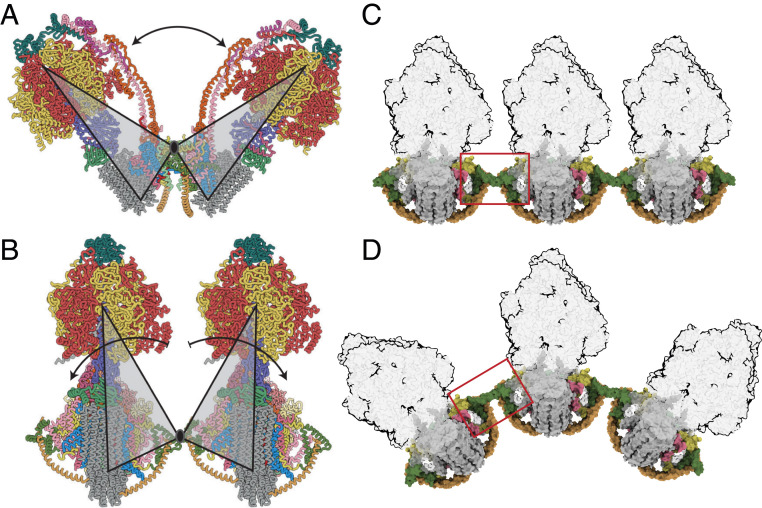
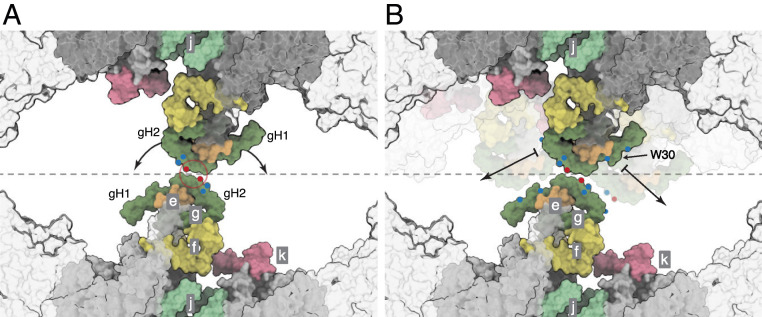
The ATP synthase complexes in mitochondria make the ATP required to sustain life by a rotary mechanism. Their membrane domains are embedded in the inner membranes of the organelle, and they dimerize via interactions between their membrane domains. The dimers form extensive chains along the tips of the cristae with the two rows of monomeric catalytic domains extending into the mitochondrial matrix at an angle to each other. Disruption of the interface between dimers by mutation affects the morphology of the cristae severely. By analysis of particles of purified dimeric bovine ATP synthase by cryo-electron microscopy, we have shown that the angle between the central rotatory axes of the monomeric complexes varies between ca. 76 and 95°. These particles represent active dimeric ATP synthase. Some angular variations arise directly from the catalytic mechanism of the enzyme, and others are independent of catalysis. The monomer-monomer interaction is mediated mainly by j subunits attached to the surface of wedge-shaped protein-lipid structures in the membrane domain of the complex, and the angular variation arises from rotational and translational changes in this interaction, and combinations of both. The structures also suggest how the dimeric ATP synthases might be interacting with each other to form the characteristic rows along the tips of the cristae via other interwedge contacts, molding themselves to the range of oligomeric arrangements observed by tomography of mitochondrial membranes, and at the same time allowing the ATP synthase to operate under the range of physiological conditions that influence the structure of the cristae.
线粒体中的 ATP 合酶复合物通过旋转机制产生维持生命所需的 ATP。它们的膜结构域嵌入细胞器的内膜中,并通过膜结构域之间的相互作用二聚化。这些二聚体通过在嵴的尖端形成广泛的链,与彼此成一定角度延伸到线粒体基质中的两个单体催化结构域的两排结合在一起。突变破坏二聚体之间的界面会严重影响嵴的形态。通过对纯化的牛二聚体 ATP 合酶颗粒进行冷冻电镜分析,我们表明单体复合物的中心旋转轴之间的角度在约 76 到 95°之间变化。这些颗粒代表活性二聚体 ATP 合酶。一些角度变化直接来自于酶的催化机制,而另一些则与催化无关。单体-单体相互作用主要通过附着在复合物膜结构域中楔形蛋白-脂质结构表面的 j 亚基介导,角度变化来自于这种相互作用的旋转和平移变化,以及两者的组合。这些结构还表明,二聚体 ATP 合酶如何通过其他楔形间接触相互作用,形成沿着嵴尖端的特征行,通过改变自身形状以适应通过线粒体膜断层扫描观察到的寡聚排列范围,同时允许 ATP 合酶在影响嵴结构的一系列生理条件下运行。