International Healthcare Center, Asan Medical Center, Seoul, Korea.
Department of Clinical Epidemiology and Biostatics, Asan Medical Center, Seoul, Korea.
Sci Rep. 2021 Feb 4;11(1):3087. doi: 10.1038/s41598-021-82593-7.
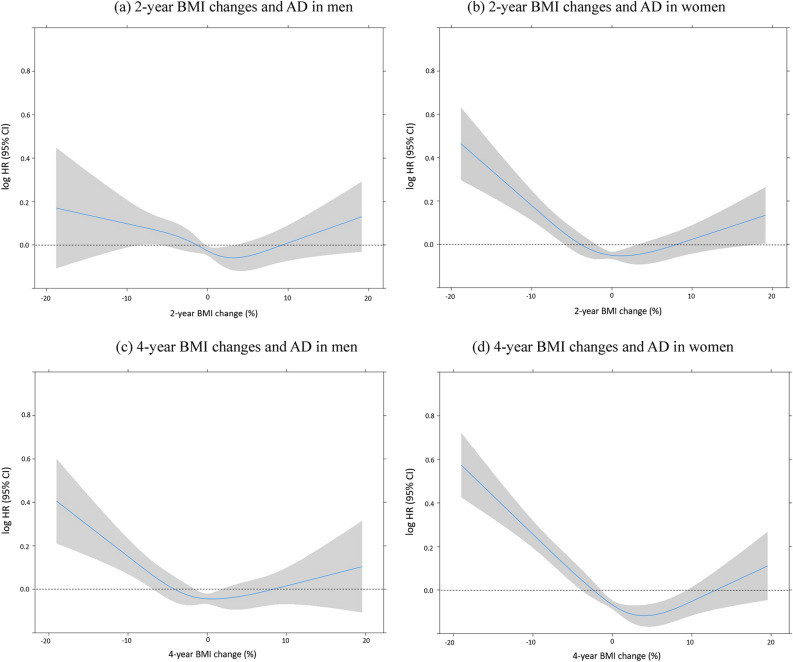
The effect of body mass index (BMI) changes and variability on the risk for Alzheimer's disease (AD) remains unclear. We analyzed 45,076 participants, whose BMI were measured on phase 1 (2002-2003), phase 2 (2004-2005), and phase 3 (2006-2007), of the Korean National Health Insurance Service-Health Screening Cohort. We evaluated the effect of 2- and 4-year BMI changes and BMI variability on the risk of AD using Cox regression models. In men, association between 2-year BMI changes, BMI variability, and the risk of AD was not significant. Risk of AD was higher in men whose BMI had decreased 10.1-15.0% over 4 years. In women, aHRs and 95% CIs for AD were 1.14 (1.02-1.29), 1.44 (1.17-1.79), and 1.51 (1.09-2.09) when 2-year BMI loss was 5.1-10.0%, 10.1-15.0%, and > 15.0%. The HRs for AD in women significantly increased when 4-year BMI loss was > 5.0%. The aHR and 95% CI for AD was 1.31 (1.17-1.46) in the 4th quartile of average successive variability (ASV) compared with the 1st quartile of ASV in women. BMI loss over 2- and 4-year period was associated with increased risk for AD, and risk increased in women with higher BMI variability. Appropriate body weight management is recommended to prevent AD.
体重指数(BMI)变化和变异性对阿尔茨海默病(AD)风险的影响尚不清楚。我们分析了 45076 名参与者,他们的 BMI 在韩国国民健康保险服务-健康筛查队列的第 1 阶段(2002-2003 年)、第 2 阶段(2004-2005 年)和第 3 阶段(2006-2007 年)进行了测量。我们使用 Cox 回归模型评估了 2 年和 4 年 BMI 变化以及 BMI 变异性对 AD 风险的影响。在男性中,2 年 BMI 变化、BMI 变异性与 AD 风险之间没有显著关联。在男性中,4 年内 BMI 下降 10.1-15.0%的 AD 风险较高。在女性中,2 年 BMI 损失为 5.1-10.0%、10.1-15.0%和>15.0%时,AD 的校正 HR 和 95%CI 分别为 1.14(1.02-1.29)、1.44(1.17-1.79)和 1.51(1.09-2.09)。当 4 年内 BMI 损失>5.0%时,女性 AD 的 HR 显著增加。与女性 ASV 第 1 四分位数相比,ASV 第 4 四分位数的 AD 的校正 HR 和 95%CI 为 1.31(1.17-1.46)。2 年和 4 年内 BMI 下降与 AD 风险增加相关,BMI 变异性较高的女性风险增加。建议适当的体重管理以预防 AD。