Department of Gynecology, European Competence Center for Ovarian Cancer, Berlin, Germany, Charité - Universitätsmedizin Berlin, corporate member of Freie Universität Berlin, Humboldt-Universität zu Berlin, and Berlin Institute of Health, Berlin, Germany.
Division of Cardiology and Metabolism, Department of Cardiology (CVK), Charité Universitätsmedizin Berlin, Berlin, Germany.
J Cachexia Sarcopenia Muscle. 2021 Apr;12(2):393-402. doi: 10.1002/jcsm.12676. Epub 2021 Feb 4.
Malnutrition and sarcopenia often occur simultaneously in cancer patients and are thought to have harmful effects on both surgical and oncological outcomes. Therefore, we want to evaluate the effects of sarcopenia and malnutrition on severe postoperative complications and overall survival in gynecologic cancer patients.
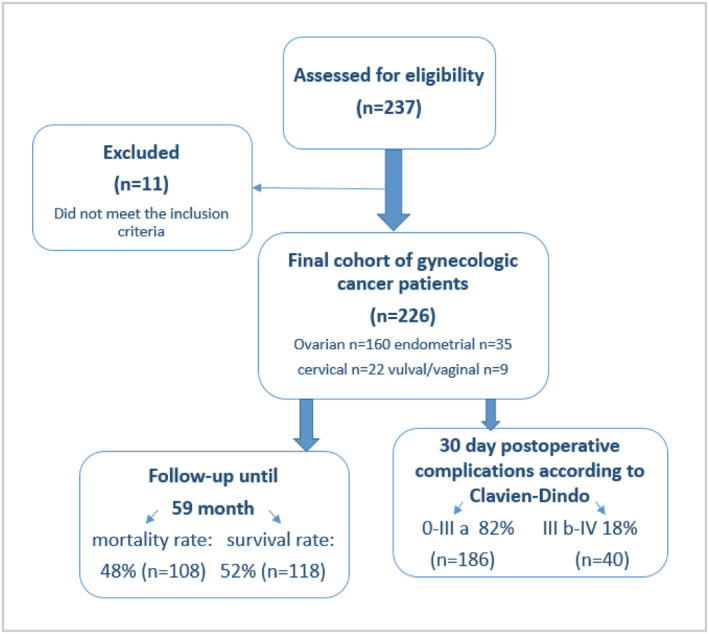
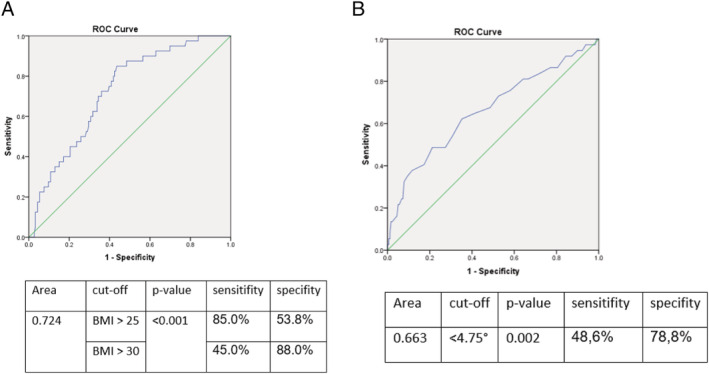
We assessed nutritional parameters and run a bioelectrical impedance analysis in 226 women. Extracellular mass to body cell mass index, phase angle alpha, muscle mass, and fat mass were evaluated. To determine if patients suffer from sarcopenia, we ran the Timed 'Up and Go' test, performed hand grip strength, and calculated a skeletal muscle index. Postoperative complications were categorized using Clavien-Dindo Classification. Utilizing ROC analysis and logistic regression, we determined predictive clinical factors for severe postoperative complications. Kaplan-Meier method and log-rank test were used for overall survival analysis.
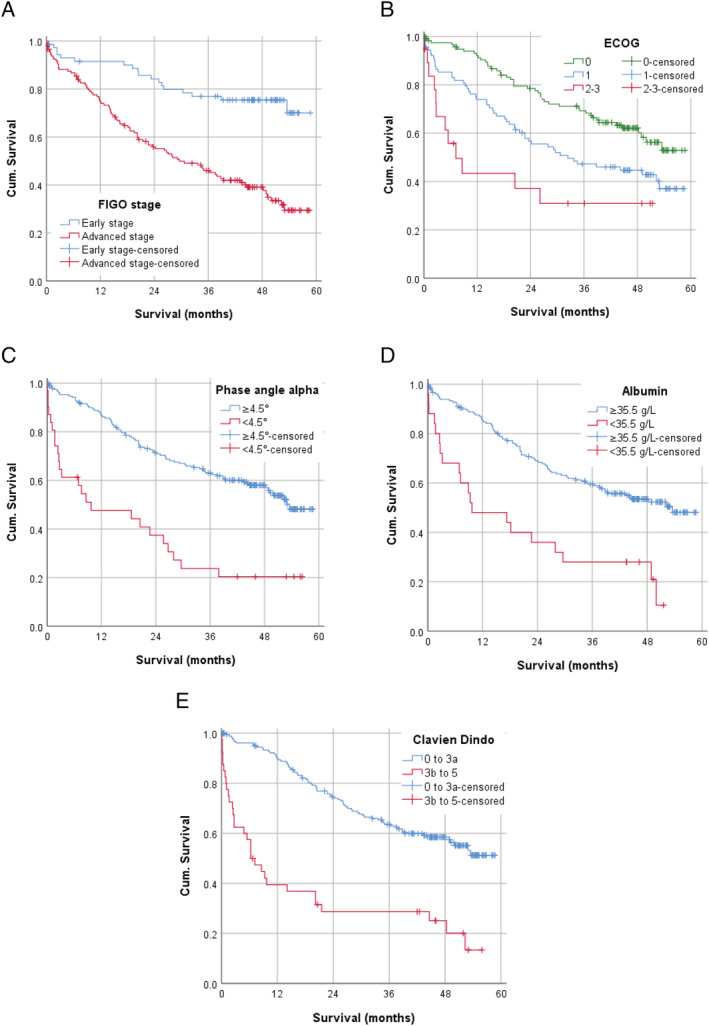
Of the 226 female patients, 120 (53%) had a BMI ≥ 25 kg/m , 56 (26%) had a phase angle < 4.75°, and 68 (32%) were sarcopenic according to skeletal muscle index < 27%. Within 30 days after surgery, 40 (18%) patients developed severe postoperative complications, and 4% had died. According to multivariable regression analysis, ECOG status > 1 (OR 4.56, 95% CI: 1.46-14.28, P = 0.009), BMI ≥ 25 kg/m (OR 8.22, 95% CI: 3.01-22.48, P < 0.001), phase angle < 4.75° (OR 3.95, 95% CI: 1.71-9.10, P = 0.001), and tumour stage ≥ III A (OR 3.65, 95% CI: 1.36-9.76, P = 0.01) were predictors of severe postoperative complications. During 59 months of follow-up, 108 (48%) patients had died. According to multivariable Cox regression ECOG status > 1 (HR 2.51, 95% CI: 1.25-5.03, P = 0.01), hypoalbuminemia (HR 2.15, 95% CI: 1.28-3.59, P = 0.004), phase angle < 4.5° (HR 1.76, 95% CI 1.07-2.90, P = 0.03), tumour stage ≥ III A (HR 2.61, 95% CI: 1.53-4.45, P < 0.001), and severe postoperative complications (HR 2.82, 95% CI: 1.80-4.41, P < 0.001) were predictors of overall mortality.
We observed that preoperatively assessed ECOG status > 1, BMI > 25 kg, as well as phase angle alpha < 4.75° and FIGO stage ≥ III A are significantly associated with severe postoperative complications within the first month. Whereas ECOG status > 1, hypoalbuminemia, phase angle < 4.5° as well as FIGO stage ≥ III A and severe postoperative complications within 30 days correlate significantly with poor overall survival.
营养不良和肌肉减少症常同时发生在癌症患者中,被认为对手术和肿瘤学结果都有不良影响。因此,我们想评估肌肉减少症和营养不良对妇科癌症患者严重术后并发症和总生存的影响。
我们评估了 226 名女性的营养参数并进行了生物电阻抗分析。评估了细胞外液质量与细胞内液质量指数、相位角α、肌肉质量和脂肪质量。为了确定患者是否患有肌肉减少症,我们进行了计时“起立行走”测试、进行了握力测试,并计算了骨骼肌指数。使用 Clavien-Dindo 分类对术后并发症进行分类。利用 ROC 分析和逻辑回归,我们确定了严重术后并发症的预测临床因素。Kaplan-Meier 方法和对数秩检验用于总生存分析。
在 226 名女性患者中,120 名(53%)的 BMI≥25kg/m2,56 名(26%)的相位角<4.75°,68 名(32%)根据骨骼肌指数<27%诊断为肌肉减少症。术后 30 天内,40 名(18%)患者发生严重术后并发症,4%患者死亡。根据多变量回归分析,ECOG 状态>1(OR 4.56,95%CI:1.46-14.28,P=0.009)、BMI≥25kg/m2(OR 8.22,95%CI:3.01-22.48,P<0.001)、相位角<4.75°(OR 3.95,95%CI:1.71-9.10,P=0.001)和肿瘤分期≥III A(OR 3.65,95%CI:1.36-9.76,P=0.01)是严重术后并发症的预测因素。在 59 个月的随访中,有 108 名(48%)患者死亡。根据多变量 Cox 回归分析,ECOG 状态>1(HR 2.51,95%CI:1.25-5.03,P=0.01)、低白蛋白血症(HR 2.15,95%CI:1.28-3.59,P=0.004)、相位角<4.5°(HR 1.76,95%CI 1.07-2.90,P=0.03)、肿瘤分期≥III A(HR 2.61,95%CI:1.53-4.45,P<0.001)和严重术后并发症(HR 2.82,95%CI:1.80-4.41,P<0.001)是总死亡率的预测因素。
我们观察到,术前评估的 ECOG 状态>1、BMI>25kg/m2 以及相位角 alpha<4.75°和 FIGO 分期≥III A 与术后第一个月内严重的术后并发症显著相关。而 ECOG 状态>1、低白蛋白血症、相位角<4.5°以及 FIGO 分期≥III A 和术后 30 天内严重的术后并发症与总生存率显著相关。