Tian Feng, Pan Huiying, Wu Qi, Jiang Dapeng
Department of Pediatric Surgery, Suzhou Wujiang District Children's Hospital, Suzhou, Jiangsu Province, People's Republic of China.
Department of Oncology (Ward 2), Shanghai Children's Medical Center, School of Medicine, Shanghai Jiao Tong University, Shanghai, People's Republic of China.
Int J Womens Health. 2025 Jun 17;17:1815-1828. doi: 10.2147/IJWH.S526607. eCollection 2025.
To investigate the relationship between sarcopenia susceptibility and cesarean section (CS) and to assess causality using Mendelian randomization (MR).
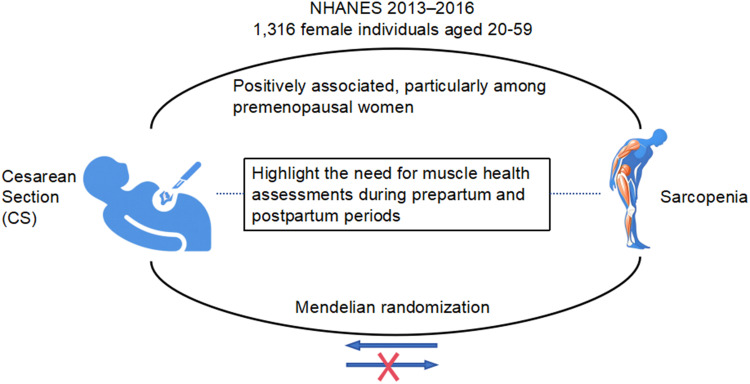
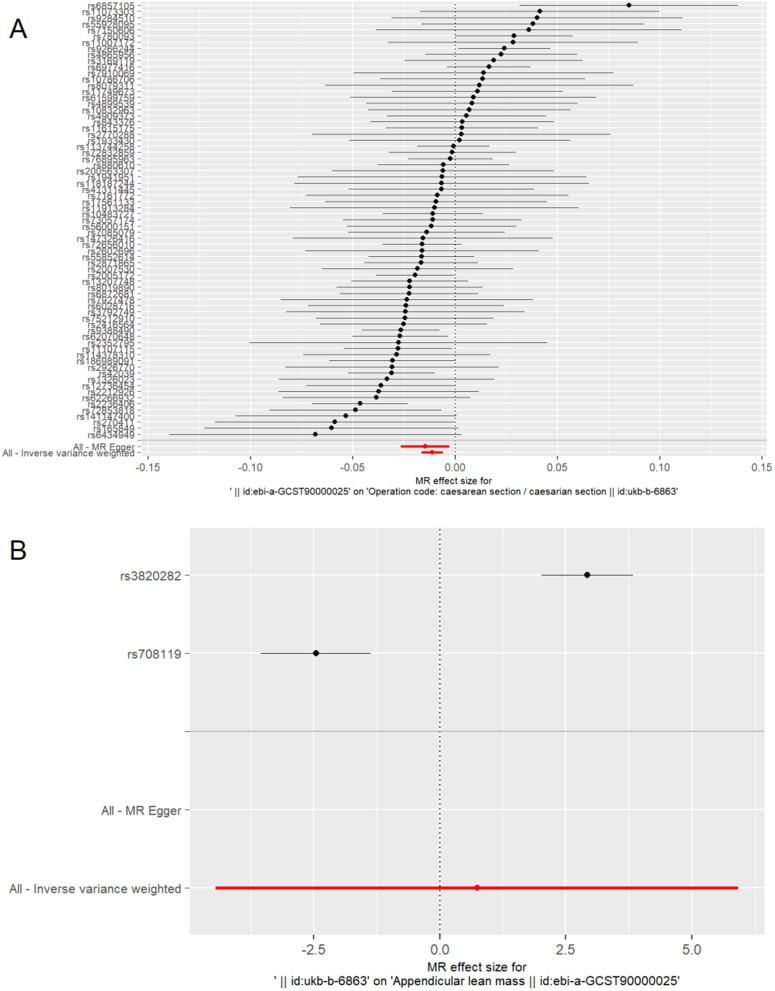
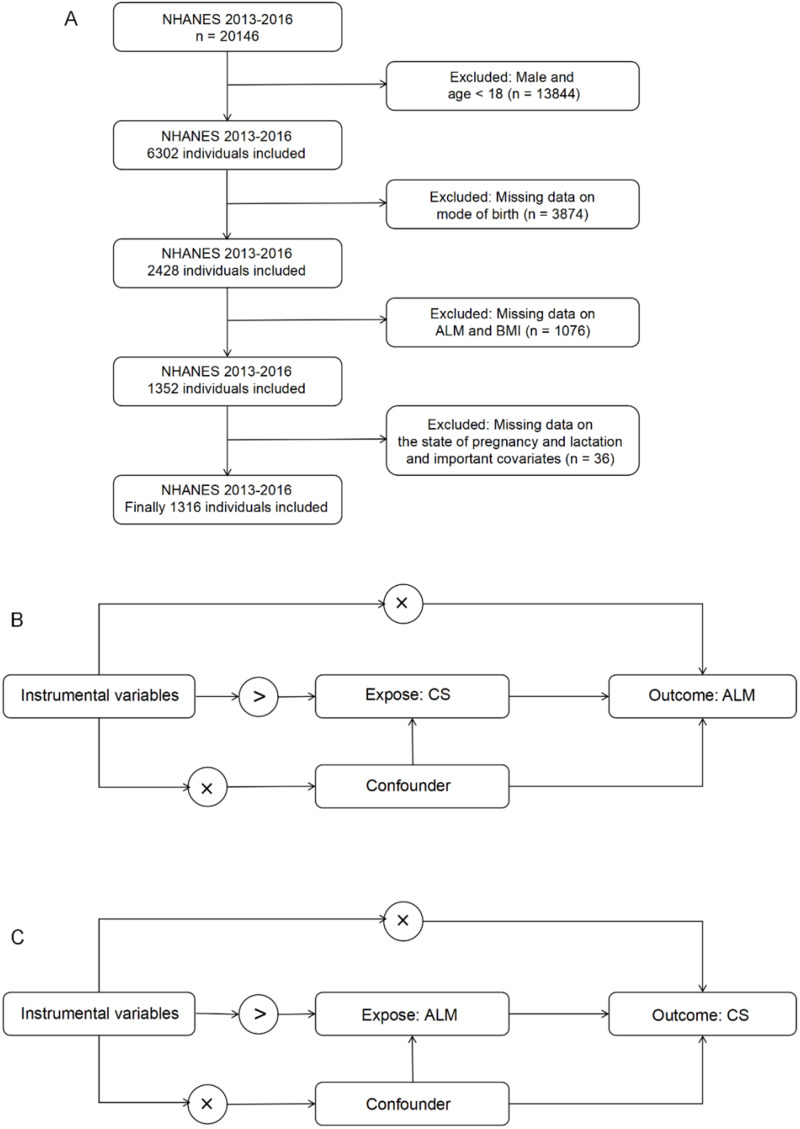
Data from 1,316 individuals aged from 20-59 in National Health and Nutrition Examination Survey (NHANES) 2013-2016 were included in the study. The association between sarcopenia and CS was investigated by adjusting for confounders using multivariable linear and logistic regression analysis. Two-sample bidirectional MR was employed to evaluate causal relationships. Genetic data associated with CS (n=462,933) and appendicular lean mass (ALM, n=450,243) were sourced from the largest genome-wide association studies (GWAS). The primary analytical method used was inverse variance-weighted (IVW).
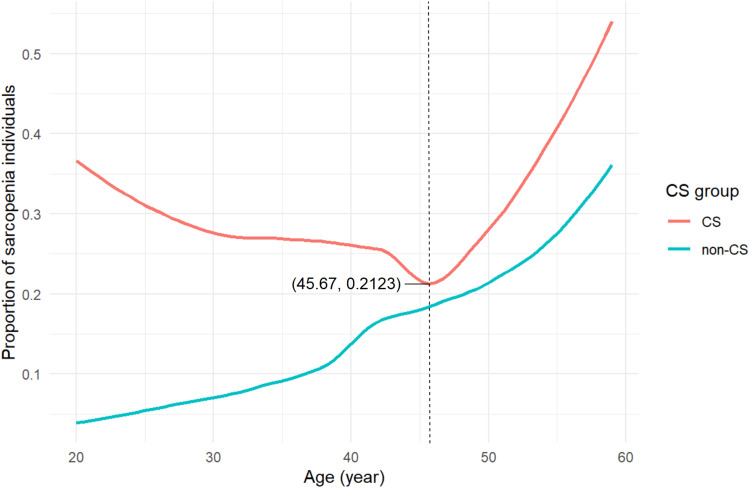
Based on the cross-sectional study, the number of CS was positively correlated with sarcopenia across all adjusted models, whereas no such association was observed with vaginal delivery (VD). Subgroup analyses indicated that these associations were primarily evident among premenopausal women. IVW-MR analysis revealed a significant association between sarcopenia and CS (OR=0.989, 95% CI: 0.984 to 0.994, P<0.001), but there was no statistically causal link in reverse (OR=2.100, 95% CI: 0.012 to 364.040, P=0.779).
A significant positive correlation and potential causal relationship between sarcopenia susceptibility and CS were identified, which highlighted the need for increased attention to sarcopenia in women with a history or high likelihood of CS, including but not limited to muscle health assessments during prepartum and postpartum periods, along with necessary muscle-strengthening interventions.
探讨肌肉减少症易感性与剖宫产(CS)之间的关系,并使用孟德尔随机化(MR)评估因果关系。
本研究纳入了2013 - 2016年美国国家健康与营养检查调查(NHANES)中1316名年龄在20 - 59岁之间的个体数据。通过多变量线性和逻辑回归分析调整混杂因素,研究肌肉减少症与剖宫产之间的关联。采用两样本双向MR评估因果关系。与剖宫产(n = 462,933)和四肢瘦体重(ALM,n = 450,243)相关的遗传数据来自最大的全基因组关联研究(GWAS)。使用的主要分析方法是逆方差加权(IVW)。
基于横断面研究,在所有调整模型中,剖宫产次数与肌肉减少症呈正相关,而阴道分娩(VD)则未观察到这种关联。亚组分析表明,这些关联主要在绝经前女性中明显。IVW - MR分析显示肌肉减少症与剖宫产之间存在显著关联(OR = 0.989,95%CI:0.984至0.994,P < 0.001),但反向无统计学因果联系(OR = 2.100,95%CI:0.012至364.040,P = 0.779)。
确定了肌肉减少症易感性与剖宫产之间存在显著正相关和潜在因果关系,这突出了需要更多关注有剖宫产史或剖宫产高可能性的女性的肌肉减少症,包括但不限于产前和产后期间的肌肉健康评估,以及必要的肌肉强化干预措施。