Universitäres Herz- und Gefäßzentrum Hamburg, Klinik und Poliklinik für Kardiologie, Universitätsklinikum Hamburg-Eppendorf, Hamburg, Germany.
Standort Hamburg/Kiel/Lübeck, Deutsches Zentrum für Herz-Kreislaufforschung (DZKH e. V.), Hamburg, Germany.
Herz. 2021 Mar;46(2):138-149. doi: 10.1007/s00059-021-05022-5. Epub 2021 Feb 5.
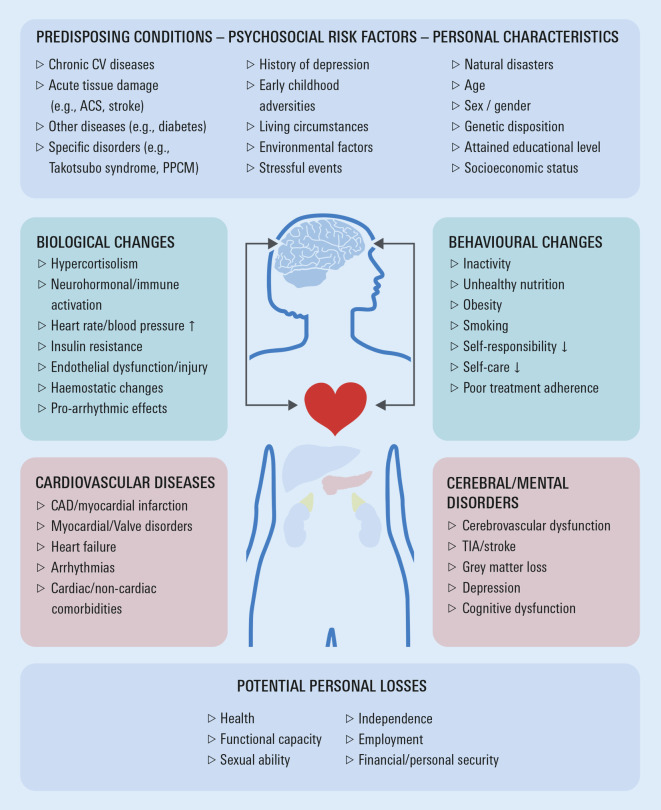
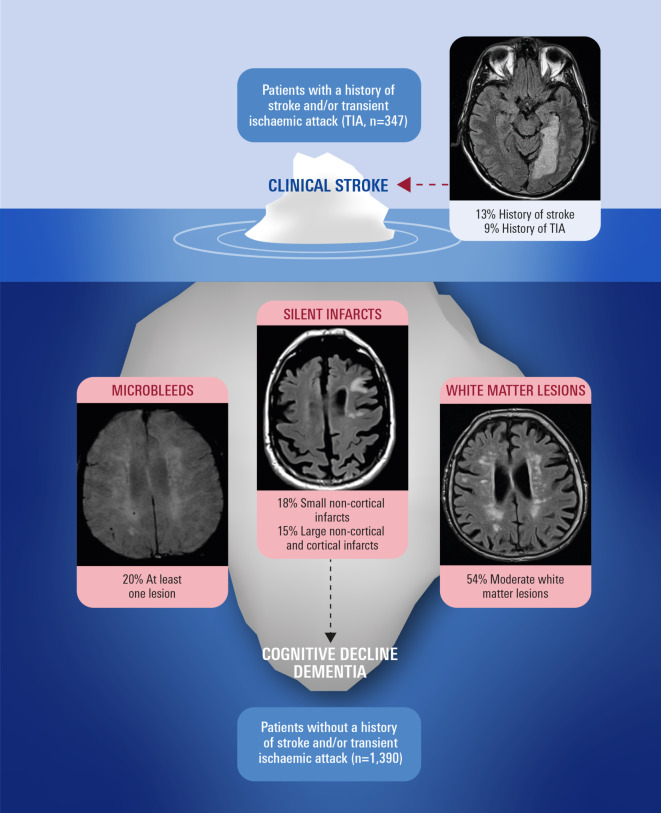
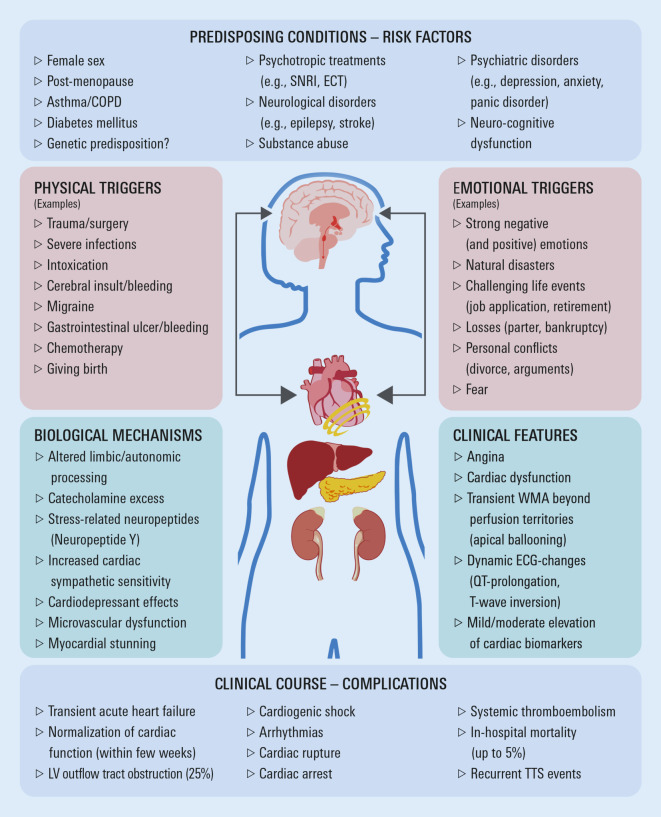
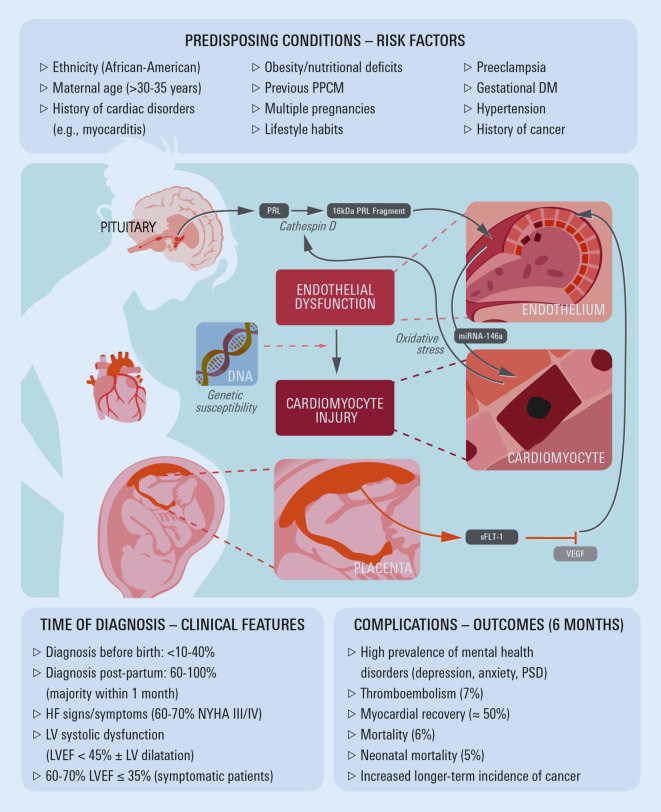
Cardiovascular diseases (CVD) and mental health disorders (MHD; e.g. depression, anxiety and cognitive dysfunction) are highly prevalent and are associated with significant morbidity and mortality and impaired quality of life. Currently, possible interactions between pathophysiological mechanisms in MHD and CVD are rarely considered during the diagnostic work-up, prognostic assessment and treatment planning in patients with CVD, and research addressing bidirectional disease mechanisms in a systematic fashion is scarce. Besides some overarching pathogenetic principles shared by CVD and MHD, there are specific syndromes in which pre-existing neurological or psychiatric illness predisposes and contributes to CVD development (as in Takotsubo syndrome), or in which the distorted interplay between innate immune and central nervous systems and/or pre-existing CVD leads to secondary MHD and brain damage (as in peripartum cardiomyopathy or atrial fibrillation). Clinical manifestations and phenotypes of cardio-psycho-neurological diseases depend on the individual somatic, psychosocial, and genetic risk profile as well as on personal resilience, and differ in many respects between men and women. In this article, we provide arguments on why, in such conditions, multidisciplinary collaborations should be established to allow for more comprehensive understanding of the pathophysiology as well as appropriate and targeted diagnosis and treatment. In addition, we summarize current knowledge on the complex interactions between the cardiovascular and central nervous systems in Takotsubo syndrome and peripartum cardiomyopathy, and on the neurological and psychiatric complications of atrial fibrillation.
心血管疾病 (CVD) 和精神健康障碍 (MHD;例如抑郁症、焦虑症和认知功能障碍) 非常普遍,与高发病率和死亡率以及生活质量受损有关。目前,在 CVD 患者的诊断工作、预后评估和治疗计划中,很少考虑到 MHD 和 CVD 之间的病理生理机制可能存在的相互作用,并且很少有研究以系统的方式解决双向疾病机制。除了 CVD 和 MHD 共有的一些总体发病机制原则外,还有一些特定的综合征,其中先前存在的神经或精神疾病使 CVD 的发展更容易发生(如 Takotsubo 综合征),或者先天免疫系统和中枢神经系统之间的扭曲相互作用和/或先前存在的 CVD 导致继发性 MHD 和脑损伤(如围产期心肌病或心房颤动)。心身神经病学疾病的临床表现和表型取决于个体的躯体、心理社会和遗传风险状况以及个人的适应能力,并且在男性和女性之间存在许多方面的差异。在本文中,我们提供了一些论据,说明为什么在这种情况下,应该建立多学科合作,以更全面地了解病理生理学,以及进行适当和有针对性的诊断和治疗。此外,我们总结了当前关于 Takotsubo 综合征和围产期心肌病中心血管系统和中枢神经系统之间复杂相互作用的知识,以及心房颤动的神经和精神并发症。