Department of Exercise Science, Brigham Young University, Provo, Utah, United States of America.
PLoS One. 2021 Feb 5;16(2):e0246605. doi: 10.1371/journal.pone.0246605. eCollection 2021.
Obesity is a growing global health concern. The increased body mass and altered mass distribution associated with obesity may be related to increases in plantar shear that putatively leads to physical functional deficits. Therefore, measurement of plantar shear may provide unique insights on the effects of body mass and body distribution on physical function or performance.
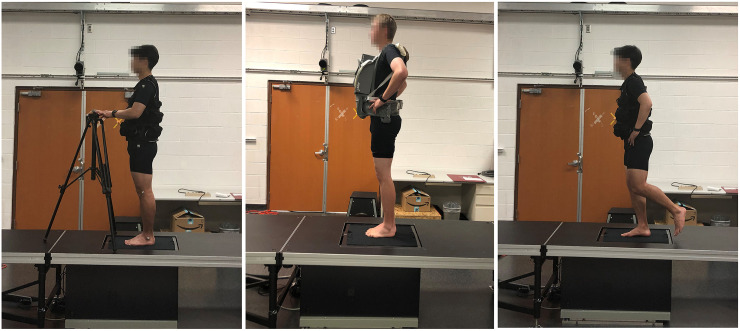
Twenty healthy young males participated in four different tests: 1) static test (for measuring plantar shear and CoP location without acceleration, 2) bilateral-foot standing postural control test, 3) single-foot standing postural test, and 4) walking test. All tests were executed in three different weight conditions: 1) unweighted (NV), 2) EV with 20% added body mass, and 3) FV, also with 20% added body mass. Plantar shear stresses were measured using a pressure/shear device, and several shear and postural control metrics were extracted. Repeated measures ANOVAs with Holms post hoc test were used to compare each metric among the three conditions (α = 0.05).
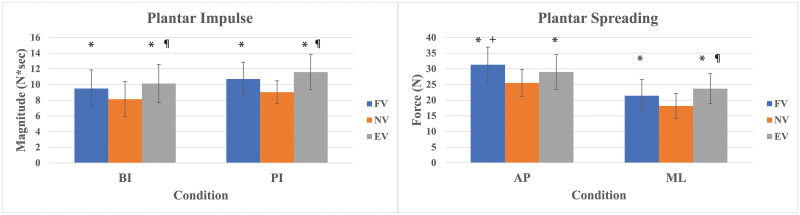
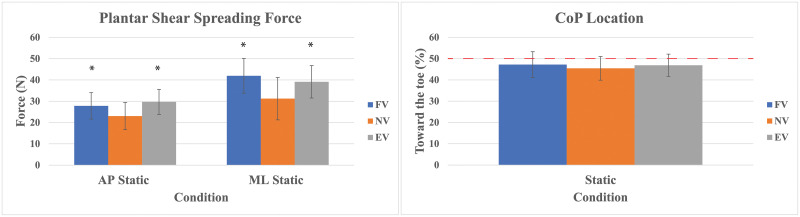
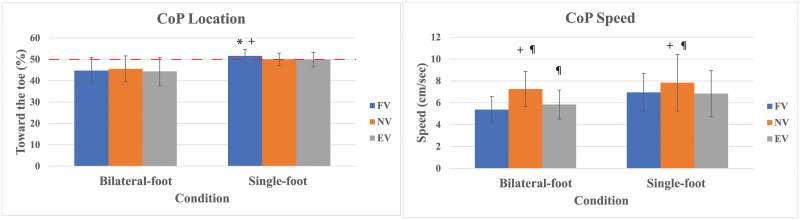
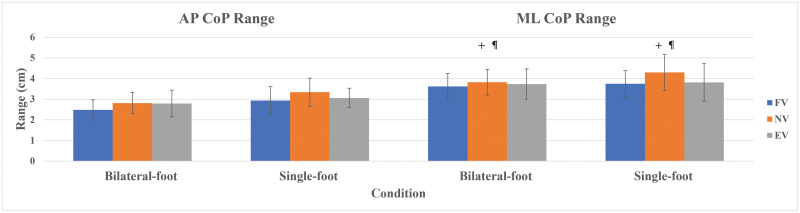
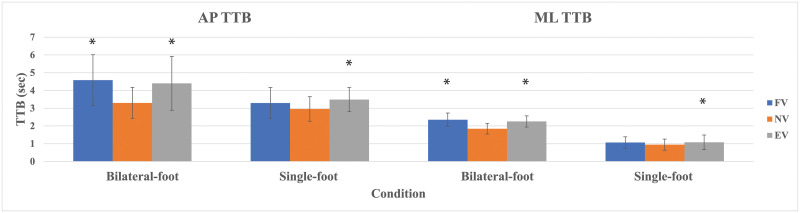
FV and EV increased both AP and ML plantar shear forces compared to NV. FV shifted CoP forward in single-foot trials. FV and EV showed decreased CoP range and velocity and increased Time-to-Boundary (TTB) during postural control compared to NV. EV and FV showed increased breaking impulse and propulsive impulse compared to NV. In addition, EV showed even greater impulses than FV. While EV increased ML plantar shear spreading force, FV increased AP plantar shear spreading force during walking.
Added body mass increases plantar shear spreading forces. Body mass distribution had greater effects during dynamic tasks. In addition, healthy young individuals seem to quickly adapt to external stimuli to control postural stability. However, as this is a first step study, follow-up studies are necessary to further support the clinical role of plantar shear in other populations such as elderly and individuals with obesity or diabetes.
肥胖是一个日益严重的全球健康问题。与肥胖相关的体重增加和体重分布改变,可能与足底剪切力的增加有关,而足底剪切力可能导致身体功能缺陷。因此,测量足底剪切力可能会提供关于体重和身体分布对身体功能或表现的影响的独特见解。
1)研究体重和分布对足底剪切力的影响。2)研究足底剪切力改变如何影响姿势控制和步态动力学。
1)与均匀分布的负重背心(EV)相比,前置负重背心(FV)会使站立时的中心压力(CoP)位置向前移动。2)FV 在站立时会比 EV 更增加足底剪切扩散力。3)FV 会增加站立时的姿势摆动,而 EV 则不会。4)FV 在行走时会引起比 EV 更大的代偿变化。
20 名健康年轻男性参加了四项不同的测试:1)静态测试(用于测量无加速度的足底剪切力和 CoP 位置),2)双侧足站立姿势控制测试,3)单足站立姿势测试,和 4)行走测试。所有测试均在三种不同的体重状态下进行:1)无负重(NV),2)添加 20%体重的 EV,和 3)添加 20%体重的 FV。使用压力/剪切装置测量足底剪切力,并提取了几个剪切和姿势控制指标。使用 Holm 事后检验的重复测量方差分析比较了三种状态下的每个指标(α=0.05)。
与 NV 相比,FV 和 EV 均增加了 AP 和 ML 足底剪切力。FV 在单足试验中使 CoP 向前移动。与 NV 相比,FV 和 EV 在姿势控制测试中显示 CoP 范围和速度减小,而到达边界的时间(TTB)增加。EV 和 FV 显示出比 NV 更大的制动冲量和推进冲量。此外,EV 显示出甚至更大的冲量。EV 增加了 ML 足底剪切扩散力,而 FV 增加了行走时的 AP 足底剪切扩散力。
添加的体重增加了足底剪切扩散力。体重分布在动态任务中影响更大。此外,健康的年轻个体似乎能够迅速适应外部刺激来控制姿势稳定性。然而,由于这是一项初步研究,因此需要进一步的研究来进一步支持在其他人群(如老年人和肥胖或糖尿病患者)中足底剪切力的临床作用。