Chamoun Kamal, Firoozmand Amin, Caimi Paolo, Fu Pingfu, Cao Shufen, Otegbeye Folashade, Metheny Leland, Patel Seema, Gerson Stanton L, Boughan Kirsten, De Lima Marcos, Malek Ehsan
Hematologic Malignancies and Stem Cell Transplant Program, University Hospitals Seidman Cancer Center, Case Western Reserve University, Cleveland, OH 44106, USA.
Department of Population and Quantitative Health Sciences, Case Western Reserve University, Cleveland, OH 44106, USA.
Cancers (Basel). 2021 Feb 3;13(4):590. doi: 10.3390/cancers13040590.
Outcome of Multiple Myeloma (MM) patients has improved as the result of the introduction of novel medications and use of autologous hematopoietic cell transplantation. However, this improvement comes at the expense of increased financial burden. It is largely unknown if socioeconomic factors influence MM survival.
We used the National Cancer Database, a database that houses data on 70% of cancer patients in the US, to evaluate the effect of socioeconomic factors on the survival of 117,926 MM patients diagnosed between 2005 and 2014.
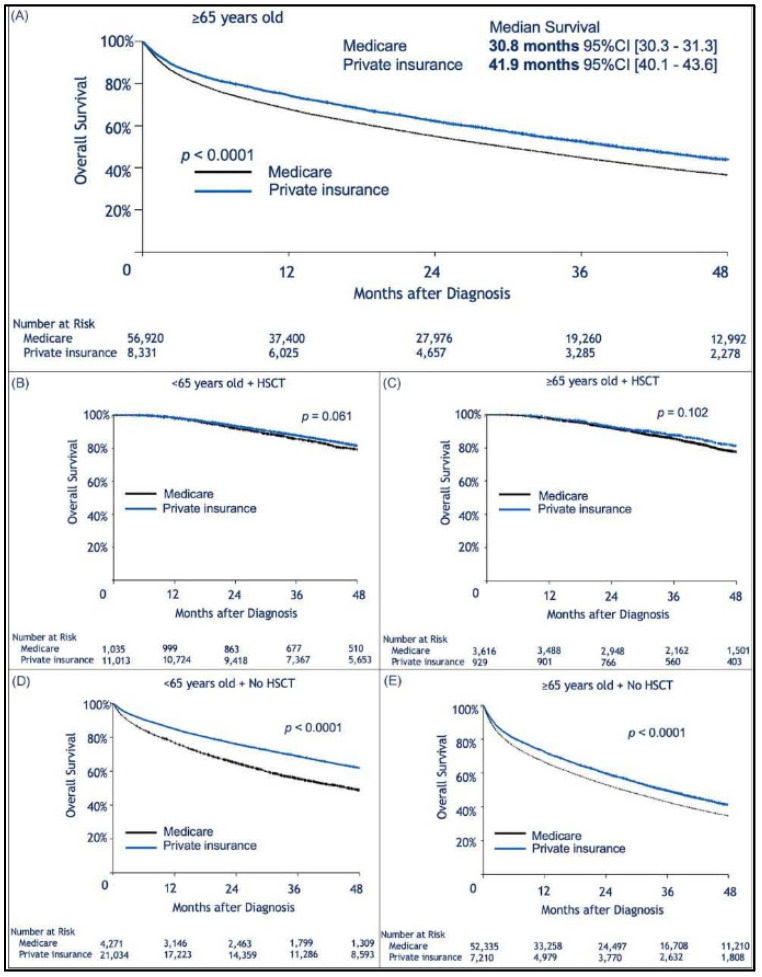
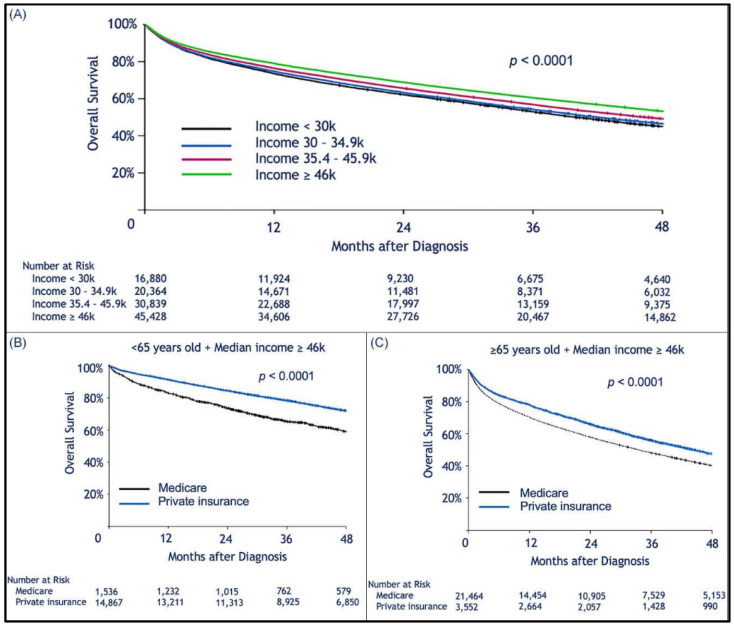
Patients aged ≥65 years who were privately insured lived longer than patients with Medicare (42 months vs. 31 months, respectively, 0.0001). Treatment in academic institutions led to better survival (HR: 1.49, 95% CI: 1.39, 1.59). Younger age, fewer comorbidities, treatment in academic centers, and living in a higher median income area were significantly associated with improved survival. After adjusting for confounders, survival of Medicare patients was similar to those with private insurance. However, the hazard of death remained higher for patients with Medicaid (HR: 1.59, 95% CI: 1.36, 1.87) or without insurance (HR: 1.62, 95% CI: 1.32, 1.99), compared to privately insured patients.
Economic factors and treatment facility type play an important role in the survival of MM patients.
由于新型药物的引入和自体造血细胞移植的应用,多发性骨髓瘤(MM)患者的预后有所改善。然而,这种改善是以增加经济负担为代价的。社会经济因素是否影响MM患者的生存情况在很大程度上尚不清楚。
我们使用了国家癌症数据库,该数据库收录了美国70%癌症患者的数据,以评估社会经济因素对2005年至2014年间确诊的117,926例MM患者生存情况的影响。
年龄≥65岁且有私人保险的患者比参加医疗保险的患者寿命更长(分别为42个月和31个月,P<0.0001)。在学术机构接受治疗的患者生存情况更好(风险比:1.49,95%置信区间:1.39,1.59)。年龄较小、合并症较少、在学术中心接受治疗以及生活在中等收入较高地区与生存情况改善显著相关。在对混杂因素进行调整后,参加医疗保险患者的生存情况与有私人保险的患者相似。然而,与有私人保险的患者相比,参加医疗补助计划的患者(风险比:1.59,95%置信区间:1.36,1.87)或无保险的患者(风险比:1.62,95%置信区间:1.32,1.99)的死亡风险仍然更高。
经济因素和治疗机构类型在MM患者的生存中起着重要作用。