• 文献检索
  • 文档翻译
  • 深度研究
  • 学术资讯
  • Suppr Zotero 插件Zotero 插件
  • 邀请有礼
  • 套餐&价格
  • 历史记录
应用&插件
Suppr Zotero 插件Zotero 插件浏览器插件Mac 客户端Windows 客户端微信小程序
定价
高级版会员购买积分包购买API积分包
服务
文献检索文档翻译深度研究API 文档MCP 服务
关于我们
关于 Suppr公司介绍联系我们用户协议隐私条款
关注我们

Suppr 超能文献

核心技术专利:CN118964589B侵权必究
粤ICP备2023148730 号-1Suppr @ 2026

文献检索

告别复杂PubMed语法,用中文像聊天一样搜索,搜遍4000万医学文献。AI智能推荐,让科研检索更轻松。

立即免费搜索

文件翻译

保留排版,准确专业,支持PDF/Word/PPT等文件格式,支持 12+语言互译。

免费翻译文档

深度研究

AI帮你快速写综述,25分钟生成高质量综述,智能提取关键信息,辅助科研写作。

立即免费体验

嗅觉和味觉丧失可准确预测新冠病毒感染:一种机器学习方法。

Loss of Smell and Taste Can Accurately Predict COVID-19 Infection: A Machine-Learning Approach.

作者信息

Callejon-Leblic María A, Moreno-Luna Ramon, Del Cuvillo Alfonso, Reyes-Tejero Isabel M, Garcia-Villaran Miguel A, Santos-Peña Marta, Maza-Solano Juan M, Martín-Jimenez Daniel I, Palacios-Garcia Jose M, Fernandez-Velez Carlos, Gonzalez-Garcia Jaime, Sanchez-Calvo Juan M, Solanellas-Soler Juan, Sanchez-Gomez Serafin

机构信息

Rhinology Unit, Department of Otolaryngology, Head and Neck Surgery, Virgen Macarena University Hospital, 41009 Seville, Spain.

Biomedical Engineering Group, University of Seville, 41092 Seville, Spain.

出版信息

J Clin Med. 2021 Feb 3;10(4):570. doi: 10.3390/jcm10040570.

DOI:10.3390/jcm10040570
PMID:33546319
原文链接:https://pmc.ncbi.nlm.nih.gov/articles/PMC7913595/
Abstract

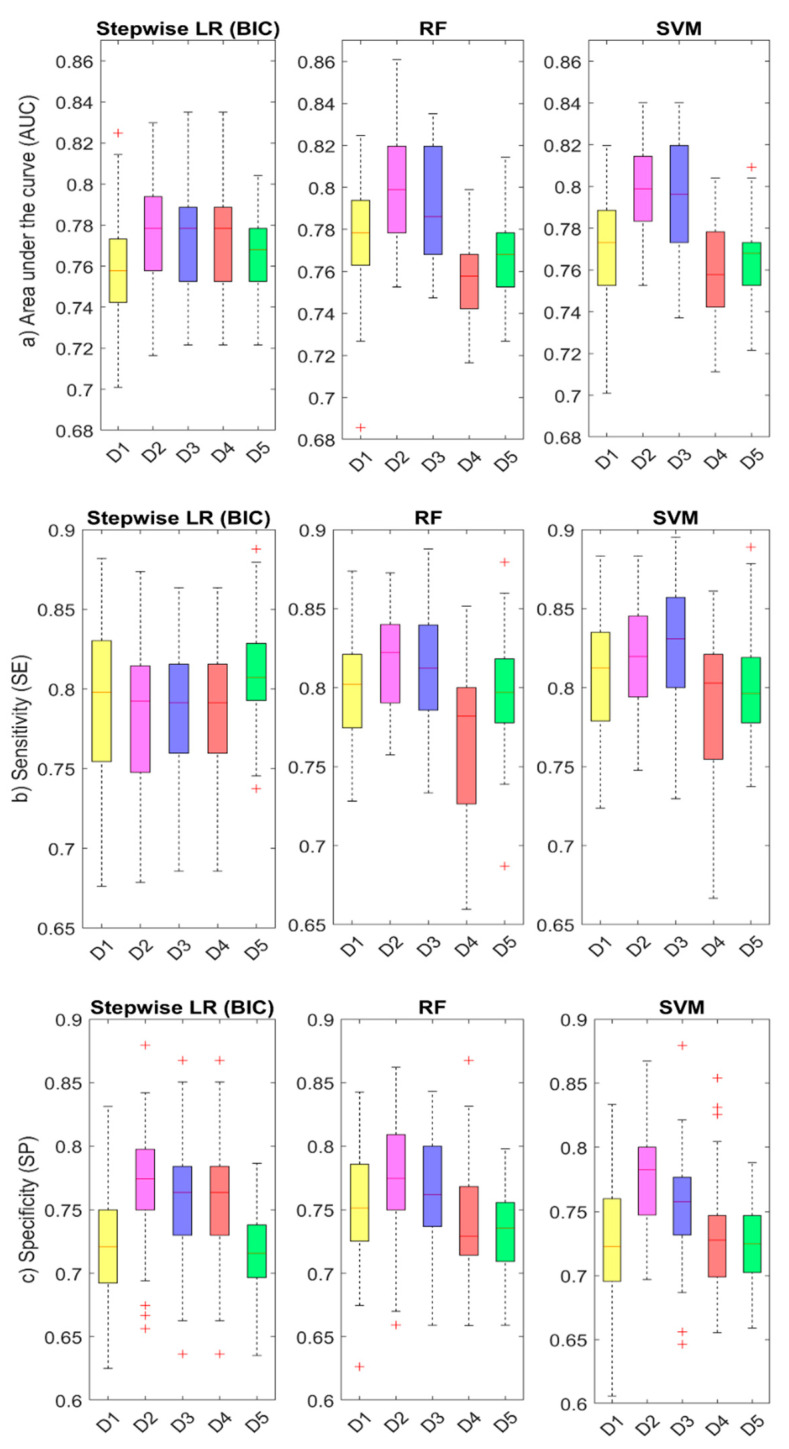
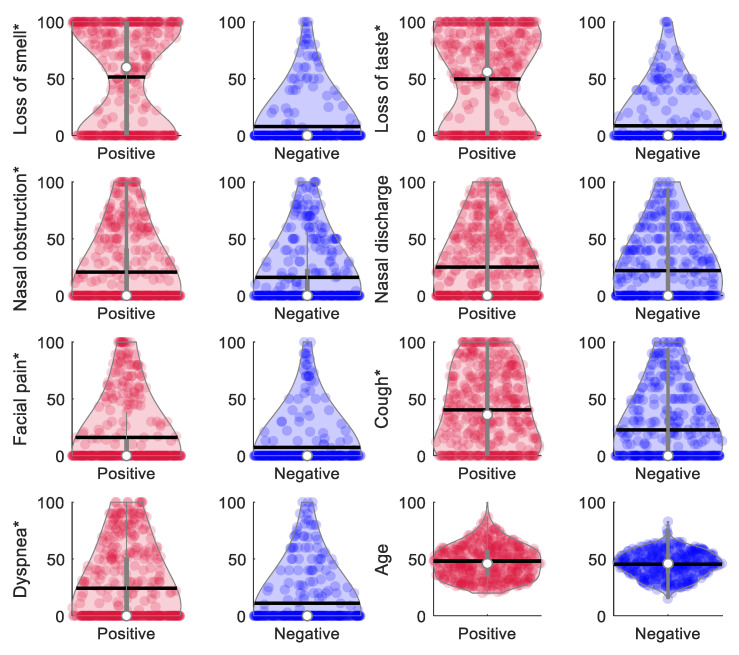
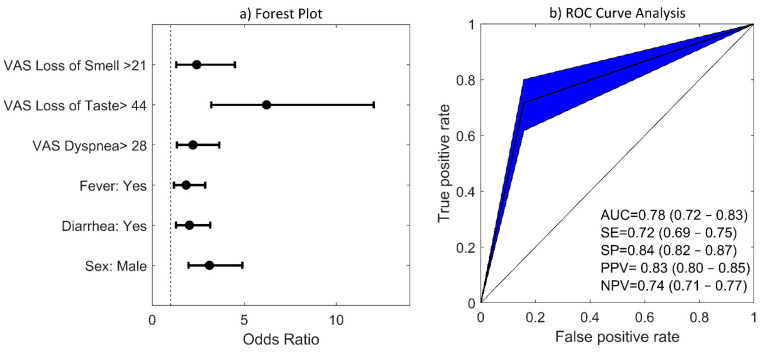
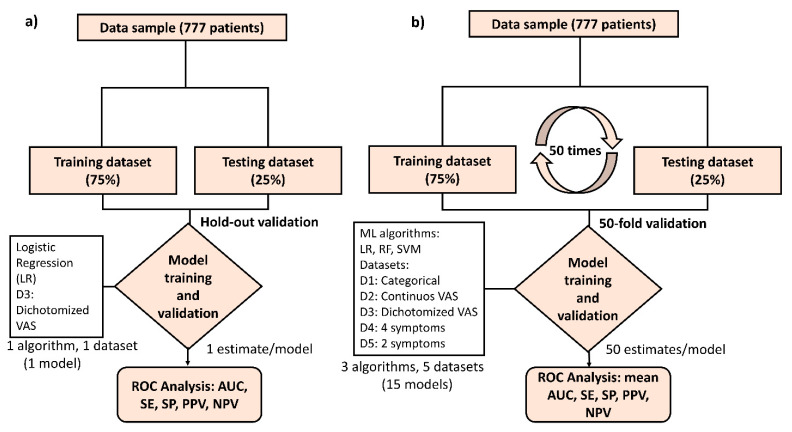
The COVID-19 outbreak has spread extensively around the world. Loss of smell and taste have emerged as main predictors for COVID-19. The objective of our study is to develop a comprehensive machine learning (ML) modelling framework to assess the predictive value of smell and taste disorders, along with other symptoms, in COVID-19 infection. A multicenter case-control study was performed, in which suspected cases for COVID-19, who were tested by real-time reverse-transcription polymerase chain reaction (RT-PCR), informed about the presence and severity of their symptoms using visual analog scales (VAS). ML algorithms were applied to the collected data to predict a COVID-19 diagnosis using a 50-fold cross-validation scheme by randomly splitting the patients in training (75%) and testing datasets (25%). A total of 777 patients were included. Loss of smell and taste were found to be the symptoms with higher odds ratios of 6.21 and 2.42 for COVID-19 positivity. The ML algorithms applied reached an average accuracy of 80%, a sensitivity of 82%, and a specificity of 78% when using VAS to predict a COVID-19 diagnosis. This study concludes that smell and taste disorders are accurate predictors, with ML algorithms constituting helpful tools for COVID-19 diagnostic prediction.

摘要

新型冠状病毒肺炎(COVID-19)疫情已在全球广泛传播。嗅觉和味觉丧失已成为COVID-19的主要预测指标。我们研究的目的是开发一个全面的机器学习(ML)建模框架,以评估嗅觉和味觉障碍以及其他症状在COVID-19感染中的预测价值。我们进行了一项多中心病例对照研究,其中对COVID-19疑似病例采用实时逆转录聚合酶链反应(RT-PCR)进行检测,并使用视觉模拟量表(VAS)让他们告知自身症状的存在情况和严重程度。将ML算法应用于收集的数据,通过随机将患者分为训练集(75%)和测试集(25%),采用50倍交叉验证方案来预测COVID-19诊断。共纳入777例患者。发现嗅觉和味觉丧失是COVID-19阳性几率较高的症状,比值比分别为6.21和2.42。当使用VAS预测COVID-19诊断时,所应用的ML算法平均准确率达到80%,敏感性为82%,特异性为78%。本研究得出结论,嗅觉和味觉障碍是准确的预测指标,ML算法是COVID-19诊断预测的有用工具。
https://cdn.ncbi.nlm.nih.gov/pmc/blobs/364c/7913595/334d02ce5941/jcm-10-00570-g004.jpg
https://cdn.ncbi.nlm.nih.gov/pmc/blobs/364c/7913595/212af6cf5af3/jcm-10-00570-g001.jpg
https://cdn.ncbi.nlm.nih.gov/pmc/blobs/364c/7913595/bb6d786bab44/jcm-10-00570-g002.jpg
https://cdn.ncbi.nlm.nih.gov/pmc/blobs/364c/7913595/d3f17634e970/jcm-10-00570-g003.jpg
https://cdn.ncbi.nlm.nih.gov/pmc/blobs/364c/7913595/334d02ce5941/jcm-10-00570-g004.jpg
https://cdn.ncbi.nlm.nih.gov/pmc/blobs/364c/7913595/212af6cf5af3/jcm-10-00570-g001.jpg
https://cdn.ncbi.nlm.nih.gov/pmc/blobs/364c/7913595/bb6d786bab44/jcm-10-00570-g002.jpg
https://cdn.ncbi.nlm.nih.gov/pmc/blobs/364c/7913595/d3f17634e970/jcm-10-00570-g003.jpg
https://cdn.ncbi.nlm.nih.gov/pmc/blobs/364c/7913595/334d02ce5941/jcm-10-00570-g004.jpg

相似文献

1
Loss of Smell and Taste Can Accurately Predict COVID-19 Infection: A Machine-Learning Approach.嗅觉和味觉丧失可准确预测新冠病毒感染:一种机器学习方法。
J Clin Med. 2021 Feb 3;10(4):570. doi: 10.3390/jcm10040570.
2
Machine learning predictive modeling of the persistence of post-Covid19 disorders: Loss of smell and taste as case studies.新冠后疾病持续存在的机器学习预测模型:以嗅觉和味觉丧失为例的案例研究
Heliyon. 2024 Jul 27;10(15):e35246. doi: 10.1016/j.heliyon.2024.e35246. eCollection 2024 Aug 15.
3
Smell and Taste Dysfunction in COVID-19 Is Associated With Younger Age in Ambulatory Settings: A Multicenter Cross-Sectional Study.在门诊环境中,COVID-19 嗅觉和味觉障碍与年龄较小有关:一项多中心横断面研究。
J Investig Allergol Clin Immunol. 2020;30(5):346-357. doi: 10.18176/jiaci.0595. Epub 2020 Jun 17.
4
Simultaneously complete but not partial taste and smell losses were associated with SARS-CoV-2 infection.同时完全丧失味觉和嗅觉与 SARS-CoV-2 感染有关。
Int J Infect Dis. 2021 May;106:329-337. doi: 10.1016/j.ijid.2021.03.083. Epub 2021 Apr 2.
5
Visual Analogue Scale for the Evaluation of Olfactory and Gustatory Dysfunction of COVID-19 Patients in Northwestern Greece.用于评估希腊西北部新冠病毒肺炎患者嗅觉和味觉功能障碍的视觉模拟量表
Cureus. 2023 Mar 20;15(3):e36413. doi: 10.7759/cureus.36413. eCollection 2023 Mar.
6
Construction and validation of a COVID-19 pandemic trend forecast model based on Google Trends data for smell and taste loss.基于谷歌趋势数据构建和验证用于嗅觉和味觉丧失的 COVID-19 大流行趋势预测模型。
Front Public Health. 2022 Dec 1;10:1025658. doi: 10.3389/fpubh.2022.1025658. eCollection 2022.
7
Could self-reported symptoms be predictors of RT-PCR positivity in suspected COVID-19 cases? The Libya experience.自我报告的症状能否作为疑似新冠肺炎病例中逆转录聚合酶链反应(RT-PCR)阳性的预测指标?利比亚的经验。
East Mediterr Health J. 2022 Sep 29;28(9):664-672. doi: 10.26719/emhj.22.061.
8
Prevalence of Loss of Smell and/or Taste and other Otorhinolaryngology Symptoms in COVID-19 Patients.新冠病毒感染者嗅觉和/或味觉丧失及其他耳鼻喉症状的流行情况。
Kathmandu Univ Med J (KUMJ). 2021 Apr-Jun;19(74):173-179.
9
Evaluating the Onset, Severity, and Recovery of Changes to Smell and Taste Associated With COVID-19 Infection in a Singaporean Population (the COVOSMIA-19 Trial): Protocol for a Prospective Case-Control Study.评估新加坡人群中与新冠病毒感染相关的嗅觉和味觉变化的发作、严重程度及恢复情况(COVOSMIA-19试验):一项前瞻性病例对照研究方案
JMIR Res Protoc. 2020 Dec 31;9(12):e24797. doi: 10.2196/24797.
10
The COVOSMIA-19 trial: Preliminary application of the Singapore smell and taste test to objectively measure smell and taste function with COVID-19.COVOSMIA-19试验:新加坡嗅觉和味觉测试在客观测量新冠病毒感染相关嗅觉和味觉功能方面的初步应用
Food Qual Prefer. 2022 Apr;97:104482. doi: 10.1016/j.foodqual.2021.104482. Epub 2021 Nov 25.

引用本文的文献

1
Machine learning predictive modeling of the persistence of post-Covid19 disorders: Loss of smell and taste as case studies.新冠后疾病持续存在的机器学习预测模型:以嗅觉和味觉丧失为例的案例研究
Heliyon. 2024 Jul 27;10(15):e35246. doi: 10.1016/j.heliyon.2024.e35246. eCollection 2024 Aug 15.
2
A non-invasive AI-based system for precise grading of anosmia in COVID-19 using neuroimaging.一种基于人工智能的非侵入性系统,用于利用神经影像学对新冠肺炎患者的嗅觉丧失进行精确分级。
Heliyon. 2024 Jun 12;10(12):e32726. doi: 10.1016/j.heliyon.2024.e32726. eCollection 2024 Jun 30.
3
The Value of Subjective Olfactometry as a Predictive Biomarker of Neurodegenerative Diseases: A Systematic Review.

本文引用的文献

1
Predicting olfactory loss in chronic rhinosinusitis using machine learning.利用机器学习预测慢性鼻-鼻窦炎患者的嗅觉丧失。
Chem Senses. 2021 Jan 1;46. doi: 10.1093/chemse/bjab042.
2
Recent Smell Loss Is the Best Predictor of COVID-19 Among Individuals With Recent Respiratory Symptoms.近期嗅觉丧失是近期有呼吸道症状个体中 COVID-19 的最佳预测指标。
Chem Senses. 2021 Jan 1;46. doi: 10.1093/chemse/bjaa081.
3
A model to identify individuals with a high probability of a SARS-CoV-2 infection.一种用于识别感染严重急性呼吸综合征冠状病毒2(SARS-CoV-2)高概率个体的模型。
主观嗅觉测量作为神经退行性疾病预测生物标志物的价值:一项系统综述
Life (Basel). 2024 Feb 23;14(3):298. doi: 10.3390/life14030298.
4
Taste loss as a distinct symptom of COVID-19: a systematic review and meta-analysis.味觉丧失是 COVID-19 的一个独特症状:系统评价和荟萃分析。
Chem Senses. 2023 Jan 1;48. doi: 10.1093/chemse/bjad043.
5
Machine Learning-Based Prediction of COVID-19 Prognosis Using Clinical and Hematologic Data.基于临床和血液学数据的机器学习对COVID-19预后的预测
Cureus. 2023 Dec 9;15(12):e50212. doi: 10.7759/cureus.50212. eCollection 2023 Dec.
6
Symptom-based scoring technique by machine learning to predict COVID-19: a validation study.基于症状的机器学习评分技术预测 COVID-19:一项验证研究。
BMC Infect Dis. 2023 Dec 12;23(1):871. doi: 10.1186/s12879-023-08846-0.
7
Transient loss and recovery of oral chemesthesis, taste and smell with COVID-19: A small case-control series.新冠病毒感染后口腔化学感觉、味觉和嗅觉的短暂丧失和恢复:一项小型病例对照研究系列。
Physiol Behav. 2023 Nov 1;271:114331. doi: 10.1016/j.physbeh.2023.114331. Epub 2023 Aug 16.
8
Hearing recovery prediction and prognostic factors of idiopathic sudden sensorineural hearing loss: a retrospective analysis with a deep neural network model.特发性突发性聋的听力恢复预测和预后因素:基于深度神经网络模型的回顾性分析。
Braz J Otorhinolaryngol. 2023 Jul-Aug;89(4):101273. doi: 10.1016/j.bjorl.2023.04.001. Epub 2023 Apr 21.
9
Transient loss and recovery of oral chemesthesis, taste and smell with COVID-19: a small case-control series.新冠病毒感染导致口腔化学感觉、味觉和嗅觉的短暂丧失及恢复:一项小型病例对照研究系列
medRxiv. 2023 Mar 29:2023.03.27.23287763. doi: 10.1101/2023.03.27.23287763.
10
Compression-Complexity Measures for Analysis and Classification of Coronaviruses.用于冠状病毒分析和分类的压缩-复杂度度量
Entropy (Basel). 2022 Dec 31;25(1):81. doi: 10.3390/e25010081.
J Infect. 2021 Mar;82(3):e32-e34. doi: 10.1016/j.jinf.2020.11.028. Epub 2020 Nov 25.
4
Smell and taste changes are early indicators of the COVID-19 pandemic and political decision effectiveness.嗅觉和味觉变化是 COVID-19 大流行和政治决策有效性的早期指标。
Nat Commun. 2020 Oct 14;11(1):5152. doi: 10.1038/s41467-020-18963-y.
5
Analytical Sensitivity and Specificity of Two RT-qPCR Protocols for SARS-CoV-2 Detection Performed in an Automated Workflow.两种自动化工作流程下实时 RT-qPCR 方案检测 SARS-CoV-2 的分析灵敏度和特异性。
Genes (Basel). 2020 Oct 12;11(10):1183. doi: 10.3390/genes11101183.
6
Frequency and Clinical Utility of Olfactory Dysfunction in COVID-19: a Systematic Review and Meta-analysis.新冠病毒感染后嗅觉功能障碍的频率和临床实用性:系统评价和荟萃分析。
Curr Allergy Asthma Rep. 2020 Oct 13;20(12):76. doi: 10.1007/s11882-020-00972-y.
7
Clinical features of COVID-19 mortality: development and validation of a clinical prediction model.COVID-19 死亡率的临床特征:临床预测模型的建立与验证。
Lancet Digit Health. 2020 Oct;2(10):e516-e525. doi: 10.1016/S2589-7500(20)30217-X. Epub 2020 Sep 22.
8
Coincidence of COVID-19 epidemic and olfactory dysfunction outbreak in Iran.伊朗新冠疫情与嗅觉功能障碍爆发的巧合。
Med J Islam Repub Iran. 2020 Jun 15;34:62. doi: 10.34171/mjiri.34.62. eCollection 2020.
9
Prevalence of Chemosensory Dysfunction in COVID-19 Patients: A Systematic Review and Meta-analysis Reveals Significant Ethnic Differences.新冠病毒患者嗅觉和味觉功能障碍的流行率:系统评价和荟萃分析显示出显著的种族差异。
ACS Chem Neurosci. 2020 Oct 7;11(19):2944-2961. doi: 10.1021/acschemneuro.0c00460. Epub 2020 Sep 17.
10
Elevated ACE-2 expression in the olfactory neuroepithelium: implications for anosmia and upper respiratory SARS-CoV-2 entry and replication.嗅神经上皮中 ACE-2 表达升高:与嗅觉丧失以及上呼吸道 SARS-CoV-2 进入和复制有关。
Eur Respir J. 2020 Sep 24;56(3). doi: 10.1183/13993003.01948-2020. Print 2020 Sep.