Sheen Florence, Tan Vicki, Lim Amanda JiaYing, Haldar Sumanto, Sengupta Sharmila, Allen David, Somani Jyoti, Chen Hui Yee, Tambyah Paul, Forde Ciarán G
Clinical Nutrition Research Centre (CNRC), Singapore Institute of Food and Biotechnology Innovation (SIFBI), Agency of Science and Research (ASTAR), Singapore.
Division of Infectious Diseases, Department of Medicine, National University Hospital, Singapore.
Food Qual Prefer. 2022 Apr;97:104482. doi: 10.1016/j.foodqual.2021.104482. Epub 2021 Nov 25.
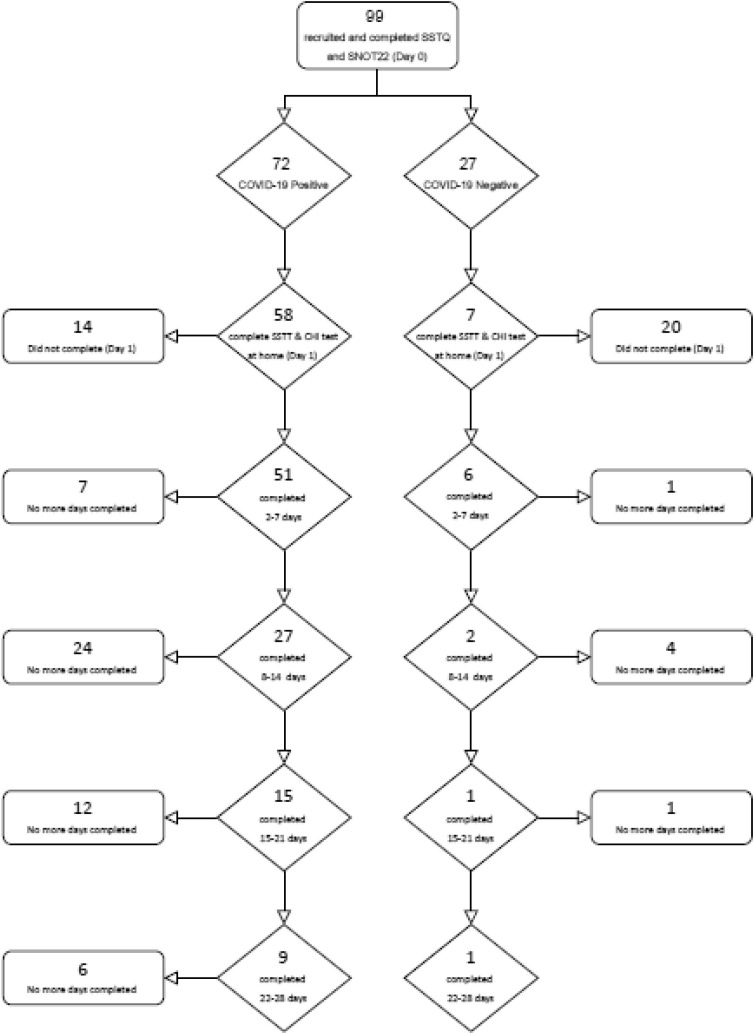
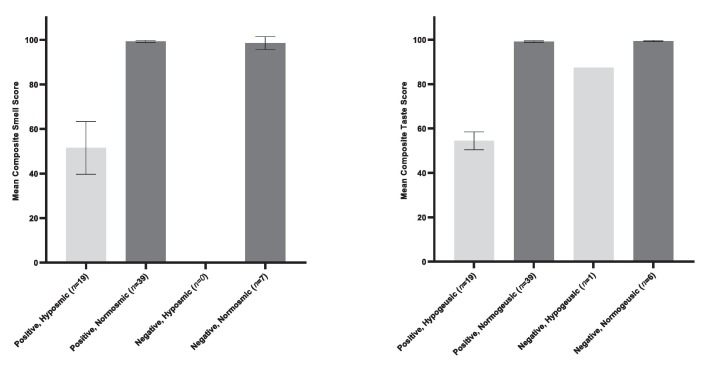
Sudden loss of smell and/or taste has been identified as an early symptom of SARS-CoV-2 2019 (COVID-19) infection, and presents an effective target for prompt self-isolation and reducing community spread. The current study sought to develop and test a novel, rapid, self-administered test to objectively measure smell and taste losses associated with COVID-19, and administered self-report questionnaires to characterise symptoms associated with COVID-19 in Singapore. Participants ( = 99) completed questionnaires to record recent changes in smell and taste ability. This was followed by the 'Singapore Smell and Taste Test' (SSTT), a personal, objective testing kit for daily self-assessment of smell and taste function at their place of residence. Seventy-two recruited participants were confirmed as COVID-19 positive at baseline, of which 58 completed the SSTT at home. Of these, 36.2% had objectively measured smell and/or taste loss. The SSTT measures of smell and taste function were positively associated with participants' self-reported smell and taste acuity, and rated smell intensity of 6 common household items. This study presents the first application of the SSTT as a rapid, cost-effective, objective tool to self-monitor smell and taste function in a residential setting, and ensures comparability across individuals through the use of standardised stimuli. The SSTT has potential for future application in populations with limited access to formal COVID-19 testing as a self-administered objective method to monitor sudden changes in smell and taste, and to prompt early self-isolation, in order to reduce community transmission of COVID-19.
嗅觉和/或味觉突然丧失已被确定为2019年严重急性呼吸综合征冠状病毒(SARS-CoV-2,即新冠病毒)感染的早期症状,是及时进行自我隔离和减少社区传播的有效靶点。本研究旨在开发并测试一种新型、快速、可自行操作的检测方法,以客观测量与新冠病毒相关的嗅觉和味觉丧失情况,并发放自我报告问卷来描述新加坡与新冠病毒相关的症状。参与者(n = 99)填写问卷以记录近期嗅觉和味觉能力的变化。随后进行“新加坡嗅觉和味觉测试”(SSTT),这是一种个人客观检测工具,用于在居住场所对嗅觉和味觉功能进行日常自我评估。72名招募的参与者在基线时被确诊为新冠病毒阳性,其中58人在家中完成了SSTT。在这些人中,36.2%的人经客观测量存在嗅觉和/或味觉丧失。SSTT对嗅觉和味觉功能的测量结果与参与者自我报告的嗅觉和味觉敏锐度以及对6种常见家居用品的嗅觉强度评分呈正相关。本研究首次将SSTT作为一种快速、经济高效的客观工具,用于在居住环境中自我监测嗅觉和味觉功能,并通过使用标准化刺激确保个体间的可比性。SSTT未来有可能应用于难以获得正规新冠病毒检测的人群,作为一种自我操作的客观方法来监测嗅觉和味觉的突然变化,并促使早期自我隔离,以减少新冠病毒的社区传播。