CAS Key Laboratory of Behavioral Science, Institute of Psychology, 16 Lincui Road, Beijing, 100101, China.
Department of Psychology, University of Chinese Academy of Sciences, Beijing, 100049, China.
BMC Geriatr. 2021 Feb 5;21(1):108. doi: 10.1186/s12877-021-02034-y.
Although it is well known that aging impairs navigation performance, the underlying mechanisms remain largely unknown. Egocentric strategy requires navigators to remember a series of body-turns without relying on the relationship between environmental cues. Previous study suggested that the egocentric strategy, compared with non-egocentric strategy, was relatively unimpaired during aging. In this study, we aimed to examine strategy use during virtual navigation task and the underlying cognitive supporting mechanisms in older adults.
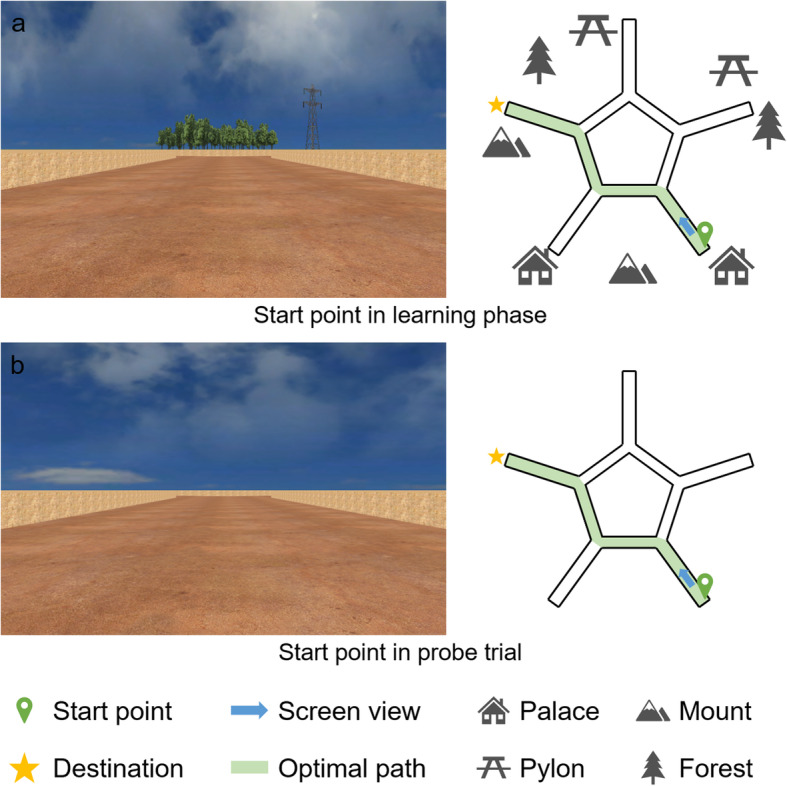
Thirty young adults and thirty-one older adults were recruited from the local community. This study adapted star maze paradigm using non-immersive virtual environment. Participants moved freely in a star maze with adequate landmarks, and were requested to find a fixed destination. After 9 learning trials, participants were probed in the same virtual star maze but with no salient landmarks. Participants were classified as egocentric or non-egocentric strategy group according to their response in the probe trial.
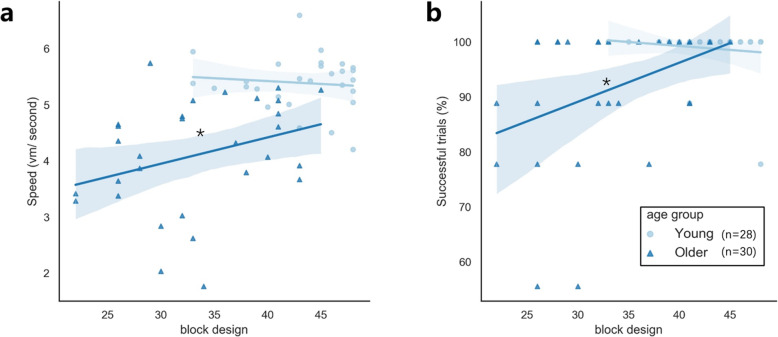
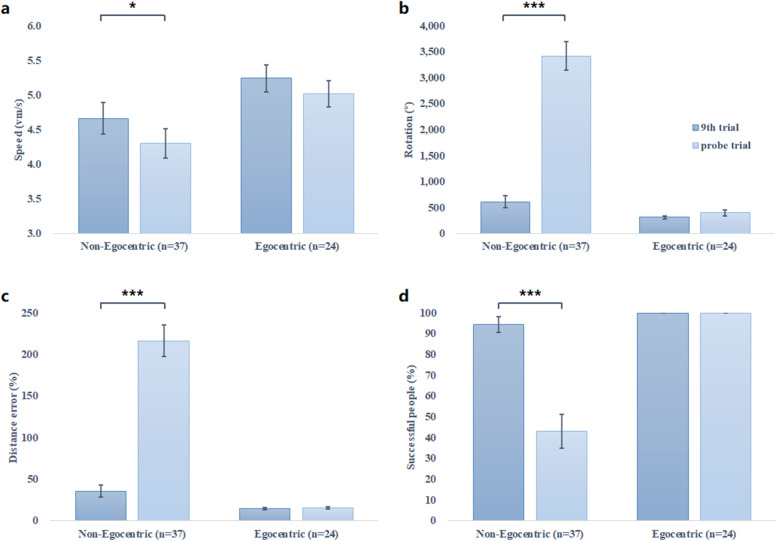
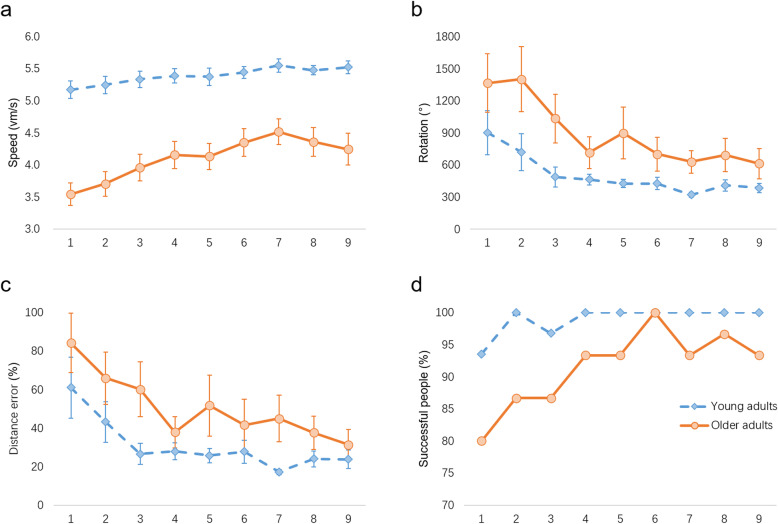
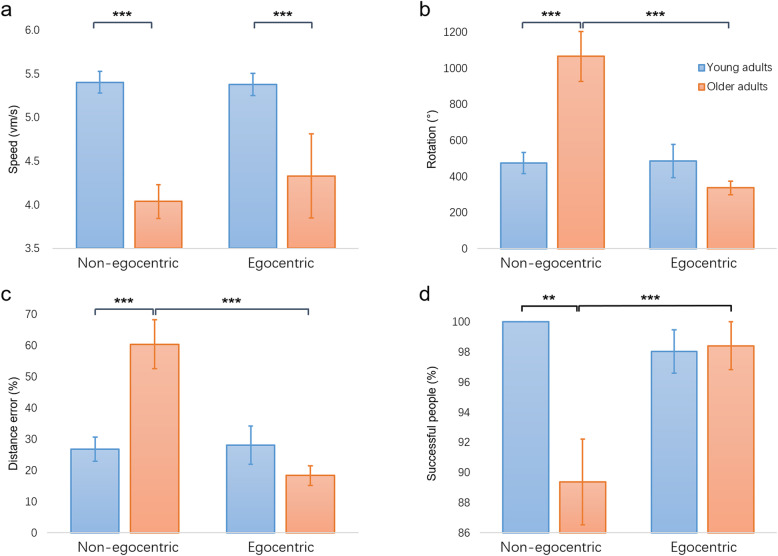
The results revealed that older adults adopting egocentric strategy completed the navigation task as accurate as young adults, whereas older adults using non-egocentric strategy completed the navigation task with more detours and lower accuracy. The relatively well-maintained egocentric strategy in older adults was related to better visuo-spatial ability.
Visuo-spatial ability might play an important role in navigation accuracy and navigation strategy of older adults. This study demonstrated the potential value of the virtual star maze in evaluating navigation strategy and visuo-spatial ability in older adults.
尽管众所周知,衰老会损害导航性能,但其中的机制仍很大程度上未知。以自我为中心的策略要求导航者记住一系列的身体转向,而不依赖于环境线索之间的关系。先前的研究表明,与非以自我为中心的策略相比,以自我为中心的策略在衰老过程中相对不受影响。在这项研究中,我们旨在研究老年人在虚拟导航任务中的策略使用以及潜在的认知支持机制。
从当地社区招募了 30 名年轻成年人和 31 名老年成年人。该研究使用非沉浸式虚拟环境改编了星型迷宫范式。参与者在一个有足够地标物的星型迷宫中自由移动,并要求找到一个固定的目的地。在 9 次学习试验后,参与者在相同的虚拟星型迷宫中进行探测,但没有明显的地标物。根据参与者在探测试验中的反应,将他们分为以自我为中心或非以自我为中心策略组。
结果表明,采用以自我为中心策略的老年人完成导航任务的准确性与年轻人一样高,而采用非以自我为中心策略的老年人完成导航任务时会走更多的弯路,准确性也较低。老年人相对较好地维持以自我为中心的策略与更好的视空间能力有关。
视空间能力可能在老年人的导航准确性和导航策略中起着重要作用。本研究表明,虚拟星型迷宫在评估老年人的导航策略和视空间能力方面具有潜在价值。