Department of Endocrinology-Diabetology-Nutrition, AP-HP, Avicenne Hospital, Université Paris 13, Sorbonne Paris Cité, CRNH-IdF, CINFO, Bobigny, France.
Unité de Recherche Epidémiologique Nutritionnelle, UMR U1153 INSERM/U11125 INRA/CNAM/Université Paris 13, Bobigny, France.
Cardiovasc Diabetol. 2021 Feb 5;20(1):35. doi: 10.1186/s12933-021-01225-6.
Epicardial adipose tissue (EAT) has anatomic and functional proximity to the heart and is considered a novel diagnostic marker and therapeutic target in cardiometabolic diseases. The aim of this study was to evaluate whether EAT volume was associated with coronary artery calcification (CAC) in people living with diabetes, independently of confounding factors.
We included all consecutive patients with diabetes whose EAT volume and CAC score were measured using computed tomography between January 1, 2019 and September 30, 2020 in the Department of Diabetology-Endocrinology-Nutrition at Avicenne Hospital, France. Determinants of EAT volume and a CAC score ≥ 100 Agatston units (AU) were evaluated.
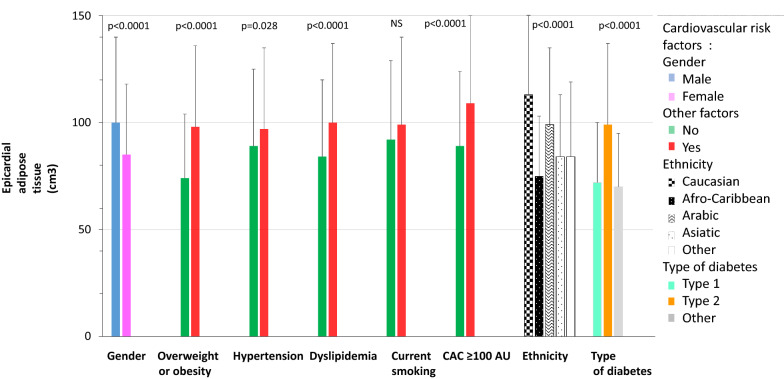
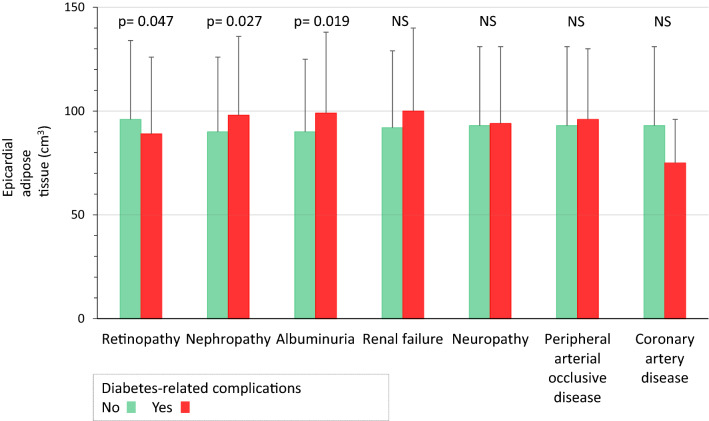
The study population comprised 409 patients (218 men). Mean (± standard deviation) age was 57 ± 12 years, and 318, 56 and 35 had type 2 (T2D), type 1 (T1D), or another type of diabetes, respectively. Mean body mass index (BMI) was 29 ± 6 kg/m, mean AET volume 93 ± 38 cm. EAT volume was positively correlated with age, BMI, pack-year smoking history and triglyceridaemia, but negatively correlated with HDL-cholesterol level. Furthermore, it was lower in people with retinopathy, but higher in men, in Caucasian people, in patients on antihypertensive and lipid-lowering medication, in people with nephropathy, and finally in individuals with a CAC ≥ 100 AU (CAC < 100 vs CAC ≥ 100: 89 ± 35 vs 109 ± 41 cm, respectively, p < 0.05). In addition to EAT volume, other determinants of CAC ≥ 100 AU (n = 89, 22%) were age, T2D, ethnicity, antihypertensive and lipid-lowering medication, cumulative tobacco consumption, retinopathy, macular edema and macrovascular disease. Multivariable analysis considering all these determinants as well as gender and BMI showed that EAT volume was independently associated with CAC ≥ 100 AU (per 10 cm increase: OR 1.11 [1.02-1.20]).
EAT volume was independently associated with CAC. As it may play a role in coronary atherosclerosis in patients with diabetes, reducing EAT volume through physical exercise, improved diet and pharmaceutical interventions may improve future cardiovascular risk outcomes in this population.
心外膜脂肪组织 (EAT) 与心脏在解剖和功能上密切相关,被认为是代谢性心血管疾病的一种新的诊断标志物和治疗靶点。本研究旨在评估在糖尿病患者中,EAT 体积是否与冠状动脉钙化 (CAC) 相关,且不受混杂因素影响。
我们纳入了 2019 年 1 月 1 日至 2020 年 9 月 30 日期间在法国阿维森纳医院内分泌科接受计算机断层扫描测量 EAT 体积和 CAC 评分的所有连续糖尿病患者。评估了 EAT 体积和 CAC 评分≥100 个 Agatston 单位 (AU) 的决定因素。
研究人群包括 409 名患者(218 名男性)。平均(±标准差)年龄为 57±12 岁,分别有 318、56 和 35 名患者患有 2 型糖尿病(T2D)、1 型糖尿病(T1D)或其他类型糖尿病。平均体重指数(BMI)为 29±6kg/m,平均 EAT 体积为 93±38cm。EAT 体积与年龄、BMI、吸烟包年史和三酰甘油水平呈正相关,与高密度脂蛋白胆固醇水平呈负相关。此外,EAT 体积在视网膜病变患者中较低,但在男性、白种人、接受降压和降脂药物治疗的患者、肾病患者和 CAC≥100 AU 的患者中较高(CAC<100 与 CAC≥100:89±35 与 109±41cm,分别,p<0.05)。除 EAT 体积外,CAC≥100 AU 的其他决定因素(n=89,22%)为年龄、T2D、种族、降压和降脂药物、累积吸烟量、视网膜病变、黄斑水肿和大血管疾病。考虑所有这些决定因素以及性别和 BMI 的多变量分析表明,EAT 体积与 CAC≥100 AU 独立相关(每增加 10cm:OR 1.11[1.02-1.20])。
EAT 体积与 CAC 独立相关。由于它可能在糖尿病患者的冠状动脉粥样硬化中发挥作用,因此通过体育锻炼、改善饮食和药物干预来减少 EAT 体积可能会改善该人群未来的心血管风险结局。