Health Sciences Postgraduate Program, Federal University Of Rio Grande do Norte, Natal, Rio Grande do Norte 59056-150, Brazil.
Health Surveillance Department, Municipal Health Secretary, Natal, Rio Grande do Norte 59025-090, Brazil.
Trans R Soc Trop Med Hyg. 2021 Sep 3;115(9):1010-1018. doi: 10.1093/trstmh/trab011.
Currently syphilis is considered an epidemic disease worldwide. The objective of this study was to identify intra-urban differentials in the occurrence of congenital and acquired syphilis and syphilis in pregnant women in the city of Natal, in northeast Brazil.
Cases of syphilis recorded by the municipal surveillance system from 1 January 2011 to 30 December 2018 were analysed. Spatial statistical analyses were performed using the kernel density estimator of the quadratic smoothing function (weighted). SaTScan software was applied for the calculation of risk based on a discrete Poisson model.
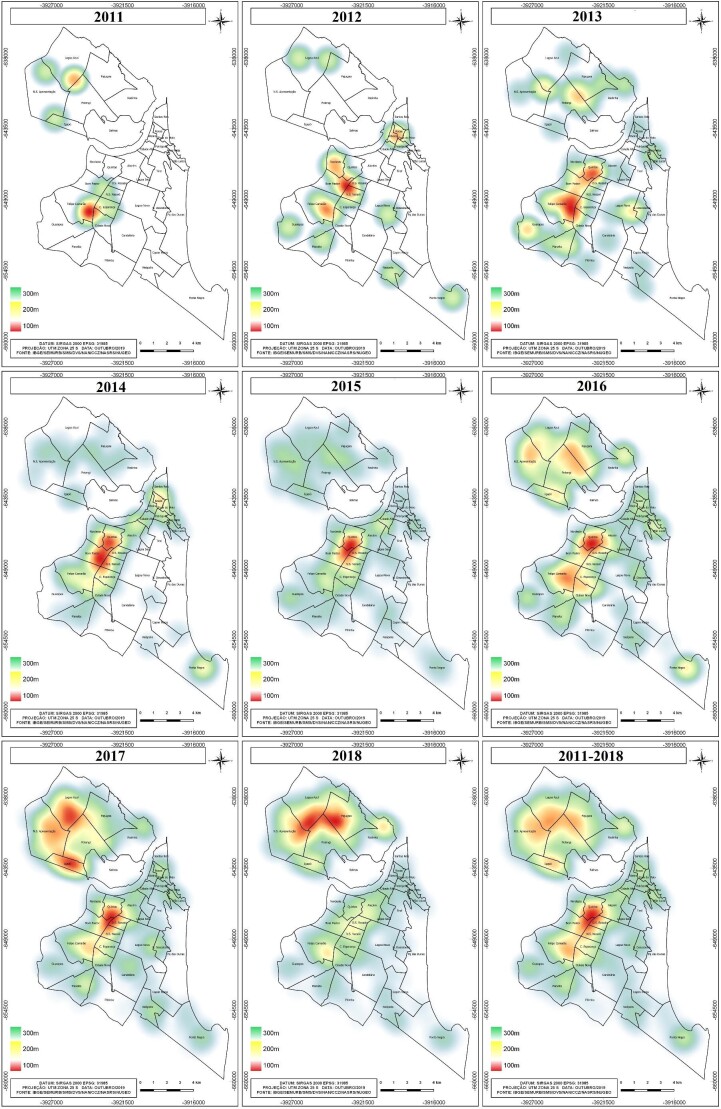
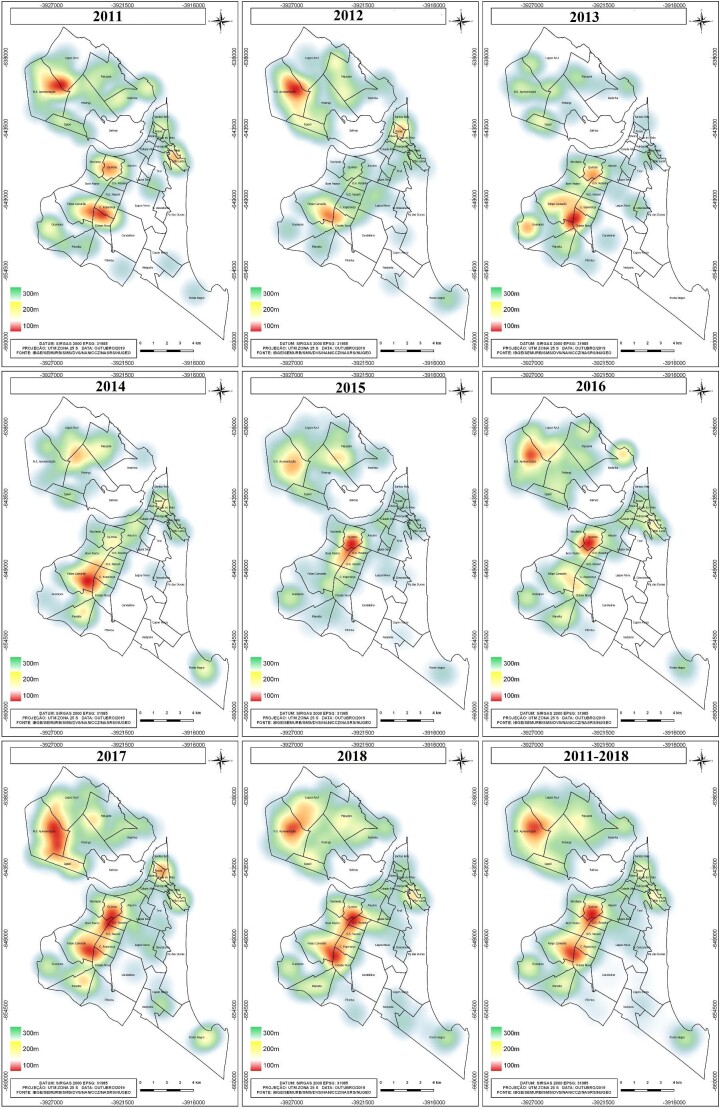
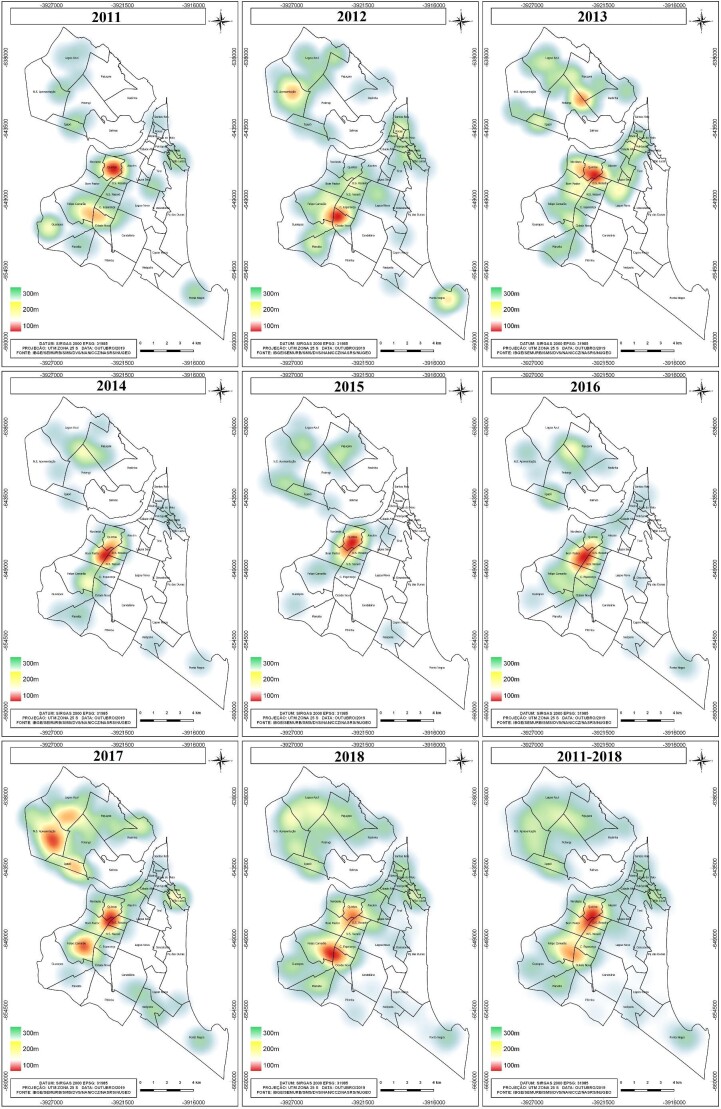
There were 2163 cases of acquired syphilis, 738 cases of syphilis in pregnant women and 1279 cases of congenital syphilis. Kernel density maps showed that the occurrence of cases is more prevalent in peripheral areas and in areas with more precarious urban infrastructure. In 2011-2014 and 2015-2018, seven statistically significant clusters of acquired syphilis were identified. From 2011 to 2014, the most likely cluster had a relative risk of 3.54 (log likelihood ratio [LLR] 38 895; p<0.001) and from 2015 to 2018 the relative risk was 0.54 (LLR 69 955; p<0.001).
In the municipality of Natal, there was a clustered pattern of spatial distribution of syphilis, with some areas presenting greater risk for the occurrence of new cases.
目前梅毒被认为是一种全球性的传染病。本研究旨在确定巴西东北部纳塔尔市先天性和获得性梅毒及孕妇梅毒的城市内差异。
分析了 2011 年 1 月 1 日至 2018 年 12 月 30 日市监测系统记录的梅毒病例。采用二次平滑函数核密度估计器(加权)进行空间统计分析。SaTScan 软件用于基于离散泊松模型计算风险。
共发现 2163 例获得性梅毒、738 例孕妇梅毒和 1279 例先天性梅毒。核密度图显示,病例发生更普遍的地区是城市周边地区和城市基础设施较差的地区。2011-2014 年和 2015-2018 年期间,共发现 7 个具有统计学意义的获得性梅毒聚集区。2011-2014 年,最有可能的聚集区相对风险为 3.54(对数似然比[LLR]38895;p<0.001),2015-2018 年的相对风险为 0.54(LLR 69955;p<0.001)。
在纳塔尔市,梅毒的空间分布存在聚集模式,一些地区新发病例的发生风险更高。