Department of Forensic and Addiction Psychiatry, Jianan Psychiatric Center, Ministry of Health and Welfare, Tainan City 717, Taiwan; Department of Mental Health, Johns Hopkins Bloomberg School of Public Health, Baltimore, MD 21205, USA; Department of Medical Laboratory Science and Biotechnology, Chung Hwa University of Medical Technology, Tainan City 717, Taiwan.
College of Medicine, China Medical University, Taichung, Taiwan; Mind-Body Interface Laboratory (MBI-Lab) and Department of Psychiatry, China Medical University Hospital, Taichung, Taiwan; An-Nan Hospital, China Medical University, Tainan, Taiwan; Institute of Psychiatry, Psychology and Neuroscience, King's College London, London, UK.
Brain Behav Immun. 2021 Mar;93:409-414. doi: 10.1016/j.bbi.2021.01.030. Epub 2021 Feb 4.
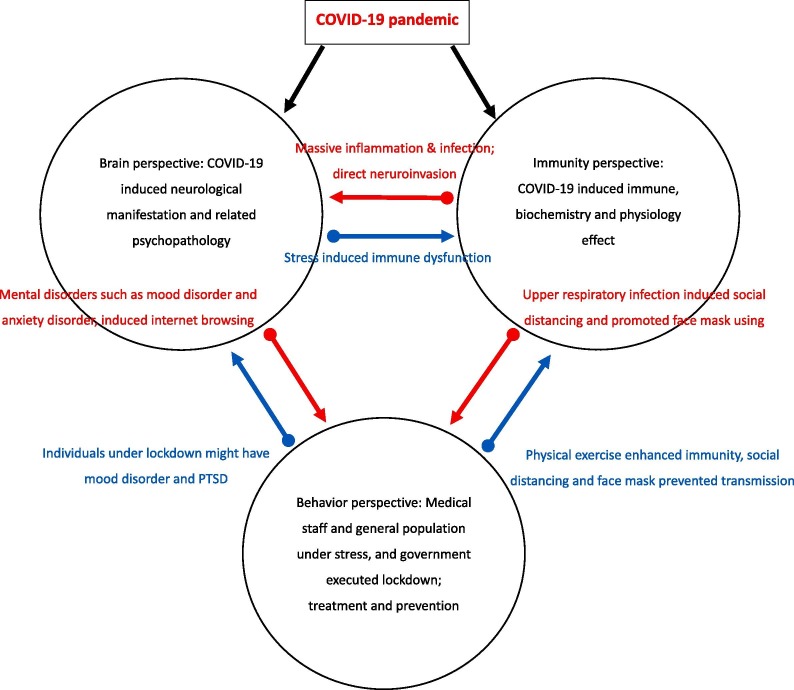
The pandemic outbreak of coronavirus disease 2019 (COVID-19) is raising global anxiety and fear of both real and perceived health threat from the virus. Overwhelming evidence shows infected patients experiencing neuropsychiatric complications, suggesting that the "psychoneuroimmunity" model might be beneficial in understanding the impact of the virus. Therefore, this Special Issue on "Immunopsychiatry of COVID-19 Pandemic" was launched immediately after the pandemic was declared, with the first paper accepted on the March 25th, 2020. A total of ninety-three papers were accepted, the last one was on the July 10th, 2020 when the initial acute phase started declining. The papers of this Special Issue have illuminated the social impact, psychopathology, neurological manifestation, immunity responses, and potential treatments and prevention on COVID-19. For example, anxiety disorders, mood disorders, and suicidal ideation are most common psychiatric manifestations. COVID-19 infection can have central and/or peripheral nervous system symptoms, including headache, sleep disorders, encephalopathy, and loss of taste and smell. A "three-steps" Neuro-COVID infection model (neuro-invasion, clearance and immune response) was established. The current therapeutic interventions for COVID-19 include supportive intervention, immunomodulatory agents, antiviral therapy, and plasma transfusion. Psychological support should be implemented, improving the psychological wellbeing, as well as to enhance psychoneuroimmunity against COVID-19.
2019 年冠状病毒病(COVID-19)大流行的爆发引起了全球对这种病毒的真实和感知到的健康威胁的焦虑和恐惧。压倒性的证据表明,感染患者经历了神经精神并发症,这表明“心理神经免疫学”模型可能有助于理解病毒的影响。因此,在宣布大流行后立即推出了这个关于“COVID-19 大流行的免疫精神病学”的特刊,第一份论文于 2020 年 3 月 25 日被接受。共接受了 93 篇论文,最后一篇论文于 2020 年 7 月 10 日被接受,当时初始急性阶段开始下降。本特刊的论文阐明了 COVID-19 的社会影响、精神病理学、神经表现、免疫反应以及潜在的治疗和预防方法。例如,焦虑症、抑郁症和自杀意念是最常见的精神表现。COVID-19 感染可引起中枢和/或外周神经系统症状,包括头痛、睡眠障碍、脑病和味觉和嗅觉丧失。建立了一个“三步”神经 COVID 感染模型(神经入侵、清除和免疫反应)。目前 COVID-19 的治疗干预包括支持性干预、免疫调节剂、抗病毒治疗和血浆输注。应实施心理支持,改善心理健康,增强对 COVID-19 的心理神经免疫。