Hitchcock Leah N, Tracy Brian L, Bryan Angela D, Hutchison Kent E, Bidwell L Cinnamon
Institute of Cognitive Science, University of Colorado-Boulder, Boulder, CO, United States.
Department of Health and Exercise Science, Colorado State University, Fort Collins, CO, United States.
Front Psychiatry. 2021 Jan 22;11:623672. doi: 10.3389/fpsyt.2020.623672. eCollection 2020.
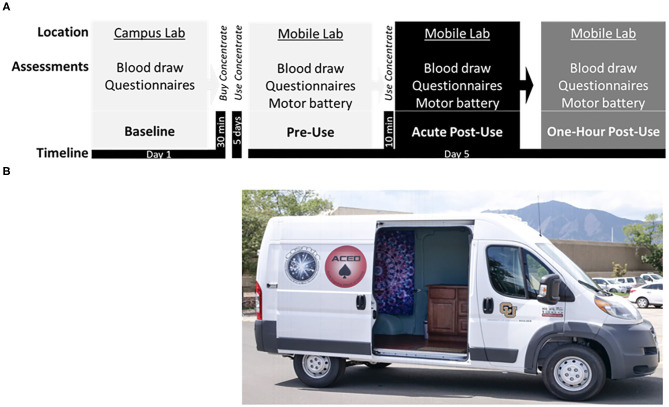
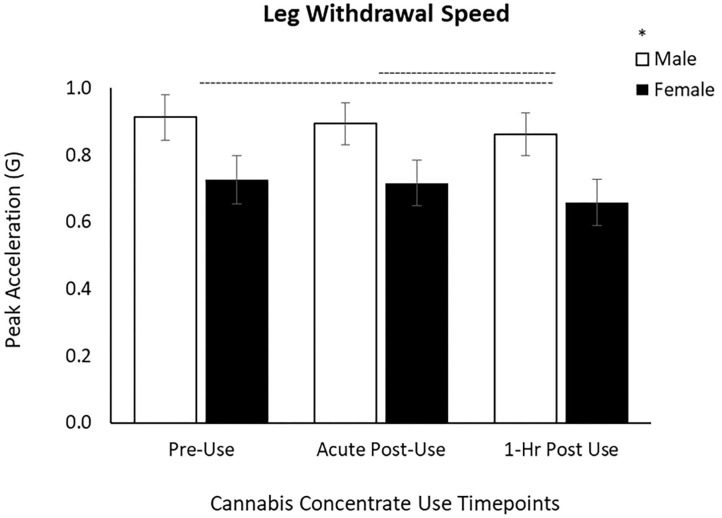
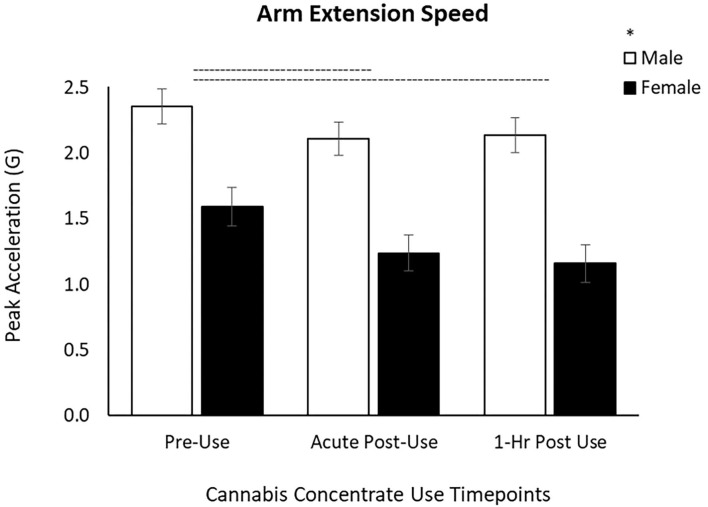
The use of cannabis concentrate is dramatically rising and sparking major safety concerns. Cannabis concentrate contains tetrahydrocannabinol (THC) potencies up to 90%, yet there has been little research on motor impairment after concentrate use (commonly referred to as "dabbing"). This study measured postural control and motor speed after the use of high potency concentrates in males and females. Experienced concentrate users ( = 65, Female: 46%, 17 ± 11 days/month of concentrate use) were assessed for motor performance in a mobile laboratory before, immediately after, and 1 h after cannabis concentrate use. Plasma levels of THC were obtained via venipuncture at each timepoint. We used a remotely deployable motor performance battery to assess arm and leg movement speed, index finger tapping rate, and balance. The sensors on a smart device (iPod Touch) attached to the participant provided quantitative measures of movement. Arm speed slowed immediately after concentrate use and remained impaired after 1 h ( < 0.001), leg speed slowed 1 h after use ( = 0.033), and balance decreased immediately after concentrate use (eyes open: = 0.017, eyes closed: = 0.013) but not at 1 h post-use. These effects were not different between sexes and there was no effect of concentrate use on finger tapping speed. Acute changes in THC plasma levels after use of concentrates were minimally correlated with acute changes in balance performance. Use of cannabis concentrates in frequent users impairs movement speed and balance similarly in men and women. The motor impairment is largely uncorrelated with the change in THC plasma levels. These results warrant further refinement of cannabis impairment testing and encourage caution related to use of cannabis concentrates in work and driving settings.
大麻浓缩物的使用正在急剧增加,并引发了重大安全担忧。大麻浓缩物含有高达90%的四氢大麻酚(THC)效力,但关于使用浓缩物(通常称为“滴吸”)后运动功能受损的研究很少。本研究测量了男性和女性使用高效力浓缩物后的姿势控制和运动速度。对有经验的浓缩物使用者(n = 65,女性:46%,每月使用浓缩物17±11天)在使用大麻浓缩物之前、之后立即以及1小时后在移动实验室中进行运动表现评估。在每个时间点通过静脉穿刺获取THC的血浆水平。我们使用了一种可远程部署的运动表现测试组合来评估手臂和腿部的运动速度、食指敲击速率以及平衡能力。附着在参与者身上的智能设备(iPod Touch)上的传感器提供了运动的定量测量。使用浓缩物后手臂速度立即减慢,1小时后仍受损(P < 0.001),腿部速度在使用后1小时减慢(P = 0.033),使用浓缩物后平衡能力立即下降(睁眼:P = 0.017,闭眼:P = 0.013),但在使用后1小时没有下降。这些影响在性别之间没有差异,并且使用浓缩物对敲击手指速度没有影响。使用浓缩物后THC血浆水平的急性变化与平衡表现的急性变化之间的相关性极小。频繁使用者使用大麻浓缩物会同样损害男性和女性的运动速度和平衡能力。运动功能受损在很大程度上与THC血浆水平的变化无关。这些结果需要进一步完善大麻损害测试,并鼓励在工作和驾驶环境中谨慎使用大麻浓缩物。