Henriquez Claudia L, Croat Thomas B, Poczai Peter, Ahmed Ibrar
Department of Biochemistry, Faculty of Biological Sciences, Quaid-i-Azam University, Islamabad, Pakistan.
Department of Ecology and Evolutionary Biology, University of California, Los Angeles, Los Angeles, CA, United States.
Front Genet. 2021 Jan 20;11:610838. doi: 10.3389/fgene.2020.610838. eCollection 2020.
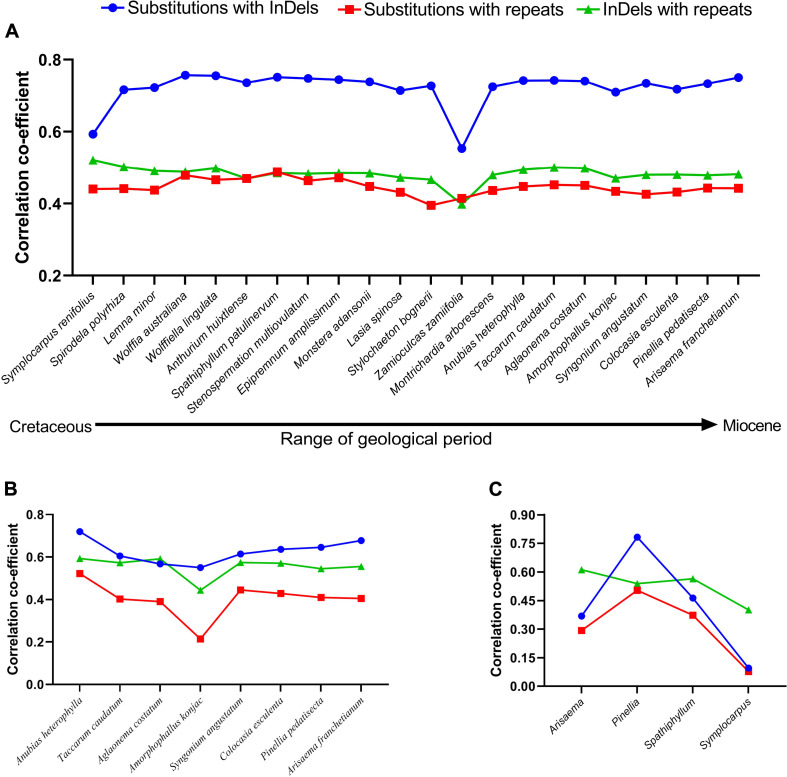
The co-occurrence among single nucleotide polymorphisms (SNPs), insertions-deletions (InDels), and oligonucleotide repeats has been reported in prokaryote, eukaryote, and chloroplast genomes. Correlations among SNPs, InDels, and repeats have been investigated in the plant family Araceae previously using pair-wise sequence alignments of the chloroplast genomes of two morphotypes of one species, belonging to subfamily Aroideae (crown group), and four species from the subfamily Lemnoideae, a basal group. The family Araceae is a large family comprising 3,645 species in 144 genera, grouped into eight subfamilies. In the current study, we performed 34 comparisons using 27 species from 7 subfamilies of Araceae to determine correlation coefficients among the mutational events at the family, subfamily, and genus levels. We express strength of the correlations as: negligible or very weak (0.10-0.19), weak (0.20-0.29), moderate (0.30-0.39), strong (0.40-0.69), very strong (0.70-0.99), and perfect (1.00). We observed strong/very strong correlations in most comparisons, whereas a few comparisons showed moderate correlations. The average correlation coefficient was recorded as 0.66 between "SNPs and InDels," 0.50 between "InDels and repeats," and 0.42 between "SNPs and repeats." In qualitative analyses, 95-100% of the repeats at family and sub-family level, while 36-86% of the repeats at genus level comparisons co-occurred with SNPs in the same bins. Our findings show that such correlations among mutational events exist throughout Araceae and support the hypothesis of distribution of oligonucleotide repeats as a proxy for mutational hotspots.
单核苷酸多态性(SNP)、插入缺失(InDel)和寡核苷酸重复序列之间的共现现象已在原核生物、真核生物和叶绿体基因组中被报道。此前,在天南星科植物中,利用属于天南星亚科(冠群)的一个物种的两种形态型以及基部类群浮萍亚科的四个物种的叶绿体基因组进行成对序列比对,研究了SNP、InDel和重复序列之间的相关性。天南星科是一个大家族,包括144个属的3645个物种,分为八个亚科。在本研究中,我们使用天南星科7个亚科的27个物种进行了34次比较,以确定在科、亚科和属水平上突变事件之间的相关系数。我们将相关性强度表示为:可忽略或非常弱(0.10 - 0.19)、弱(0.20 - 0.29)、中等(0.30 - 0.39)、强(0.40 - 0.69)、非常强(0.70 - 0.99)和完美(1.00)。我们在大多数比较中观察到强/非常强的相关性,而少数比较显示出中等相关性。“SNP和InDel”之间的平均相关系数记录为0.66,“InDel和重复序列”之间为0.50,“SNP和重复序列”之间为0.42。在定性分析中,科和亚科水平上95 - 100%的重复序列,而在属水平比较中36 - 86%的重复序列与同一区间内的SNP共现。我们的研究结果表明,这种突变事件之间的相关性存在于整个天南星科中,并支持寡核苷酸重复序列作为突变热点代理分布的假设。