Alshehri Mohammed A, Alshehri Moath M, Albalawi Naif N, Al-Ghamdi Moshari A, Al-Gayyar Mohammed M H
PharmD Program, Faculty of Pharmacy, University of Tabuk, Tabuk 71491, Saudi Arabia.
Department of Biochemistry, Faculty of Pharmacy, Mansoura University, Mansoura 35516, Egypt.
Oncol Lett. 2021 Feb;21(2):173. doi: 10.3892/ol.2021.12434. Epub 2021 Jan 4.
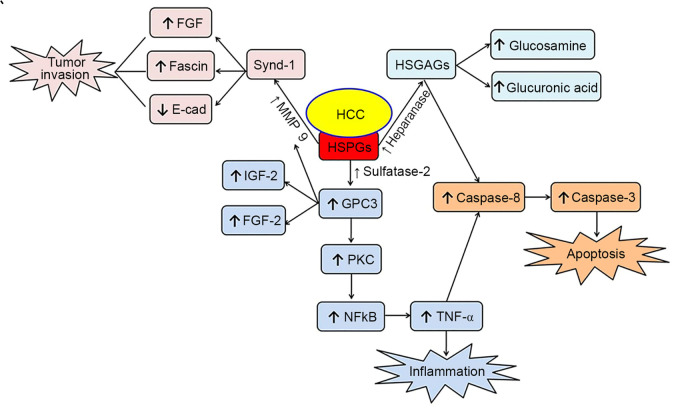
Hepatocellular carcinoma (HCC) is one of the most common types of primary liver cancer. Despite advancements in the treatment strategies of HCC, there is an urgent requirement to identify and develop novel therapeutic drugs that do not lead to resistance. These novel agents should have the potential to influence the primary mechanisms participating in the pathogenesis of HCC. Heparan sulfate proteoglycans (HSPGs) are major elements of the extracellular matrix that perform structural and signaling functions. HSPGs protect against invasion of tumor cells by preventing cell infiltration and intercellular adhesion. Several enzymes, such as heparanase, matrix metalloproteinase-9 and sulfatase-2, have been reported to affect HSPGs, leading to their degradation and thus enhancing tumor invasion. In addition, some compounds that are produced from the degradation of HSPGs, including glypican-3 and syndecan-1, enhance tumor progression. Thus, the identification of enzymes that affect HSPGs or their degradation products in HCC may lead to the development of novel therapeutic targets. The present review discusses the main enzymes and compounds associated with HSPGs, and their involvement with the pathogenicity of HCC.
肝细胞癌(HCC)是最常见的原发性肝癌类型之一。尽管HCC的治疗策略取得了进展,但迫切需要鉴定和开发不会导致耐药性的新型治疗药物。这些新型药物应具有影响参与HCC发病机制的主要机制的潜力。硫酸乙酰肝素蛋白聚糖(HSPG)是细胞外基质的主要成分,具有结构和信号传导功能。HSPG通过防止细胞浸润和细胞间粘附来防止肿瘤细胞的侵袭。据报道,几种酶,如乙酰肝素酶、基质金属蛋白酶-9和硫酸酯酶-2,会影响HSPG,导致其降解,从而增强肿瘤侵袭。此外,一些由HSPG降解产生的化合物,包括磷脂酰肌醇蛋白聚糖-3和多配体蛋白聚糖-1,会促进肿瘤进展。因此,鉴定影响HCC中HSPG或其降解产物的酶可能会导致开发新的治疗靶点。本综述讨论了与HSPG相关的主要酶和化合物,以及它们与HCC致病性的关系。