Booker Tom R, Yeaman Sam, Whitlock Michael C
Department of Forest and Conservation Sciences University of British Columbia Vancouver Canada.
Biodiversity Research Centre University of British Columbia Vancouver Canada.
Evol Lett. 2020 Dec 15;5(1):4-15. doi: 10.1002/evl3.208. eCollection 2021 Feb.
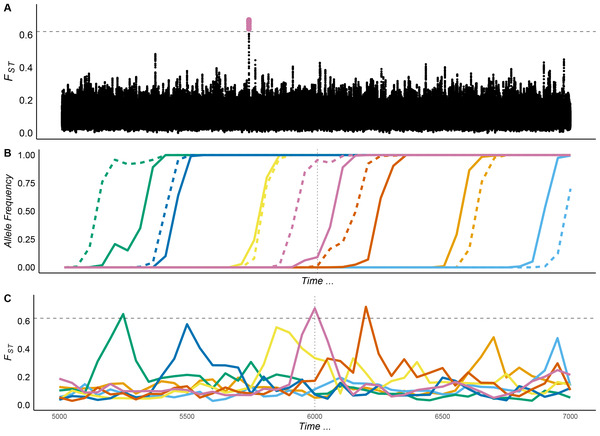
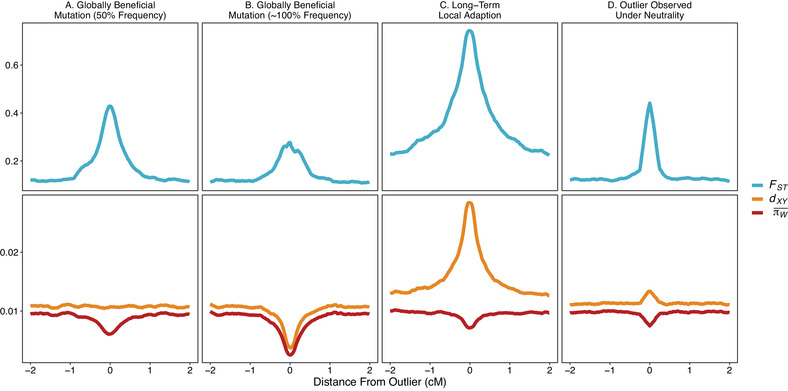
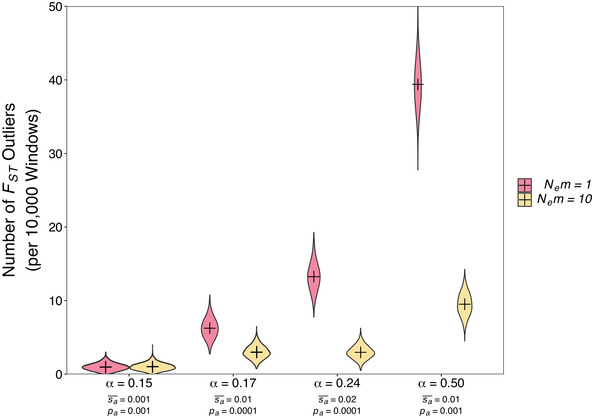
Spatially varying selection promotes variance in allele frequencies, increasing genetic differentiation between the demes of a metapopulation. For that reason, outliers in the genome-wide distribution of summary statistics measuring genetic differentiation, such as , are often interpreted as evidence for alleles that contribute to local adaptation. However, theoretical studies have shown that in spatially structured populations the spread of beneficial mutations with spatially uniform fitness effects can also induce transient genetic differentiation. In recent years, numerous empirical studies have suggested that such species-wide, or global, adaptation makes a substantial contribution to molecular evolution. In this perspective, we discuss how commonly such global adaptation may influence the genome-wide distribution of and generate genetic differentiation patterns, which could be mistaken for local adaptation. To illustrate this, we use forward-in-time population genetic simulations assuming parameters for the rate and strength of beneficial mutations consistent with estimates from natural populations. We demonstrate that the spread of globally beneficial mutations in parapatric populations may frequently generate outliers, which could be misinterpreted as evidence for local adaptation. The spread of beneficial mutations causes selective sweeps at flanking sites, so in some cases, the effects of global versus local adaptation may be distinguished by examining patterns of nucleotide diversity within and between populations in addition to . However, when local adaptation has been only recently established, it may be much more difficult to distinguish from global adaptation, due to less accumulation of linkage disequilibrium at flanking sites. Through our discussion, we conclude that a large fraction of outliers that are presumed to arise from local adaptation may instead be due to global adaptation.
空间异质性选择会促进等位基因频率的变异,增加集合种群中各亚种群间的遗传分化。因此,衡量遗传分化的汇总统计量在全基因组分布中的异常值,如 ,常被解释为有助于局部适应的等位基因的证据。然而,理论研究表明,在空间结构种群中,具有空间均匀适应度效应的有益突变的传播也会诱导瞬时遗传分化。近年来,大量实证研究表明,这种全物种范围的或全局的适应对分子进化有重大贡献。从这个角度出发,我们讨论这种全局适应可能多普遍地影响 的全基因组分布并产生遗传分化模式,而这些模式可能会被误认为是局部适应。为了说明这一点,我们使用基于时间向前推进的种群遗传模拟,假设有益突变的速率和强度参数与自然种群的估计值一致。我们证明,在邻域种群中全局有益突变的传播可能经常产生 异常值,这可能会被误解释为局部适应的证据。有益突变的传播会导致侧翼位点的选择性清除,所以在某些情况下,除了 之外,通过检查种群内部和种群之间的核苷酸多样性模式,可以区分全局适应和局部适应的影响。然而,当局部适应最近才建立时,由于侧翼位点的连锁不平衡积累较少,可能更难与全局适应区分开来。通过我们的讨论,我们得出结论,许多被认为源于局部适应的 异常值可能反而归因于全局适应。