Li Yueming, Chen Jianwei, Weng Shuping, Yan Chuan, Ye Rongping, Zhu Yuemin, Wen Liting, Cao Dairong, Hong Jinsheng
Department of Radiology, The First Affiliated Hospital of Fujian Medical University, Fuzhou, China.
Department of Radiology, Fujian Provincial Cancer Hospital, Fuzhou, China.
Ann Transl Med. 2021 Jan;9(1):55. doi: 10.21037/atm.2020.02.38.
To determine the clinical value of hepatobiliary phase (HBP) hypointensity for noninvasive diagnosis of hepatocellular carcinoma (HCC).
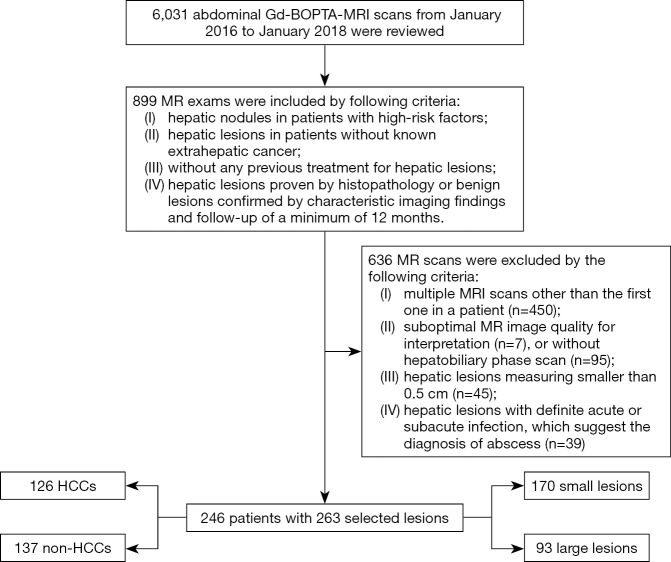
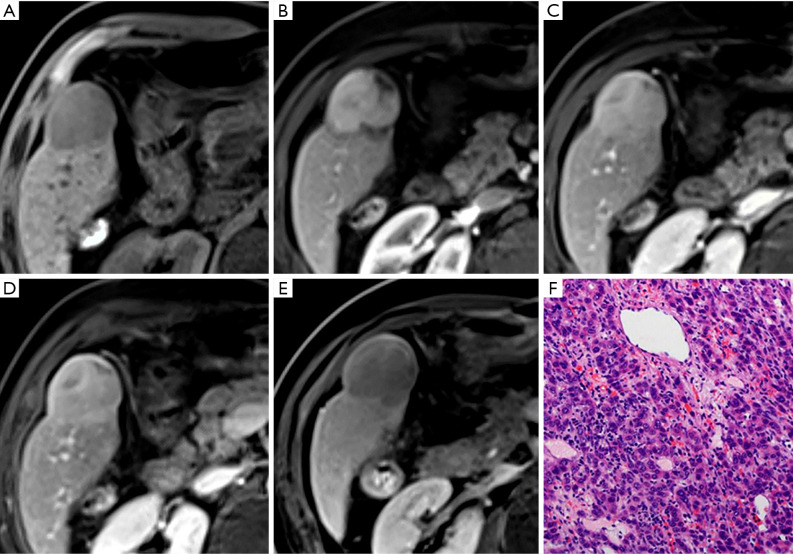
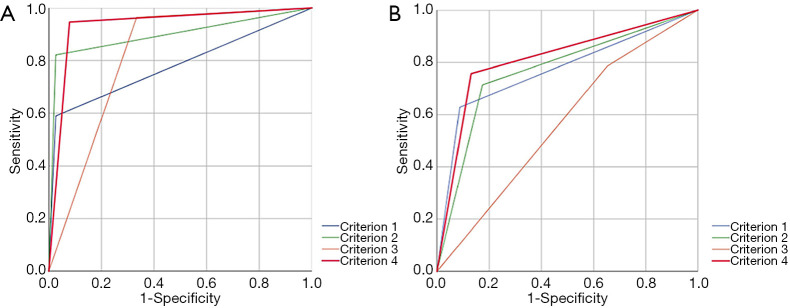
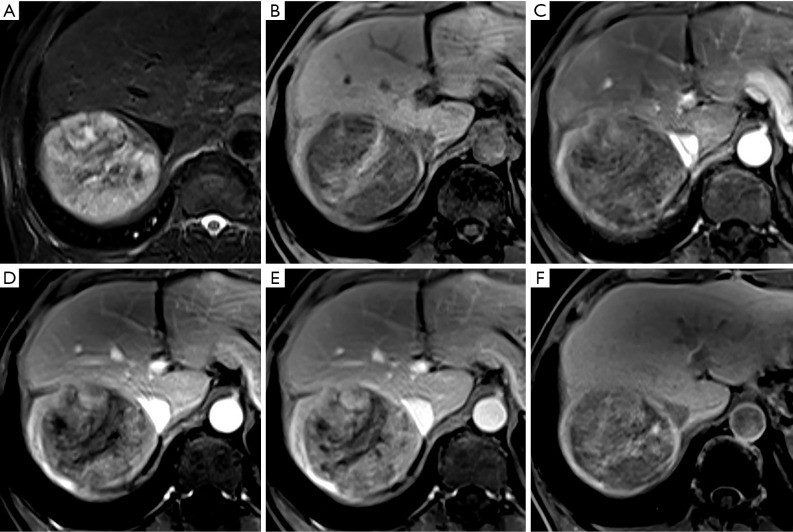
A total of 246 high-risk patients with 263 selected nodules (126 HCCs, 137 non-HCCs) undergoing gadobenate dimeglumine (Gd-BOPTA)-enhanced magnetic resonance imaging (MRI) were included in the study. Imaging-based diagnoses of small (≤3 cm) and large (>3 cm) HCCs were made using the following 4 criteria: (I) non-rim arterial phase hyper-enhancement (APHE) plus hypointensity on the portal venous phase (PVP); (II) non-rim APHE plus hypointensity on the PVP and/or transitional phase (TP); (III) non-rim APHE plus hypointensity on the PVP and/or TP and/or HBP; (IV) criterion 3 plus non-LR-1/2/M. Based on typical imaging features, LR-1, LR-2, or LR-M (if definitely benign, probably benign, malignant but not HCC specific, respectively) were defined according to the Liver Imaging Reporting and Data System (LI-RADS). Sensitivities and specificities of imaging criteria were calculated and compared using McNemar's test.
Among the diagnostic criteria for small HCCs, criterion 3 and 4, which included HBP hypointensity, showed significantly higher sensitivities (96.4% and 94.6%, respectively) than criterion 1 (58.9%, P<0.001 for both). Moreover, criterion 4, which included HBP hypointensity and ancillary features, showed significantly higher specificity (94.7%) than criterion 3 (66.7%, P<0.001) and comparable specificity to criterion 1 (97.4%, P=0.375), achieving the highest accuracies (94.7%). The diagnostic performance of criterion 4 for large HCCs was similar to that for small HCCs.
HBP hypointensity acquired from Gd-BOPTA-MRI can improve sensitivity and maintain high specificity in the diagnosis of both small and large HCCs after excluding benignities or non-HCC malignancies according to characteristic imaging features.
确定肝胆期(HBP)低信号强度在肝细胞癌(HCC)无创诊断中的临床价值。
本研究纳入了246例高危患者,其263个选定结节(126个HCC,137个非HCC)接受了钆贝葡胺(Gd-BOPTA)增强磁共振成像(MRI)检查。基于影像对小(≤3 cm)和大(>3 cm)HCC的诊断采用以下4条标准:(I)非边缘动脉期高增强(APHE)加门静脉期(PVP)低信号;(II)非边缘APHE加PVP和/或过渡期(TP)低信号;(III)非边缘APHE加PVP和/或TP和/或HBP低信号;(IV)标准3加非LR-1/2/M。根据典型影像特征,按照肝脏影像报告和数据系统(LI-RADS)分别定义为LR-1、LR-2或LR-M(分别表示肯定良性、可能良性、恶性但非HCC特异性)。计算影像标准的敏感性和特异性,并采用McNemar检验进行比较。
在小HCC的诊断标准中,包含HBP低信号的标准3和标准4的敏感性(分别为96.4%和94.6%)显著高于标准1(58.9%,两者P<0.001)。此外,包含HBP低信号和辅助特征的标准4的特异性(94.7%)显著高于标准3(66.7%,P<0.001),且与标准1的特异性(97.4%,P=0.375)相当,准确性最高(94.7%)。标准4对大HCC的诊断性能与小HCC相似。
Gd-BOPTA-MRI获得的HBP低信号强度在根据特征性影像特征排除良性病变或非HCC恶性肿瘤后,可提高小和大HCC诊断的敏感性并保持高特异性。