Bonny Tania S, Patel Eshan U, Zhu Xianming, Bloch Evan M, Grabowski M Kate, Abraham Alison G, Littlefield Kirsten, Shrestha Ruchee, Benner Sarah E, Laeyendecker Oliver, Shoham Shmuel, Sullivan David, Quinn Thomas C, Casadevall Arturo, Pekosz Andrew, Redd Andrew D, Tobian Aaron A R
Department of Pathology, Johns Hopkins School of Medicine, Baltimore, Maryland, USA.
Department of Epidemiology, Johns Hopkins Bloomberg School of Public Health, Baltimore, Maryland, USA.
Open Forum Infect Dis. 2020 Nov 26;8(2):ofaa574. doi: 10.1093/ofid/ofaa574. eCollection 2021 Feb.
The efficacy of coronavirus disease 2019 (COVID-19) convalescent plasma (CCP) is primarily ascribed as a source of neutralizing anti-severe acute respiratory syndrome coronavirus 2 (SARS-CoV-2) antibodies. However, the composition of other immune components in CCP and their potential roles remain largely unexplored. This study aimed to describe the composition and concentrations of plasma cytokines and chemokines in eligible CCP donors.
A cross-sectional study was conducted among 20 prepandemic healthy blood donors without SARS-CoV-2 infection and 140 eligible CCP donors with confirmed SARS-CoV-2 infection. Electrochemiluminescence detection-based multiplexed sandwich immunoassays were used to quantify plasma cytokine and chemokine concentrations (n = 35 analytes). A SARS-CoV-2 microneutralization assay was also performed. Differences in the percentage of detection and distribution of cytokine and chemokine concentrations were examined by categorical groups using Fisher's exact and Wilcoxon rank-sum tests, respectively.
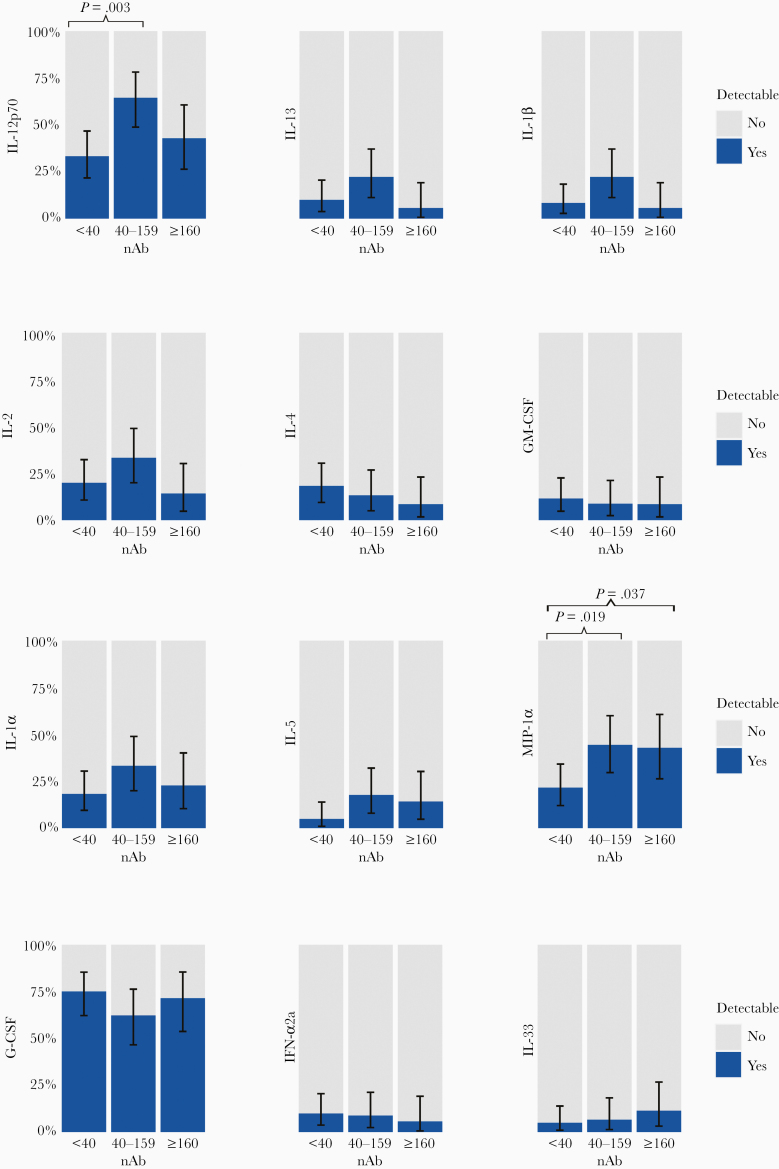
Among CCP donors (n = 140), the median time since molecular diagnosis of SARS-CoV-2 was 44 days (interquartile range = 38-50) and 9% (n = 12) were hospitalized due to COVID-19. Compared with healthy blood donor controls, CCP donors had significantly higher plasma levels of interferon (IFN)-γ, interleukin (IL)-10, IL-15, IL-21, and macrophage-inflammatory protein-1, but lower levels of IL-1RA, IL-8, IL-16, and vascular endothelial growth factor-A ( < .0014). The distributions of plasma levels of IL-8, IL-15, and IFN-inducible protein-10 were significantly higher among CCP donors with high (≥160) versus low (<40) anti-SARS-CoV-2 neutralizing antibody titers ( < .0014). The median levels of IL-6 were significantly higher among CCP donors who were hospitalized versus nonhospitalized ( < .0014).
Heterogeneity in cytokine and chemokine composition of CCP suggests there is a different inflammatory state among the CCP donors compared with SARS-CoV-2 naive, healthy blood donors.
2019冠状病毒病(COVID-19)康复期血浆(CCP)的疗效主要归因于其作为中和抗严重急性呼吸综合征冠状病毒2(SARS-CoV-2)抗体的来源。然而,CCP中其他免疫成分的组成及其潜在作用在很大程度上仍未得到探索。本研究旨在描述符合条件的CCP捐献者血浆细胞因子和趋化因子的组成及浓度。
对20名未感染SARS-CoV-2的疫情前健康献血者和140名确诊感染SARS-CoV-2的符合条件的CCP捐献者进行了一项横断面研究。基于电化学发光检测的多重夹心免疫测定法用于定量血浆细胞因子和趋化因子浓度(n = 35种分析物)。还进行了SARS-CoV-2微量中和试验。分别使用Fisher精确检验和Wilcoxon秩和检验按分类组检查细胞因子和趋化因子浓度检测百分比和分布的差异。
在CCP捐献者(n = 140)中,自SARS-CoV-2分子诊断以来的中位时间为44天(四分位间距 = 38 - 50),9%(n = 12)因COVID-19住院。与健康献血者对照相比,CCP捐献者的血浆干扰素(IFN)-γ、白细胞介素(IL)-10、IL-15、IL-21和巨噬细胞炎性蛋白-1水平显著更高,但IL-1RA、IL-8、IL-16和血管内皮生长因子-A水平更低(<0.0014)。在抗SARS-CoV-2中和抗体滴度高(≥160)与低(<40)的CCP捐献者中,IL-8、IL-15和IFN诱导蛋白-10的血浆水平分布显著更高(<0.0014)。住院的CCP捐献者中IL-6的中位水平显著高于未住院者(<0.0014)。
CCP中细胞因子和趋化因子组成的异质性表明,与未感染SARS-CoV-2的健康献血者相比,CCP捐献者存在不同的炎症状态。