Zisopoulos George, Roussi Pagona, Mouloudi Eleni
Applied Psychology Laboratory, Department of Social and Clinical Psychology, Aristotle University of Thessaloniki.
Intensive Care Unit, Ippokrateio General Hospital of Thessaloniki, Greece.
Health Psychol Res. 2020 Dec 30;8(3):8852. doi: 10.4081/hpr.2020.8852.
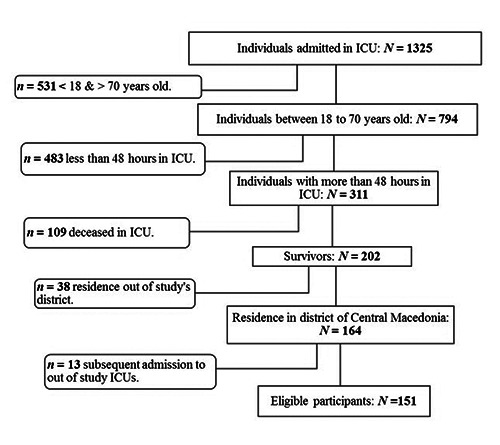
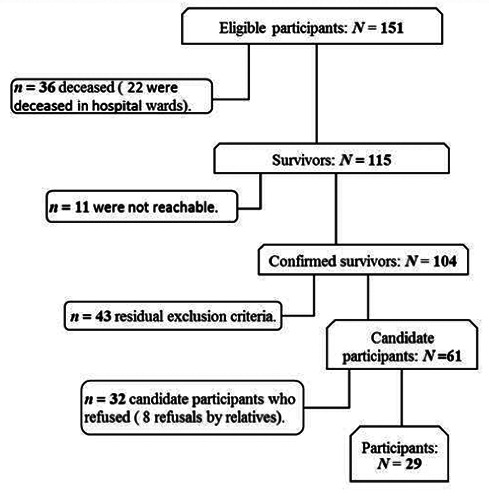
Several studies have linked treatment in the Intensive Care Unit (ICU) with negative psychological outcomes. This study explores the prevalence of negative psychological outcomes in Greek patients (=29), a year after treatment in ICU. Percentages of participants with anxiety [41%, 95% CI (22%, 60%)] and Post- Traumatic Stress Disorder (PTSD) [34%, 95% CI (16%, 53%)] symptoms were similar to the related literature. Percentages of participants with depressive [17%, 95% CI (3%, 32%)] symptoms were rather low. Only 10% of participants reported absence of quality of live issues. Anxiety symptoms were related to desire to talk about the ICU experience (=0.010), duration of propofol administration (=0.018) and loss of employment (=0.019) and negatively related to duration of stay in the ICU (=0.025). PTSD symptoms were related to experiencing other stressors during the year after the ICU stay (=0.001), social constraint (=0.003), duration of propofol administration (=0.004), loss of employment (=0.020), low income (=0.022) and negative ICU memories (=0.029). Depressive symptoms were related to loss of employment (=0.003), low income (=0.029) and social constraint (=0.033). Patients experience elevated levels of psychological symptoms long after they are discharged from the hospital. Several psychosocial factors emerged as important factors to consider for predicting levels of distress.
多项研究表明,在重症监护病房(ICU)接受治疗会产生负面心理影响。本研究探讨了希腊患者(=29例)在ICU治疗一年后出现负面心理影响的发生率。出现焦虑症状[41%,95%置信区间(22%,60%)]和创伤后应激障碍(PTSD)症状[34%,95%置信区间(16%,53%)]的参与者百分比与相关文献中的数据相似。出现抑郁症状[17%,95%置信区间(3%,32%)]的参与者百分比相对较低。只有10%的参与者表示没有生活质量问题。焦虑症状与谈论ICU经历的意愿(=0.010)、丙泊酚给药时间(=0.018)和失业(=0.019)有关,与在ICU的住院时间呈负相关(=0.025)。PTSD症状与在ICU住院后的一年内经历其他压力源(=0.001)、社会限制(=0.003)、丙泊酚给药时间(=0.004)、失业(=0.020)、低收入(=0.022)以及对ICU的负面记忆(=0.029)有关。抑郁症状与失业(=0.003)、低收入(=0.029)和社会限制(=0.033)有关。患者在出院很长时间后心理症状水平仍会升高。一些社会心理因素成为预测痛苦程度时需要考虑的重要因素。