Waseem Aadil, Johar Muhammad Ali, Hassan Mostafa Afifi, Bagal Indrajit V, Abdullah Ameer, Ha Jun-Seok, Lee June Key, Ryu Sang-Wan
Department of Physics, Chonnam National University, Gwangju 61186, Republic of Korea.
Optoelectronics Convergence Research Center, Chonnam National University, Gwangju 61186, Republic of Korea.
ACS Omega. 2021 Jan 22;6(4):3173-3185. doi: 10.1021/acsomega.0c05587. eCollection 2021 Feb 2.
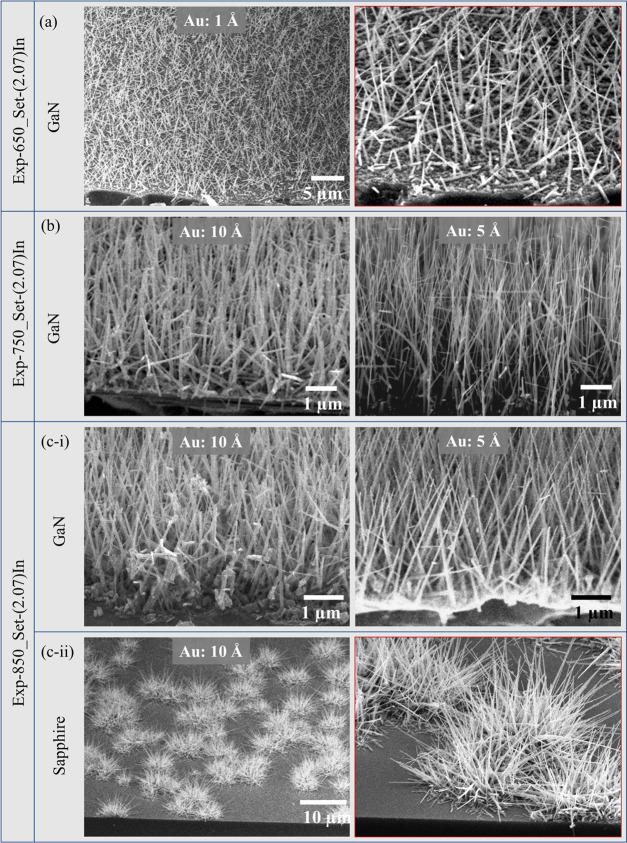
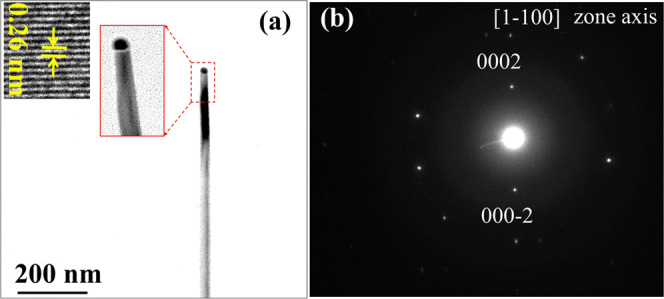
The crystallographic orientation control of GaN nanowires (NWs) has been widely investigated by varying the V-III ratio. Here, we report the tuning of crystallographic orientation of GaN NWs by varying the composition of indium (In) in gallium-gold (Ga-Au) alloy catalyst using metal-organic chemical vapor deposition (MOCVD). The c-plane GaN thin film and sapphire substrate are used as growth templates. We found that the substrates of same orientation have a negligible influence on the orientation of the GaN NWs. The catalyst composition and the dimensions of alloy droplets determine the morphology of the NWs. The density of the NWs was controlled by tuning the droplet size of the alloy catalysts. With the constant V/III ratio, the crystallographic orientation of the GaN NWs was tuned from - to -axis by increasing the In composition inside alloy catalyst.
通过改变V-III比,氮化镓纳米线(NWs)的晶体取向控制已得到广泛研究。在此,我们报告了使用金属有机化学气相沉积(MOCVD)通过改变镓金(Ga-Au)合金催化剂中铟(In)的组成来调整氮化镓纳米线的晶体取向。c面氮化镓薄膜和蓝宝石衬底用作生长模板。我们发现相同取向的衬底对氮化镓纳米线的取向影响可忽略不计。催化剂组成和合金液滴的尺寸决定了纳米线的形态。通过调整合金催化剂的液滴尺寸来控制纳米线的密度。在V/III比恒定的情况下,通过增加合金催化剂内部的铟组成,氮化镓纳米线的晶体取向从-轴调整到-轴。